 Return to the Home Page | Translate this Page
Major Earthquakes and Catastrophes in the Old Testament
Catastrophes at the Time of the End
Part Three
Translation by the New King James Version
Commentary by Robert D. Mock MD
May, 2003
Section One
Major Biblical Earthquakes in the OT
1-3 – Creation, Noah’s Flood and the Days of Jared
The Historian Manethos and the King called Tutimaeus
6 - The Volcanic Eruption of Thera (Island of Santorini) in 1625 BCE
7 - Moses Crossing the Sea of Reeds
8 - Rebellion of Korah against Moses
Earthquake and Volcano Eruptions
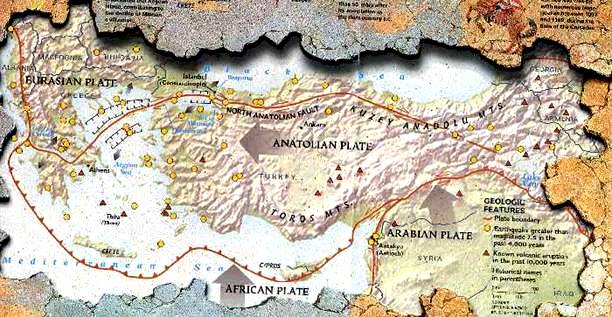
The Major Continental Plates Surrounding the Mediterranean Basin
The Land of Israel is sitting on the western edge of the Arabian Tectonic Plate as it slides north/south along the side of the African Plate, which is pushing into the Anatolian Tectonic Plate, also north and south. Yet the Anatolian Plate is sliding east and west along the Eurasian Plate. As can be imagined, this is a very unstable part of the world and the site of some of the major catastrophic disasters recorded in the history of man.
The yellow circles are areas where earthquakes greater than 7.4M have occurred in the last 4000 years and the red triangles are known volcanic sites.
IV
Book of Ezra – “Thou
didst bow down the heavens, didst make the earth quake, and convulsed
the world. Thou didst cause the deeps to tremble and didst
alarm the  spheres.” (IV Ezra (Trans. Box),
in the Apocrypha and Pseudepigraphy of the Old Testament, ed. R.H. Charles)
spheres.” (IV Ezra (Trans. Box),
in the Apocrypha and Pseudepigraphy of the Old Testament, ed. R.H. Charles)
Velikovsky on Exodus and Mount Sinai: “The earth groaned; for weeks now all its strata had been disarranged, its orbit distorted, its world quarters displaced, its oceans thrown upon its continents, its seas turned into deserts, its mountains up heaved, its islands submerged, its rivers running upstream – a world flowing with lava, shattered by meteorites, with yawning chasms, burning naphtha, vomiting volcanoes, quaking ground, a world enshrouded in an atmosphere filled with smoke and vapor.
Twisting of strata and building of mountains, earthquakes and rumbling of volcanoes joined in an infernal din. It was a voice not only in the desert of Sinai; the entire world must have heard it. “The sky and the earth resounded ….mountains and hills were moved” says the Midrash.”
Major
Biblical Earthquakes in the OT
Taken
in part by Dr. Stephen A. Austin’s works on the Institute for Creation Research
One of the quickest ways to see the handprint of the Lord of hosts with his people, the children of Israel is to look at their history of catastrophes and how they perceived the Lord becoming involved in their lives. Let us look at eighteen examples.
1. Day Three of Creation Week - the Water Rises Up
In the Book of Genesis, the record depicts that the waters over the face of the earth were collected into oceanic basins and the continents appeared.
Gen. 1:9 – “Then God said, “Let the waters under the heavens be gathered together into one place, and let the dry land appeared” and it was so. And God called the dry land Earth, and the gathering together of the waters He called Seas. And God saw that it was good.”
For the global shifts to take place with the uplifting of the continental plates and the subduction of the heavier basaltic plates, earthquakes and volcanic activity were involved in this remodeling of the surface of the earth. To the BibleSearchers, this involved the formation of a Pangaean Garden of Eden, the philosophical basis of geology
Psalms 104:5-6 – “You who laid the foundations of the earth, so that it should not be moved forever, You covered it with the deep as with a garment; the waters stood above the mountains (before Creation). At your rebuke they fled; at the voice of Your thunder they hastened away. They went up over the mountains. They went down into the valleys, to the place which You founded for them (the seas and oceans). You have set a boundary that they may not pass over, that they may not return to cover the earth.
According to scripture the angelic world was involved if nothing more than an observational and supporting role in the creation event.
Job 38:4-7 – “Where were you when I laid the foundations of the earth? Tell Me if you have understanding. Who determined its measurements? Surely you know! OR who stretched the line upon it? To what were its foundations fastened? Or who laid its cornerstone, when the morning stars sang together, and all the sons of God shouted for joy?
2. Noah's Flood
Genesis 7:11 – “In the six hundredth year of Noah’s life, in the second month, the seventeenth day of the month, on that day all the fountains of the great deep were broken up, and the windows of heaven were opened. And the rain was on the earth forty days and forty nights.”
The effect of God’s judgment in the Noachian Flood was the rupturing of the tectonic plates and the waters under the earth; the massive fountains beneath the continental crusts erupted, flooding over the surface of the earth. The flooding came from two sources, from the top down (rain) and the bottom up (rupturing of the tectonic plates). A good source to understand this process is an article by geologist and sedimentologist Art Chadwich Ph.D. called “A Creation/Flood Model”.
Noah and the Great Flood is presently on the website in a five part series under World of the Ancients. With our present understanding of the continental plate tectonics, this massive catastrophic event was caused in part by earth rending earthquakes and volcanoes.
3. The Days of Peleg
Genesis 10:25, 1 Chronicles 1:19 – To Eber were born two sons; the name of one was Peleg, for in his days the earth was divided; and his brother’s name was Joktan.
Book of Jasher 7:19 – “To Eber were born two children; the name of one was Peleg, for in his days the sons of men were divided, and in the latter days, the earth was divided. And the name of the second was Yoktan, meaning that in his day the lives of the sons of men were diminished and lessened.
Peleg was the fifth generation descendant from Noah. Of all the descendants, yet it was Peleg in which a commentary statement was made, ‘for in his days the earth was divided.” Many theologians have claimed that this statement is in reference to the division of the sons of Noah at the Fall of Babel episode, yet the scripture is clear, ‘the Earth was divided.” For BibleSearchers this is significant. A literal interpretation is always preferred unless the Lord of hosts claims that it is symbolic and especially if the symbol is interpreted.
Since the names of Hebrew, as well as most inhabitants, were significant to a specific character or event in their life, it would be interesting to note what “Jared” means in Hebrew. Strong’s Exhaustive Concordance of the Bible (#6388) states that Peleg actually means, “earthquake”. How coincidental? The clues are right in front of our eyes. Yet, Jared actually comes from a primary root word called, Palag, called paw-lag’ meaning to split or divide. Let it come at face value, earthquake, split and divide and add ‘for in his days the earth was divided, we have a major catastrophic event recorded in human history.
Comparing
the textual references from Genesis to the Book of Jasher, we see a subtle
difference and a marked contrast. In Jasher, we note, that in Jared’s
days, the sons of men
were divided and 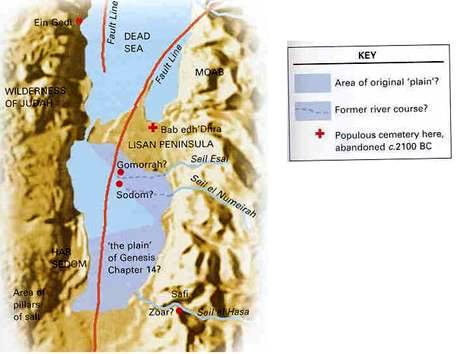 the earth was not divided until
the latter days of his life, close to his death. On the other
hand, his brother, Joktan, the upheavals resulting in the cataclysmic
changes that altered the environment around the earth resulted in
the marked diminishing of the length of the lives of his
descendants.
the earth was not divided until
the latter days of his life, close to his death. On the other
hand, his brother, Joktan, the upheavals resulting in the cataclysmic
changes that altered the environment around the earth resulted in
the marked diminishing of the length of the lives of his
descendants.
Whereas the fountains of the deep were broken up in the Flood of Noah, the one continent world, known in geological terms as Pangaea, was still intact. A human, in the days of Noah and Jared could walk from the eastern coast of China, across Eurasia, the continent of the Americas without having to cross any oceans. That’s correct; the world was one continent, Pangaea. We will be talking about this continent called Pangaea later in The Catastrophic Destruction of Pangaea.
Genesis 19:23 – “The sun had risen upon the earth when Lot entered Zoar. Then the Lord rained brimstone and fire on Sodom and Gomorrah, from the Lord out of the Heavens. So He overthrew those cities, all the plain, all the inhabitants of the cities, and what grew on the ground. But his wife looked back behind him, and she became a pillar of salt.
And Abraham went early in the morning to the place where he had stood before the Lord. Then he looked towards Sodom and Gomorrah and towards all the land of the plain and He saw, and behold, the smoke of the land which went up like the smoke of a furnace.
The catastrophe at the Vale of Siddim, the valley of the cities of the plains has every
element of a volcanic eruption, but it was much more. Unknown to Abraham, he was a living witness for only a few miles away the formation of the largest rift or fissure in the mantle of any continent on this earth was in progress, the Great Rift of Africa.
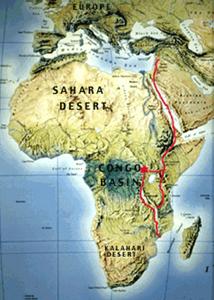
We do not know whether this rifting began at the border of Lebanon and went south or began at the southwestern coastline of Africa at Beira, on the coast Mozambique at the fracture point of where the unique island of Madagascar split off the African continent. So did this rift work up through the Red Sea to the Vail of Siddim? We do not have evidence of Abraham’s reaction or response to this event, but the proximity of where he was living; the impact of this event would have physically affected him and all of his family.
(Cross section by José F. Vigil from This Dynamic Planet -- a wall map produced jointly by the U.S. Geological Survey, the Smithsonian Institution, and the U.S. Naval Research Laboratory.)
The 4000
mile (6,400 kilometers) length
of the Great Rift Valley dwarfs the famous 780 miles of
the San Andreas rift along the California coast and maintains
an average width of 30 – 40 miles. Geologists date the rift to the
era of the Pliocene Epoch. It was caused by a deep, linear, 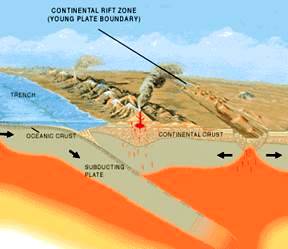 transcurrent or what is called a strike-slip
fault along the Arabian and the African Plates. Yet the geologists date
is to some 2 million to 7 million years ago.
transcurrent or what is called a strike-slip
fault along the Arabian and the African Plates. Yet the geologists date
is to some 2 million to 7 million years ago.
So what are creationists to think? If we can believe the theories of the speed of light is decaying by astrophysicist, Barry Setterfield Ph.D., then this decay is what is called the red shift in the universe since the Creation Event.
To Setterfield, the speed of light has slowed down 10 million times (10,000,000) to its present stable state of 167,000 miles per second. The issue of light-speed in the early cosmos is one that has received some attention recently in several peer-reviewed journals. Starting in December 1987, the Russian physicist V. S. Troitskii from the Radiophysical Research Institute in Gorky published a twenty-two page analysis in Astrophysics and Space Science regarding the problems cosmologists faced with the early universe. He looked at a possible solution if it was accepted that light-speed continuously decreased over the lifetime of the cosmos, and the associated atomic constants varied synchronously. He suggested that, at the origin of the cosmos, light might have traveled at 1010 times its current speed, or 1 billion times faster. He also concluded that the cosmos was static and not expanding.
Recent work by Dr. Thomas Van Flandern of the US Naval Observatory in Washington examined data from lunar laser ranging using atomic clocks, and compared their data with data from dynamical, or orbital, clocks. From this comparison of data, he concluded that
Barry Setterfield Ph.D. - "The number of atomic seconds in a dynamical interval is becoming fewer. Presumably, if the result has any generality to it, this means that atomic phenomena are slowing down with respect to dynamical phenomena" ([71]. (T. C. Van Flandern, "Is the Gravitational Constant Changing?", Precision Measurements and Fundamental Constants II, NBS (US) Special Publication 617, B. N. Taylor and W. D. Phillips eds., pp.625-627, 1984. cited by Barry Setterfield)
Dr.Van Flandern was also involved in setting the parameters for running the clocks in the Global Positioning System of satellites used for navigation around the world. When he compared his clock determinant with the dynamic standard, it showed that the atomic phenomenon was slowing up to the year of 1980. According to Setterfield, the ‘c’ decay curve apparently bottomed out around 1980 CE and may have started to increase again.
Since the speed of light is the recognized constant for Time, and affects all atomic ‘constants’ used in science since the moment of the Big Bang to this day then from the scientific evidence of the decay of the speed of light geological time has decayed from the moment of the Big Bang. Setterfield took this information and recalculated the historical story of man as recorded in the Bible. As such he was able to define a relationship between the dates of biblical historical time of the age of man and compare it with atomic or geological time.
In this instance, 2-7 millions years in geological time would be the years of Peleg and Reu, when the scripture stated that in the days of Peleg, the earth was divided. From that date the great Rift Valley division began at the time between Peleg and his son Reu about 3005-2875 BCE. The implications are that this rifting began about five generations before Abraham and finished at the time of the destruction of the Sodom and Gomorrah.
The works of Barry Setterfield Ph.D. are obviously controversial, but they do answer a question that has been plaguing short age creationists for years on how to relate to the difference between geological time and historical time. The following is a time chart on the age of the patriarchs of the Old Testament in historical and geological times.
Barry Setterfield's Old Testament Chronology
|
PATRIARCH |
Age at Birth |
Son's Birth |
Son's Birth |
Patriarch’s
Life Span |
Patriarch’s Life Span (Dates BC) |
Atomic Time BP at Patriarch's Birth |
Light Speed (times present value) |
|
Creation |
0 Adam |
0 |
5792 |
- |
- |
|
|
|
Adam |
230 Seth |
230 |
5562 |
930 |
5792-4862 |
14.8 billion |
10.6 million |
|
Seth |
205 Enos |
435 |
5357 |
912 |
5562-4650 |
12.5 billion |
|
|
Enos |
190 Cainaan |
625 |
5167 |
905 |
5357-4452 |
10.1 billion |
|
|
Cainaan |
170 Mahalaleel |
795 |
4997 |
910 |
5167-4257 |
8.96 billion |
|
|
Mahalaleel |
165 Jared |
960 |
4832 |
895 |
4997-4102 |
7.62 billion |
|
|
Jared |
162 Enoch |
1122 |
4670 |
962 |
4832-3870 |
6.42 billion |
|
|
Enoch |
165 Methusaleh |
1287 |
4505 |
365 |
4670-4305 |
5.34 billion |
|
|
Methusaleh |
187 Lamech |
1474 |
4318 |
969 |
4505-3536 |
4.35 billion |
5.8 million |
|
Lamech |
182 Noah |
1656 |
4136 |
777 |
4318-3541 |
3.35 billion |
|
|
Noah |
502 Shem |
2158 |
3634 |
950 |
4136-3186 |
2.5 billion |
4.3 million |
|
FLOOD |
Approximately 2256 years after Creation or about 3536 BC |
650 million |
2 million |
||||
|
Shem |
100 Arphaxad |
2258 |
3534 |
600 |
3634-3034 |
816 million |
|
|
Arphaxad |
135 Cainan |
2393 |
3399 |
535 |
3534-2999 |
596 million |
|
|
Cainan |
130 Salah |
2523 |
3269 |
460 |
3399-2939 |
358 million |
|
|
Salah |
130 Eber |
2653 |
3139 |
433 |
3269-2836 |
196 million |
1.1 million |
|
Eber |
134 Peleg |
2787 |
3005 |
404 |
3139-2735 |
97 million |
615,000 |
|
Peleg |
130 Reu |
2917 |
2875 |
339 |
3005-2666 |
63 million |
|
|
Reu |
132 Serug |
3049 |
2743 |
339 |
2875-2536 |
1 million |
78,000 |
|
Serug |
130 Nahor |
3179 |
2613 |
330 |
2743-2413 |
5000 |
|
|
Nahor |
179 Terah |
3358 |
2434 |
208 |
2613-2405 |
|
|
|
Terah |
130 Abram |
3488 |
2304 |
205 |
2434-2229 |
|
|
|
Abraham |
100 Isaac |
3588 |
2204 |
175 |
2304-2129 |
|
c ~ c (now) |
|
Isaac |
60 Jacob |
3648 |
2144 |
180 |
2204-2024 |
|
|
|
Jacob |
91 Joseph |
3739 |
2053 |
147 |
2144-1997 |
|
|
All along
this great rift system
from the Jordan River to southeastern Africa are evidence of deep
depressions and wall-like cliffs as it carves a deep scar
into the surface of the earth. All along this depression are relics
of extinct or dormant volcanoes, 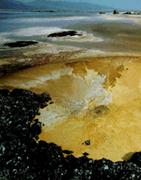 evidence of the action of three tectonic
plates moving away from each other.
evidence of the action of three tectonic
plates moving away from each other.
What we do know from Biblical records is that the Vail of Siddim was already a valley and a fresh water lake fed by the runoff of Mount Herman down the Jordan River. From there the Great Rift traverses down the Gulf of Agaba into the Red Sea and into the Danakil Depression in Ethiopia called the “Hell hole of Creation”.
In the
arena where the Great
Rift splits into a Western Rift it hosts some of the deepest lakes
in the world (up to 1,560 meters deep) and between it and the 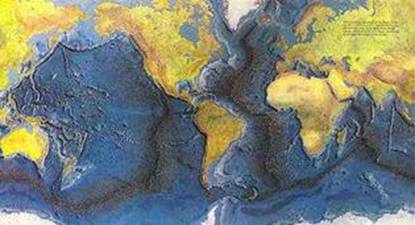 western wall is
a depression hosting the second largest inland body of water, the famous
Lake Victoria filled with up to 200 to 250 centimeter of rain per
year.
western wall is
a depression hosting the second largest inland body of water, the famous
Lake Victoria filled with up to 200 to 250 centimeter of rain per
year.
Atlantic Ridge under the Atlantic Ocean
Like the Atlantic Ridge, the Great Rift is actually part of a mid-oceanic ridge system consisting of submerged mountain ranges encircling the globe. The northern extension of the Indian Ocean ridge moves through the Red Sea over to the Mediterranean Sea and into the Atlantic Ocean. The African Rift Valley is but an extension of the Red Sea Rift encircling into the continent of Africa, while the Dead Sea and Jordan Valley rift is an extension into the Mediterranean Sea.
 The Mediterranean Sea in the days of the antediluvians
was known as the Valley or the Veil of the River of Styx, which itself
is has over 300 megalithic sites of ancient cities submerged within its
waters. The floor of the valley between the Eastern
and the Western Rifts boasts some of Africa’s most beautiful topography
of lakes, plains, deserts, volcanoes with cliffs or escarpment rising
on the edges upward to 3,000 feet from the floor of the valley
and along the margins of the rifts.
The Mediterranean Sea in the days of the antediluvians
was known as the Valley or the Veil of the River of Styx, which itself
is has over 300 megalithic sites of ancient cities submerged within its
waters. The floor of the valley between the Eastern
and the Western Rifts boasts some of Africa’s most beautiful topography
of lakes, plains, deserts, volcanoes with cliffs or escarpment rising
on the edges upward to 3,000 feet from the floor of the valley
and along the margins of the rifts.
Yet, in the Mau
Escarpment in Kenya,
the mountain ranges rise in spectacular walls as high as 9,000 feet
(2,700 meters) above the valley floor. There some of the earth’s
most majestic scenery is seen, including Mount
Kilimanjaro, Mount Kenya, and Mount Margherita.
 The
rift enters the country of Kenya,
which begins with Lake Rudolf into and proceeds through a series
of small lakes, Baringo, Bogoria, Nakuru, Elmentaita, Naivasha and Magadi into
Tanzania at Lake Natron
The
rift enters the country of Kenya,
which begins with Lake Rudolf into and proceeds through a series
of small lakes, Baringo, Bogoria, Nakuru, Elmentaita, Naivasha and Magadi into
Tanzania at Lake Natron
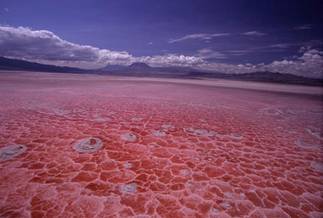
Pink Algae coloring Lake Natron in the Great Rift Valley
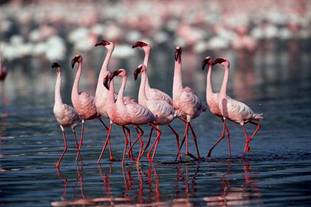
This lake is a soda lake near the Gelai Caldera in Tanzania and the home of the firebird, called the flamingo. Flamingos seem to adapt to certain lakes in order the ‘read’ the nature of the water. Due to huge underground springs, a flooded valley can be heated up to a 140 degrees which would cook a flamingo settling into its waters. These underground cauldrons are an indication of the giant lava flumes circulating under the raft. Commercially the lakes are harvested for sodium carbonate used in making paper, ceramics and glass.
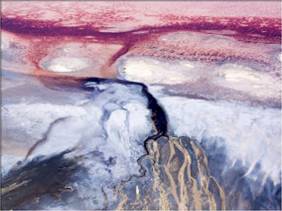 The western branch on the other hand traverses along
the borders of Uganda, Rwanda, Burundi, Tanzania, and the DR
Congo. Here the first watersheds of the famous Nile River begin,
coming from the lakes Albert, Edward, Kivu, and Tanganyika and
the Virunga-Rwenzori forest and mountain range that serve as
among the first watersheds for the Nile River.
The western branch on the other hand traverses along
the borders of Uganda, Rwanda, Burundi, Tanzania, and the DR
Congo. Here the first watersheds of the famous Nile River begin,
coming from the lakes Albert, Edward, Kivu, and Tanganyika and
the Virunga-Rwenzori forest and mountain range that serve as
among the first watersheds for the Nile River.
Dancing Colors of Saline Lake Natron Delta in the Tanzania Rift Valley
 The slipping of the plates is a continuing process.
Abraham was an early witness to this massive geological phenomenon
but the earthquakes that we will discuss later will be a continuation
of this same process. In the Jordan valley, the major fault lines
runs and is still active. The effects have left dramatic cliffs and
the continuous threat of earthquakes.
The slipping of the plates is a continuing process.
Abraham was an early witness to this massive geological phenomenon
but the earthquakes that we will discuss later will be a continuation
of this same process. In the Jordan valley, the major fault lines
runs and is still active. The effects have left dramatic cliffs and
the continuous threat of earthquakes.
Left in
the same position as
the Dead Sea, the Kenyan rift valley is the largest and deepest,
also with no outlet into the sea. Its lakes are shallow and with
the evaporation of the water, it leaves behind salts with high soda
content. Lake Magadi is almost solid soda whereas Lakes Nakuru and
Elmenteita have substantial soda flats. Yet nearby the Lakes Turkana and
Baringo have fresh underwater springs and the water stays fresh enough
to maintain a rich fish population that supports a large
variety of bird, fish and plant life.
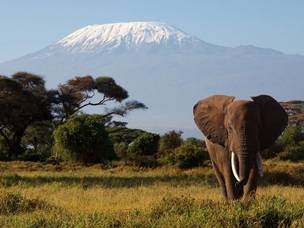
Even today there is still some seismic activity. The major and most
dramatic mountains are volcanic in origin such as Mt.
Kilimanjaro, Mt. Kenya (which was once higher than Mt. 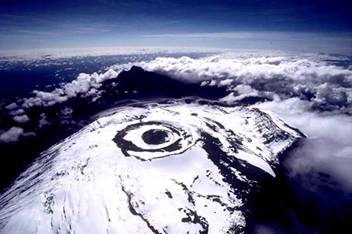 Kilimanjaro, which is geologically younger),
Mt. Meru, Mt. Elgon, the Virunga Volcanoes and the Crater
Highlands. In Virunga, Zaire in 1979, the world witnessed this
eruption.
Kilimanjaro, which is geologically younger),
Mt. Meru, Mt. Elgon, the Virunga Volcanoes and the Crater
Highlands. In Virunga, Zaire in 1979, the world witnessed this
eruption.
Aerial view of Mount Kilimanjaro in Kenya at the base of the Great Rift Valley
Some
scientist are saying today
that we are still seeing the formation of what will eventually be
another sea, such as the Atlantic, in which the rifting
causing the separation of the African and the Arabian tectonic plates
will eventually be torn away 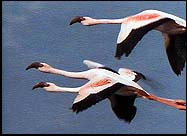 and the Indian Ocean will flood
away making the easternmost corner of Africa, called the Horn of
Africa, a large island.
and the Indian Ocean will flood
away making the easternmost corner of Africa, called the Horn of
Africa, a large island.
In 1978, just before the Virunga, Zaire volcano, scientists noted the formation of volcanic cones along the inlet called Ghoubet Kharab, "the devil's throat," in Djibouti. Here we see the same formations noted at the bottom of the Atlantic Rift, called seamounts.
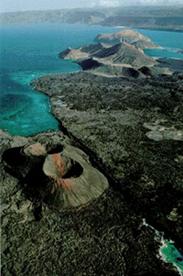 So the process
of faulting, contracting upheavals,
valley formation, warping lava plumes erupting through the earth’s
crust still occur to this day. Yet in the land of Abraham, the evidence
shows that the geologically youngest rocks are found in the Rift
Valley. These include soft siltstones, mudstones which have replaced
the extensive valley of beautiful lake once upon a time called the Valley
of Siddim and the home of Lot, the nephew of Abraham.
So the process
of faulting, contracting upheavals,
valley formation, warping lava plumes erupting through the earth’s
crust still occur to this day. Yet in the land of Abraham, the evidence
shows that the geologically youngest rocks are found in the Rift
Valley. These include soft siltstones, mudstones which have replaced
the extensive valley of beautiful lake once upon a time called the Valley
of Siddim and the home of Lot, the nephew of Abraham.
Recently scientists have been watching the molten core at the center of the earth. This core is as hot as the sun and the magma convection currents rise and fall from the core to the earth’s crust much like a lava lamp.
Seamounts at Ghoubet Kharab “The Devil’s Throat” in Djibouti
What is known is that the core of the earth, smaller than the crust of the earth spins at a faster rate. This spinning will cause the soft magma to twist and spiral and feeds like an electric generator. The reason: the twisting and spiraling of the magma rising from the molten iron core acts like an electric dynamo resembling the copper wire winding in an electric generator. Mega voltages of electric currents flow up to the surface of the earth between the positive and the negative poles. As such the magnetic field surrounding the earth is produced by the electric current flowing upwards from the molten core within this planet. Recent evidence of hot spots within the Pacific Ocean which are causing the El Nino and the El Nina planetary weather changes are a result of this dynamic process in the center of the earth.
In the midst of the 16th century BCE, during one of the greatest volcanic explosions known to mankind, a group of slaves escaped from their masters in Egypt and changed forever the words called “reclamation, redemption, and restoration”.
 Moshe (Moses), the heir
apparent to the throne of Egypt was born about 1665 BCE and fled
Egypt in 1625 BCE, only to return at the age of 80 years, about
1585 BCE.
Moshe (Moses), the heir
apparent to the throne of Egypt was born about 1665 BCE and fled
Egypt in 1625 BCE, only to return at the age of 80 years, about
1585 BCE.
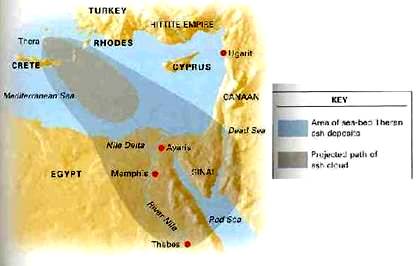
The Eruption of Thera and the Volcanic Ash spreading over the Nile Delta at the time of the Exodus
It was here that Moses led his people, the children of Jacob, out of the land of Egypt. He set them marching towards their Promise Land, the land of Canaan. This was close to the time of the 13th dynasty in the Middle Kingdom and just prior to the chaos in the land when the Hyksos invaders took over the land of the Nile River.
The plagues as recorded in Exodus record a phenomenon that eventually wrecked the economy and military power of Egypt, wiping out the 13th dynasty and allowing foreign rule to take over the land of Egypt.
In the archives in Leiden, Netherlands, a papyrus document called the Ipuwer Papyrus gives what appears to be an Egyptian account of the Hebrew Exodus. Let us look at a comparison of this amazing papyrus and the Exodus account of Moses and the children of Israel leaving Egypt.
The Papyrus Ipuwer The Hebrew Exodus prior to the
And the Exodus Events arrival of the Amalekites
|
2:5-6 |
"Plague is throughout the land. Blood is everywhere." 'The nomes are laid waste: a foreign tribe from abroad has come into Egypt.' |
7:21 |
"... there is blood throughout all the land of Egypt." |
|
2:13 |
"He who places his brother in the ground is everywhere." |
12:30 |
"... there was not a house where there was not one dead. ... there was a great cry in Egypt." |
|
3:1 |
"Forsooth, the desert is throughout the land. The nomes are laid waste. A foreign tribe from abroad has come to Egypt." |
|
|
|
3:10-13 |
"That is our water! That is our happiness! What shall we do in respect thereof? All is ruin." |
7:21 |
"... and the river stank." |
|
3:14 |
"It is groaning that is throughout the land, mingled with lamentations." |
12:12 |
"... this night ... against all the gods of Egypt I will execute judgment." |
|
4:4 |
"Forsooth, those who were in the place of embalmment are laid on the high ground." |
12:29 |
"And it came to pass, that at midnight the Lord smote all the firstborn in the land of Egypt, from the first born of Pharaoh that sat on his throne unto the first born of the captive that was in the dungeon." |
|
4:14 |
"Trees are destroyed. ... Years of noise [hrw]. There is no end to noise." |
|
|
|
5:5 |
"All animals, their hearts weep. Cattle moan ..." |
9:3 |
"... the hand of the Lord is upon thy cattle which is in the field ... there shall be a grievous moraine." |
|
|
|
9:19 |
"... gather thy cattle and all that thou hast in the field ..." |
|
5:12 |
"Forsooth, that has perished which yesterday was seen. The land is left over to its weariness like the cutting of flax." |
|
|
|
5:14f |
"Would that there might be an end of men, no conception, no birth! Oh, that the earth would cease from noise and tumult be no more!" |
|
|
|
6:1 |
"No fruits nor herbs are found. ... hunger. ... Oh, that the earth would cease from noise, and tumult (uproar) be no more." |
9:25 |
"... and the hail smote every herb of the field, and brake every tree of the field." |
|
|
|
9:23-24 |
"... the fire ran along upon the ground. ... there was hail, and fire mingled with the hail, very grievous." |
|
|
|
9:31-32 |
"... the flax and the barley was smitten: for the barley was in the ear, and the flax was boiled. But the wheat and the rye were not smitten: for they were not grown up." |
|
7:1 |
"Behold, the fire has mounted up on high. Its burning goes forth against the enemies of the land. ... weep ... the earth is ... on every side ... weep." |
|
|
|
7:4 |
"The residence is overturned in a minute." |
|
|
|
7:20 |
"...all the waters that were in the river were turned to blood." |
|
|
|
7:21 |
"... there was blood throughout all the land of Egypt. ... and the river stank." |
|
|
|
8:14 |
"Behold, the chiefs of the land flee." |
|
|
|
9:11 |
"The land is not light ... " |
10:22 |
"... and there was a thick darkness in all the land of Egypt." |
|
10:2 |
"Men flee ... Tents are what they make like the dwellers of the hills ..." (Israelites fled and became tent dwellers) |
|
|
10:3-6 |
"Lower Egypt weeps. ... The entire palace is without its revenues. To it belong (by right) wheat and barley, geese and fish. The storehouse of the king is the common property of everyone." |
10:15 |
"... and there remained not any green thing in
the trees, or in the herbs of the fields, through all the
land of Egypt." |
|
12:6ff |
"Today fear ... more than a million of people. Not seen ... enemies ... enter into the temples ... weep." (Is this an Egyptian estimate of the number of fleeing Israelites?)
|
|
|
|
14:11 |
Men ... They have come to an end for themselves. There are none found to stand and protect themselves." |
|
|
|
15:1 |
"What has happened? ... through it is to cause the Asiatics to know the condition of the land." |
|
So how did the Israelites accumulate their immense wealth? According to Ipuwer, the children of Israel had common access to all the stored wealth of gold and jewels and all the relics of veneration in the temple of Egypt at their disposal.
The Papyrus Ipuwer 10:3 - 'The storehouse of the king is the common property of everyone'
The Historian Manethos and the King called Tutimaeus
It was the Egyptian historian called Manethos, who called the plagues “A blast of heavenly displeasure….. We had a king called Tutimaeus. In his reign it happened. I do not know why God was displeased with us. Then unexpectedly from the regions of the East, came men of unknown race. Confident of victory they marched against our land. By force they took it, easily, without a single battle. (Keller, W, The Bible as History, p. 101)
Here at this historic junction, Egypt was entirely defenseless. Forty years prior they had conquered Nubia. Now with the armies of Egypt at the bottom of the Red Sea, the pharaoh and the mighty men of Egypt rested. Whereas Egypt was overtaken by foreigners, it was truly Acts of God which destroyed the entire land.
6. The Volcanic Eruption of Thera (Island of Santorini) in 1625 BCE
Devastation in the Mediterranean
On August 26, 1883, the world witnessed the largest volcanic explosion in modern times on the Island of Krakatoa near Java and Sumatra. Here are a few accounts of this massive explosion.
"Krakatoa erupted noisily. It could be heard as much as 3,000 miles away on Rodrigues Island in the Indian Ocean. Vibrations shattered shop windows 80 miles off. The energy; released in the main explosion has been estimated to be equivalent to an explosion of 150 megatons of TNT."
"Ships navigating the seas in the vicinity of Krakatoa reported that floating pumice in some places had formed a layer about 3 m thick. Other shops, 160 miles off, reported that they were covered with dust three days after the end of the eruption. In fact the dust cloud completely shrouded the area, so that it was dark even 257 miles away from the epicenter.
The period of darkness lasted twenty-four hours in places 130 miles distant and fifty-seven hours 50 miles away. The black-out in the immediate vicinity continued for three days and was so total that not even lamp-light could penetrate it. Stunningly beautiful sunsets were observed during the winter months in both American and Europe, thanks to the suspension of fine particles of dust in the atmosphere." (Christos G. Doumas Thera - Pompeii of the Ancient Aegean, p. 141)
"Two titanic volcanic explosions occurred in the Mediterranean in the fifteenth century BC, one on Mount Vesuvius and the other on the island of Thera near Crete. Each dwarfed the great explosion of the Krakatoa Volcano in 1883." (Robert Jastrow, "Hero or Heretic?” Science Digest, Sep/Oct '80)
"Descriptions of the Krakatoa explosion convey a sense of the horror that must have gripped the people who witnessed the earlier and more violent eruptions in the Mediterranean:
'A tremendous roar, heard over two thousand miles away'
'Vibrations
of the atmosphere circling the earth'
'Ninety-foot waves breaking with devastating force'
'Burning
ashes raining down,
blistering and killing
people'."
(Robert
Jastrow, "Hero or Heretic?" Science Digest, Sep/Oct '80)
"Estimates of the volume of material displaced by the Thera eruption indicated intensity five or six times as great as that of Krakatoa..." (Dr. Floyd McCoy, in Ground Truth, Earthwatch Research Report)

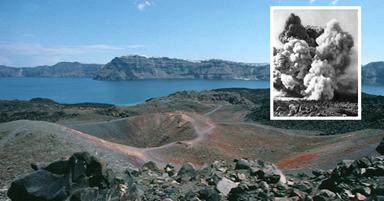
The Thera eruption on the Island of Santorini
In the
fifteenth century another famous volcano exploded, this one on the Island of Santorini,
called Thera.
Today this island is
a remnant of its former glory with a sunken crater in the center. Yet
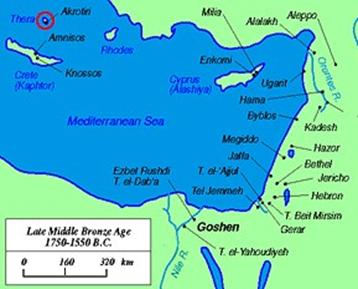
the archeological evidence depicts that this volcanic explosion 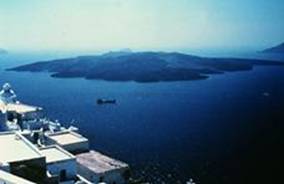 swept southeast from the Aegean Sea, across the
Mediterranean to the coast of Egypt, Sinai, southern Canaan and into
Arabia.
swept southeast from the Aegean Sea, across the
Mediterranean to the coast of Egypt, Sinai, southern Canaan and into
Arabia.
According to the VCI, the volcanic index (VEI), as recognized in the Journal of Geophysical Research 87, 1231-1238, a volcano is estimated as to the explosive magnitude for historical volcanism. A category 6 volcano is one of ‘colossal’ measurements with plumes of magma erupting into the stratosphere for over 10 miles (25 km), and a displacement volume of between 10 and 100 ks km. Both Krakatoa and Thera were rated at a VCI of 6.
The Thera eruption occurred according to the dating of pottery in the fifteenth century time frame, or well within the traditional dates of 1450 BCE for the Exodus of the Israelites from Egypt. On the other hand, dendrochronology and radiocarbon dating supports the historical record yet placing a little later at 1628/7 B.C.E. Revised chronology according to Barry Setterfield suggest that the Exodus was dated at 1575 BCE.
Classical literature leaves the following tale of the great explosion of Thera.
"About 7 cubic miles (30 cubic km) of rhyodacite magma was erupted. The plinian column during the initial phase of the eruption was about >23 miles (36 km) high." (Santorini, Greece)
"The ejection of huge masses of material created an enormous chamber under the earth's crust, and eventually the roof of this magma chamber must have fractured and collapsed." (Christos G. Doumas Thera - Pompeii of the Ancient Aegean, p. 137)
"The caldera (or crater) created by this eruption of the Stroggilí volcano on Thera (now known as Santorini) is said to have measured as much as 83 square kilometers in area. It presently extends down as much as 480 meters below sea level inside of the wall of cliffs which ring it and which themselves rise up as much as 300 meters above sea level. (Encyclopedia Britannica)
"The sea poured into this enormous void through fractures in the ring of land, in the northwest and southwest of the island. If the chamber collapse was sudden, the flow of water must have generated tidal waves to the north and southwest." (Christos G. Doumas Thera - Pompeii of the Ancient Aegean, p. 137-138)
 "Knossos [the Minoan capital] was
shattered by a
succession of earthquakes that preceded or accompanied the eruption, while great waves resulting
from it appear to have damaged settlements along the northern coast of
Crete." (Encyclopedia
Britannica)
"Knossos [the Minoan capital] was
shattered by a
succession of earthquakes that preceded or accompanied the eruption, while great waves resulting
from it appear to have damaged settlements along the northern coast of
Crete." (Encyclopedia
Britannica)
The Eruption of Thera on the Island of Santorini
"On the west coast of Turkey, just north of the island of Rhodes*, is a small body of water whose shoreline is like an ever-narrowing funnel. Its open mouth faces west, toward Thera, and anyone living behind that mouth might just as well have been a flea located in the throat of a cannon. As the shock wave surged east between increasingly confined shorelines, the waters piles higher and higher until at last they became a foaming white mountain eight hundred feet tall.
The wave penetrated thirty miles inland, in the general direction of Mount Ararat; and when it receded, it dislodged house-sized boulders, scoured the soil and carved out channeled scablands. Elsewhere, on a strip of Turkish coast only ninety miles north of the funnel, the wave seems to have risen barely twenty feet high. Tsunamis are like that - capricious." (Charles Pellegrino, Unearthing Atlantis (1991) p. 87)
It was the Greek playwright who wrote sometime between 480-406 BCE.
"Where local lore has it that a city called Cyrbe
Was ‘swallowed up by a great flood-tide’.”
“There came a sound, as if from within the Earth
Zeus'
hollow thunder boomed, awful to
hear.
The
horses lifted heads towards the
sky
And pricked their ears; while strange fear fell on us,
Whence came the voice. To the sea-beaten shore
We looked, and saw a monstrous wave that soared
Into the sky, so lofty that my eyes
Were robbed of seeing the Scironian cliffs.
It
hid the isthmus and Asclepius'
rock.
Then seething up and bubbling all about
With foaming flood and breath from the deep sea,
Shoreward it came to where the chariot stood."
- Euripides, The Hippolytus
 "According to the oral tradition handed to
Euripides [who lived on the west Aegean between 480 and 405 B.C.], a
wall of water heaved up from the deep, into a sky as clear as glass.
"According to the oral tradition handed to
Euripides [who lived on the west Aegean between 480 and 405 B.C.], a
wall of water heaved up from the deep, into a sky as clear as glass.
The Middle Bronze Age and the Eruption of Thera
This is precisely what one would expect if the poet had recorded the memory of Bronze Age Tsunamis in the western Aegean, which was spared the added calamity of Thera's death cloud." (Charles Pellegrino, Unearthing Atlantis (1991) p. 89)
"Later Greek traditions, such as the story of Deucalion's flood, may enshrine a memory of similar waves that swept the coasts of the mainland at this time. (Encyclopedia Britannica)
So here we have ‘the rest of the story” behind the great escape led by Moses, the former heir apparent to the throne of Egypt. Any re-interpretation of this event must be in light of the cosmic, atmospheric and catastrophic tectonic changes with earthquakes and volcanoes in the land of Egypt.
7. Moses Crossing the Sea of Reeds
Exodus 14: 2-3 - “Speak (Moses) to the children of Israel, that they turn and camp before Pi Hahiroth, between Migdol and the sea, opposite Baal Zephon; you shall camp before it by the sea. For Pharaoh will say of the children of Israel, they are bewildered by the land; the wilderness has closed them in.
Psalms 77:18 -20 – “The clouds poured out water; the skies sent out a sound; your arrows also flashed about. The voice of Your thunder was in the whirlwind; the lightnings lit up the world; the earth trembled and shook. Your way was in the sea, Your path in the great water, and Your footsteps were not known, You led Your people like a flock by the hand of Moses and Aaron.
The Mediterranean Sea route to the Promised Land by the “Way of the Sea”
In light of our current knowledge about the Exodus and its possible relationship with the volcanic eruption on the island of Thera or Santorini, we know by now that earthquakes and volcanoes simultaneously occur in these earth shaking events. And so, the Exodus escape would be ranked as one of the major earthquakes in Biblical history.
The fear of the people of Israel was in part due to the post-traumatic stress syndrome that occurred in the land of Egypt, and this journey is capture is this memorable Psalm.
Psalms 23:1, 4 – The Lord is my shepherd; I shall not want….Yea, though I walk through the valley of the shadow of death, I will fear no evil; for You are with me; Your rod and Your staff, they comfort me.”
This is also a psalm for the end of times, for those, the remnant, who will be participants in the Greater Exodus either as members in the final millennial kingdom with Yahshua reigning as King of kings and Lord of lords with an iron rod in His mouth, or those saints who will be spiritually raptured into another dimensional state at the revealing of the Messiah.
8. Mount Sinai, The Mount of the Lord
Mount Sinai as the flaming Volcano
Deuteronomy 4:11 – “The mountain burned with fire unto the midst of heaven, with darkness, clouds, and thick darkness.”
Great Shaking of the Mountain
Exodus 19:16-21 - “Then it came to pass on the third day, in the morning, that there were thunderings and lightnings, and a thick cloud on the mountain; and the sound of the trumpet was very loud, so that all the people who were in the camp trembled.
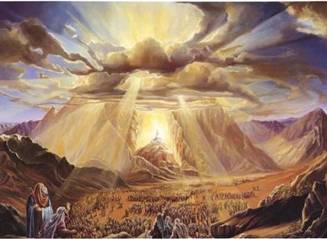
The Children of Israel at Mount Sinai
And Moses brought the people out of the camp to meet with God, and they stood at the foot of the mountain. Now Mount Sinai was completely in smoke, because the Lord descended upon it in fire. Its smoke ascended like the smoke of a furnace, and the whole mountain quaked greatly. “And when the blast of the trumpet sounded long and became louder and louder, Moses spoke, and G-d answered him by voice.”
Using Imagery of Mount Sinai
 Isaiah 29:6
– “You will be punished by the Lord of hosts with thunder and
earthquake and great noise, with storm and tempest and the flame
of devouring fire.”
Isaiah 29:6
– “You will be punished by the Lord of hosts with thunder and
earthquake and great noise, with storm and tempest and the flame
of devouring fire.”
Psalms 114: 1-7 – “When Israel went out of Egypt,
the house of Jacob from a people of strange language.
Judah became His sanctuary, and Israel His dominion.
The sea saw it and fled; Jordan turned back.
The mountains skipped like rams, the little hills like lambs.
What ails you, O sea, that you fled?
O Jordan, that you turned back?
Tremble, O earth, at the presence of the Lord,
At the presence of the G-d of Jacob,
Who turned the rock into a pool of water,
The flint into a fountain of waters.
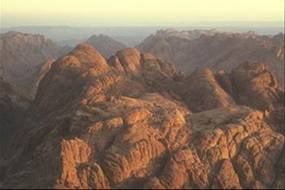 The
controversy over the journey
of the Israelites to the Mountain of the L-rd and the real site of Mount Sinai
began way back in 1873, when Charles Beke suggested that the Mount
Sinai was a volcano in the Arabian Desert. (Beke, Mount Sinai, a
Volcano (1873), cited by Velikovsky, 107)
The
controversy over the journey
of the Israelites to the Mountain of the L-rd and the real site of Mount Sinai
began way back in 1873, when Charles Beke suggested that the Mount
Sinai was a volcano in the Arabian Desert. (Beke, Mount Sinai, a
Volcano (1873), cited by Velikovsky, 107)
The Traditional Site of Sinai in the Sinai Desert.
This claim was rejected by Beke’s contemporaries and even later by himself. (The Late Dr. Charles Beke’s Discoveries of Sinai in Arabia and of Midian (1878), pp 436, 561 cited by Velikovsky ibid) Scholars today are not so sure and multiple sites have been proposed, yet most look for a site among the volcanoes in the region of Mount Seir.
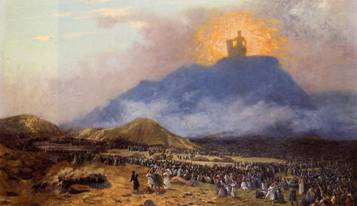 Yet the entire Sinai Peninsula is covered with basaltic formation of
ancient volcanic eruptions. All the way from Palmyra into
the depths of Arabia at Mecca, lava formations and extinct volcano
tops are noted.
Yet the entire Sinai Peninsula is covered with basaltic formation of
ancient volcanic eruptions. All the way from Palmyra into
the depths of Arabia at Mecca, lava formations and extinct volcano
tops are noted.
“Moses on Mount Sinai 1895-1900 – Artist Jean-Leon Gerome (1824-1904); Private Collection
According to the biblical story, there elapsed almost two months from the time of the Exodus until the time when the divine revelations of the Torah were given from the mount. The Talmud and the Midrashim describe the Mount ‘as quaking so greatly that it appeared as if it were lifted up and shaken above the heads of the people; and the people felt as if they were no longer standing securely on the ground, but were held up by some invisible force. The presence of a heavenly body overhead caused this phenomenon and this feeling.” (Velikovsky 108)
The violent forces of nature are seen vividly in the Samuelic picture is also recorded in Psalms 18:7-15.
2 Sam 22:8-18 – “Then the earth shook and trembled (earthquakes); The foundations of heaven quaked (celestial quakes) and were shaken, because He was angry. Smoke went up from His nostrils (volcanic eruptions), and devouring fire from His mouth; coals were kindled by it.
He bowed the heavens (warping space and time) also, and came down with darkness under His feet. He rode upon a cherub (the flying vehicle in which four cherubim carried the throne of God), and flew; and He was seen upon the wings of the wind; He made darkness canopies around Him, dark waters and thick clouds of the skies from the brightness before Him coals of fire (coals always were burning under the throne of God) were kindled.
The Lord thundered from heaven, and the Most High uttered His voice; He sent out arrows (bolides of fire) and scattered them (meteor showers); lightning bolts (celestial lightning), and He vanquished them. The channels of the sea were seen (oceanic rift systems), the foundations (continental tectonic plates) of the world were uncovered.
A celestial visitor was suggested by the text of the Tractate Shabbat, which said, “although the ancestors of the later proselytes were not present at the Mountain of the Lawgiving, their star was there close by.” (The Babylonian Talmud, Tractate Shabbat, 146a.cited by Velikovsky 109) Also the Midrash Shir, 15a-15b states that the pharaoh warned the Israelites not to leave Egypt, because they would meet the bloody star Ra” (meaning ‘evil’ in Hebrew) (Velikovsky, Immanuel, Worlds in Collision, pg. 109)
The Alexandrian philosopher Philo is credited with the following statement about the commotions of earth and in the heavens.
Philo of Alexandria - “The mountain (Sinai) burned with fire and the earth shook and the hills were removed and the mountains overthrown; the depths boils, and all the inhabitable places were shaken…and flames of fire shone forth and thunderings and lightnings were multiplied, and winds and tempests made a roaring: the stars were gathered together (collided). (The Biblical Antiquities of Philo (trans M.R.James, 1917), Chap XI)
It was Pseudo-Philo who stated;
Pseudo-Philo – “the Lord ‘impeded the course of the stars” and “the earth was stirred from her foundation, and the mountains and the rocks trembled in their fastenings, and the clouds lifted up their waves against the flame of the fire that it should not consume the world…and all the waves of the sea came together.”
It was the Hindu traditions depicting a cosmic catastrophe claim;
Hindu tradition – “The whole world breaks into flames. So also a hundred thousand times ten million worlds. At the peaks of Mount Sineru, even those which are hundreds of leagues in height, crumble and disappear in the sky. The flames of fire rise up and envelop the heaven.” (Warren, Buddhism, 323 cited by Velikovsky, Immanuel, Worlds in Collision pg.110)
The sixth sun or sun age had ended in the Hindu tradition, yet in the Jewish tradition as written by the Midrash Rabba, Bereshit, it states that with the revelation at Mount Sinai, the sixth world age was terminated and the seventh began.” (Velikovsky, Immanuel, Worlds in Collision, pg. 110)
At this moment the celestial cacophony roared throughout the entire world. The giving of Torah was not an event given to a small sect of people in a hidden and secret convocation. According to Hebrew tradition, all the nations heard the giving of the Decalogue. At the Mount, the sound that ‘sounded long’ rose ten times and in the roar the words of the Ten Commandments were given. All the inhabitants of the world heard the Lord of Hosts roar through the celestial spheres,
Thou shalt not kill Lo tirzah
Thou shalt not commit adultery Lo tin’af
Thou shalt not steal Lo tignov
According to the Babylonian Talmud in the Tractate Shabbat 88b,
Tractate Shabbat 88b - “These words were not heard by Israel alone, but by the inhabitants of all the earth. The Divine voice divided itself into the seventy tongues of men, so that all might understand it. …The souls of the heathen almost fled from them when they heard it.” (Ginzberg, Legends, III, 97)
The earthquakes that accompanied the Mount Sinai experience produced an incessant noise and groaning as the continental plates rocked and swayed, grinding against each other. These groanings and deep sighing sounds were attributed by the ancients to the gods and called ‘theophany”.
The eruption of the volcano at Krakatoa in the East Indies in 1883 was heard 3,000 miles away in Japan as reported in the (Report of the Krakatoa Committee of the Royal Society, The Eruption of Krakatoa, recorded by G.J. Symons on 1888, cited by Velikovsky Immanuel, Worlds in Collision, pg. 110)
At this fearful moment in earth’s history, the whole earth rocked and groaned with the ring of fire in the Pacific basin spewing fire from hundreds of volcanoes and the ring of fire extended across the Mediterranean and the down through the Sinai Peninsula. At the beginning of the catastrophe at Sinai, according to Hebrew traditions, there was a long deathly silence in the desert which Moses interpreted to mean “I Am that I Am” (Exodus 3:14)
According to Immanuel Velikovsky in Worlds in Collision,
 Immanuel Velikovsky - “It was a
perfect setting for hearing
words in the voice of nature in an uproar. An inspired
leader interpreted the voice he heard, ten long, trumpet like
blasts.
Immanuel Velikovsky - “It was a
perfect setting for hearing
words in the voice of nature in an uproar. An inspired
leader interpreted the voice he heard, ten long, trumpet like
blasts.
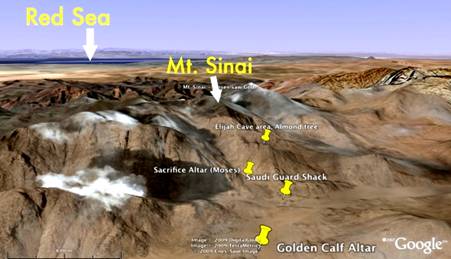
The Mount called Sin-ai at Jabal al Lawz in ancient Midian
The earth groaned: for weeks now all its strata had been disarranged, its orbit distorted, its world quarters displaced, its oceans thrown upon its continents, its seas turned into deserts, its mountains upheaved, its islands submerged, its rivers running upstream - a world flowing with lava, shattered by meteorites, with yawning chasms, burning naphtha, vomiting volcanoes, shaking ground, a world enshrouded in an atmosphere filled with smoke and vapor.
Theogony - “Twisting of strata and building of mountains, earthquakes and rumbling of volcanoes joined in an infernal din. It was a voice not only in the desert of Sinai; the entire world must have heard it. ‘The sky and the earth resounded,…mountains and hills were moved,’ say the Midrash. (Exodus 20:18) “Loud did the firmament roar, and the earth with echo resounded.” says the epic of Gilgamesh (trans. Thompson) In Hesiod ‘ the huge earth groaned; when Zeus lashed Typhoon with his bolts – ‘the earth resounded terribly, and the wide heaven above” (Theogony, II, 820 ff., 852 ff.)
As two charged steller bodies charged towards each other, a trumpet like sound waxing and waning occurs. In the Pseudo-Philo, it called this effect the “testimony of the trumpets between the stars and their Lord.” (The Biblical Antiquities of Philo, Chap XXXII)
Here arises the ethereal concept of the “music of the spheres” the Pythagorean idea that stars make music. Yet if the angels are called stars in the scripture, and the angels were the ones singing to the shepherd on the Judean hillside at the birth of Jesus, then the ‘music of the spheres” could also be the “music of the angels”.
In Ancient Babylon, the planetary spheres were called ‘voices’ and produced music. (E.F.Weidner, Handbuch der Babyloischen Astronomie (1915) cited by Velikovsky, Immanuel, pg. 111)
In
the Midrash the trumpets
heard at Sinai had seven different pitches or notes. This
has a similitude with the seven last trumpets blown by the angels
of the Lord in the Book of Revelation. According to the Sefer
Pirkei Rabbi Elieser, the heavenly music was heard ‘at the first
sound of the sky and the earth moved, the 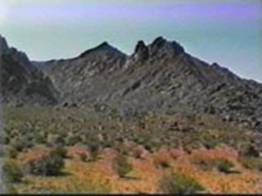 seas and the rivers turned to flight,
mountains and hills
were loosened in their foundations.” (Velikovsky, Immanuel, Worlds in
Collision, pg. 112)
seas and the rivers turned to flight,
mountains and hills
were loosened in their foundations.” (Velikovsky, Immanuel, Worlds in
Collision, pg. 112)
Jebel al-Lawz in Saudi Arabia
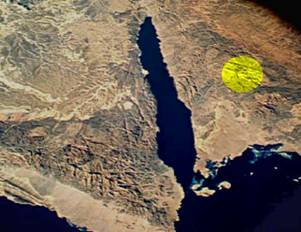
A most controversial new site for the Mount of the Lord is Jebel al-Lawz in Saudi Arabia in the ancient land of Midian. The controversy centers around that this site has received significant press coverage with no experienced archeologists having access to verify any archeological remains. This area has been popularized by several recent explorers including:
· Ron Wyatt, Samran al-Motairy and David Fasold in 1984
· Robert Cornuke and Larry Williams – 1988
· Larry Williams, The Mountain of Moses, The Discovery of Mount Sinai (1990) reprinted under the title The Mount Sinai Myth (1990).
· Howard Blum, The Gold of Exodus: The Discovery of the True Mount Sinai (1998a) reporting on the Williams-Cornuke expedition.
·
 Bob Cornuke, In Search of the
Mountain of God, "The Discovery of the real Mt. Sinai" (Cornuke and Halbrook, 2000).
Bob Cornuke, In Search of the
Mountain of God, "The Discovery of the real Mt. Sinai" (Cornuke and Halbrook, 2000).
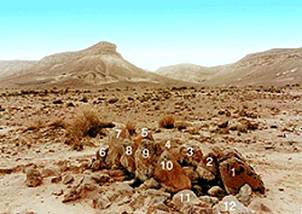
The Rock Pile of Twelve Stones near the base Mount Har Karkom as the site for Mount Sinai.
An in depth look at the location of Mount Sinai in Saudi Arabia is done by Gordon Franz, in an article, Is Mount Sinai in Saudi Arabia? Mr. Franz served as a field trip instructor at the Institute of Holy Land Studies in Jerusalem. He was later at Israel Biblical Extension (IBEX) program in Israel conducted by the Master's College. The main assumptions analyzed for this claim of Mount Sinai in Arabia are:
· The Sinai Peninsula was considered the Land of Egypt;
·
 Mount Sinai is in the Land of
Midian;
Mount Sinai is in the Land of
Midian;
· Mount Sinai is in Saudi Arabia - Galatians 4:25 – “
Aerial Photo of the Mountain location of Jabal al Lawz near Al-Bad in ancient Madyan (Midian)
“Pilgrimage
and the Holy Space in Late Antique Egypt”
 Allen Kerkeslager Ph.D – “Demetrius,
Josephus,
and other Jewish sources that identify Mt. Sinai with a discernible
location consistently place it in northwestern Arabia east of the Red
Sea. This early Jewish tradition of location Mt. Sinai in northwestern
Arabia continued to find expression in a number of early Christian
sources both before and after the growth of the competing
Christian tradition that located Mt. Sinai in the southern Sinai
Peninsula. There is not a single piece of solid evidence that any
Jew in the pre-Christian period ever located Mt. Sinai in the Sinai
Peninsula. The notion that Mt. Sinai was located in the Sinai Peninsula
must be understood as a purely Christian invention hardly different from
the Christian identification of many other locations in the near
East with ancient biblical sites.
Allen Kerkeslager Ph.D – “Demetrius,
Josephus,
and other Jewish sources that identify Mt. Sinai with a discernible
location consistently place it in northwestern Arabia east of the Red
Sea. This early Jewish tradition of location Mt. Sinai in northwestern
Arabia continued to find expression in a number of early Christian
sources both before and after the growth of the competing
Christian tradition that located Mt. Sinai in the southern Sinai
Peninsula. There is not a single piece of solid evidence that any
Jew in the pre-Christian period ever located Mt. Sinai in the Sinai
Peninsula. The notion that Mt. Sinai was located in the Sinai Peninsula
must be understood as a purely Christian invention hardly different from
the Christian identification of many other locations in the near
East with ancient biblical sites.
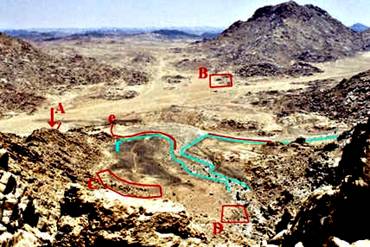
The Mount of Jabal al Lawz in Midian
A. Saudi Guardhouse
B. Altar with Petroglyphs
C. Remains of 12 Pillars
D. Large Altar - foot of Mt Sinai
E. Wells at Red Lines
F. Aqua Lines mark Stone Fences.
· The mountain must be near Al-Bad ancient Madyan.
· The mountain must be the highest mountain in the surrounding region.This criteria is potentially decisive because it would limit one's options to just one mountain.
· Jabal al Lawz is uncontested as the highest mountain in the region of ancient Madyan, Jabal al Lawz also fulfills every other criterion stated above.
· Jabal al Lawz is probably the most convincing option for identifying the mountain with which Jews identified Mt. Sinai in the Hellenistic and early Roman periods.
·
Jabal
al Lawz may also be the most convincing option for identifying the Mt. Sinai
of biblical tradition.
The potential antiquity of the traditions associated with Jabal al Lawz is without parallel in the traditions associated with other sites. The evidence discussed earlier in this study demonstrates that traditions relating Mt. Sinai to the site of ancient Madyan at modern Al-Bad extend at least to the time of the oldest portions of 250 BC. In contrast, the earliest solid date for the appearance of traditions locating Mt. Sinai in the southern Sinai Peninsula is ca. 350 AD.
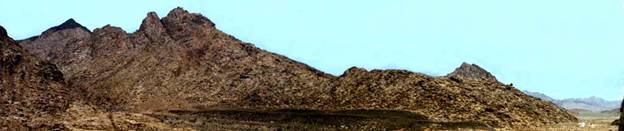 Jabal al Lawz in
ancient Midian (Madyan)
Jabal al Lawz in
ancient Midian (Madyan)
It is time for research on the location of the Mt. Sinai of
pre-exilic tradition to shift its focus to Jabal al Lawz, which is associated
with local traditions 600 years older than the traditions locating Mt.
Sinai in the southern Sinai Peninsula.
Allen Kerkeslager, "Jewish Pilgrimage and Jewish Identity in
Hellenistic and Early Roman Egypt," pp. 99-225 in Pilgrimage and Holy
Space in Late Antique Egypt, edited by David Frankfurter (Religions in the
Graeco-Roman World 134: Leiden, The Netherlands: Brill, 1998). See especially
the map on p. 105 and the section of this article devoted to pilgrimage to Mt.
Sinai on pp. 146-213.
Mount Har Karkom in the Negev Desert
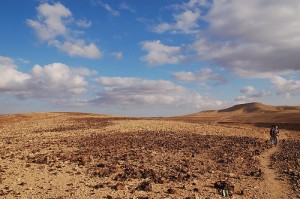
The Mount Sinai at Har Karkom in the Negev
This desert site has been investigated by an Italian archeologist, Professor Anati since 1986. Rising to a height of 2,778 feet, deep in the Negev desert near the border of the Sinai Peninsula is a treasure mine of Neolithic rock art, almost 40,000 pieces known to date. The mountain top includes a cave at the top, reminiscent when the Torah states,
Exodus 33:22 - “And it shall come to pass, while My glory passes by, that I will put you in a cleft of the rock and cover you with My hand while I pass by”
The cave at the top of Mount Har Karkom as the site for Mount Sinai
Cave painting on the mountain site suggests a holy place where pilgrims use to visit. According to Anati, these paintings include pictures of the menorah, Aaron’s rod with the brazen serpent, figures in prayer with outstretched hands and two figures with a pole and grapevine on it. These paintings seem to be unique to this locale.
Also included in the archeological discoveries are artifacts dated to the Middle Bronze Age consistent with a 1500 BCE date for the Exodus, a pile of twelve stones in a pile, an ancient rock alter with the carving of a half moon, the symbol of the moon god Sin, one of the gods of the Midianites, the land where Moses’ father-in-law Jethro lived and the root word for Sin-ai
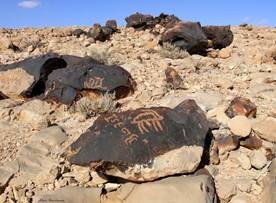


Yet to understand the events of Sinai, you must understand that the presence of the Lord of host includes all the phenomenal energy in the presence of His Being. Nobody stands quietly in the presence of an erupting volcano, yet the Lord of hosts stated that to do so was a statement of their trust in Him. The experience of the saints during the earthquake in the future 6th Seal and the 7th Trumpet of the 7th Seal will be with the same imagery as the power and fear generating experience felt by the Israelites at the base of the mountain. The world will tremble when the Lord of hosts makes His presence known.
9. Korahs rebellion against Moses
Numbers 16:23, 30-33 - “So the Lord spoke to Moses, saying ‘Speak to the congregation, saying. ‘Get away from the tents of Korah, Dathan, and Abiram.’” ….”But if the Lord creates a new thing, and the earth opens its mouth and swallows them up with all that belongs to them, and they go down alive into the pit, then you will understand that these men have rejected the Lord.
And it came to pass, as he finished speaking all these words that the ground split apart under them, and the earth opened its mouth and swallowed them up, with their household and all the men with Korah, with all their goods. So they and all those with them went down alive into the pit, the earth closed over them, and they perished from among the assembly…And a fire came out from the Lord and consumed the two hundred and fifty men who were offering incense.”
Korah, a great grandson of Levi came in direct conflict and defiance of the leadership of Moses and Aaron, with the charge;
Numbers 16: 3 - “You take too much upon yourselves, for all the congregation is holy, every one of them and the Lord is among them. Why then do you exalt yourselves above the assembly of the Lord.”
This charge against the leadership chosen by the Lord of hosts has a common vein throughout all history, closely aligned with the charge of Satan to the Lord of hosts. For it was Lucifer, the guardian cherubim, who initiated the initial rebellion against HaShem, claiming that He does not have a right to command the will and allegiance of man, for it violates free will of man.
The children of Israel were standing on the border of entry into the Promised Land at Kadesh in the Wilderness of Paran, when the designated spies sent by Moses into the land returned with the report, the land was truly a paradise, and by their verbal affirmation, “It truly flows with milk and honey.” (Numbers 13: 27)
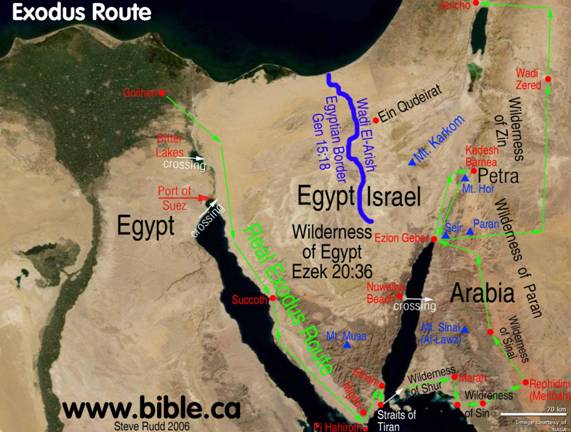
Then the faithless spies began a disinformation
campaign, about the mighty and powerful cities, about the giant
descendants of Anak plus the feared enemy that sought their
extinction in the Sinai, the Amelekites, but numerous other
powerful tribes, they would have to confront violently in order to
conquer and inhabit the land.
The Route of the Exodus from Egypt to the Promised Land
Fear set in and the trust of their leaders was challenged as their fantasies and dreams of an easy march to victory, was to be tested. They could not imagine themselves as a people capable of standing up to united confederations and military forces, neither could they imagine themselves as patiently waiting for an unseen Supreme Being to guide them in a conquering campaign.
It was much easier to rebel then to consider the unthinkable; return to the land of their captors. To do so they would have instigate an insurrection and seek to stone Moses and Aaron and the designated leaders of the Israelites. Instead the Lord of hosts, with the mediation by Moses, punished them to forty years of wandering in the wilderness. (Numbers 14:26-36) As truly spoiled children, the Israelites then decided to show the Lord, not with repentance, but that they could conquer the land of Canaan by themselves, to a dismal defeat. (Numbers 14: 41-45)
Soon after this rebellion at the border of Canaan, another rebellion was in the brewing. This time it was over the designated role of the civil and the spiritual leadership in the tabernacle service of the Lord. The Korites as Levites were given a specific role and responsibility; to the ministry of music of God in the sanctuary service (see the Psalms of the sons of Korah in Psalms 42, 44-49, 84, 85, 87, and 88)
It was Korah, a great-grandson of Levi, who allied himself with two co-conspirators who were two great-grandsons of Reuben. The Korites wanted not to be temple musicians but to have the cherished office of the priests. The Reubenites, as the descendants of the firstborn of Jacob, wanted the responsibility of civil government. In all, ‘two hundred and fifty leaders of the congregation, representatives of the congregation, men of renown’, (Vs 16:13) gather in a civil revolt against Moses, Aaron and against God for they were now in a theocracy.
The leaders of the congregation desirous to be priests, though they were not called by the Lord of hosts to be priests, were personally called by Moses, Aaron and the 70 elders of Israel to bring their censers and present themselves before the sanctuary of the Lord the next morning. Dathan and Abiram, in the camp of Reuben refused, thinking this was a set-up and they would all be ambushed and blinded by Moses and Aaron. So they chose to stay in defense by their tents.
Let us look carefully at this scenario. A rebellious group of camp leaders are now standing in the front of the Wilderness Sanctuary, all with censers. Another group of leaders are standing in armed rebellion by their tents. How was God going to answer their charges?
The answer of the Lord of hosts came with a powerful earth rending earthquake and fire bolides shooting down from the heavens. The want-to-be civil leaders in rebellion were consumed by the earth and the want-to-be spiritual leaders were consumed by heavenly fire.
The next day, the entire camp was in revolt. They charged Moses and Aaron with calling down the fire from heaven and the earthquake with its deadly destruction. How so? Let us not forget, Moses’ right to leadership with the assistance of his verbal spokesman, Aaron, was to call down the plagues upon the Egyptians in their defiance against God.
They are now charged that the “people of the Lord” were the ones that were killed, suggesting that Moses and Aaron were evil imposters. This recognition by the rebelling Israelites was that Korah, Dathan, Abiram and the 250 consumed leaders were recognized spiritual leaders in the camp of Israel.
Leaders, maybe not recognized by God, but recognized by themselves, they had set themselves up in defiance against God, with their own ambitions of power, greed and control. It was they who said, God has no right to arbitrarily kill someone even though they are in defiance against Him. God has no right to kill wives and children of rebellious leaders, for are they not the poor innocent victims? Man also has a ‘right’ to live and to rebel, even against the Lord Himself.
The armed mass of rebels then ‘turned towards the tabernacle of meeting,’ the House of the Lord. (Vs. 42) As a symbol of the Lord Almighty, were they now seeking to destroy the visible structure which sheltered the presence of the Lord’s Shekinah? Here we see, “and suddenly the cloud covered it, and the glory of the Lord appeared.” (Vs. 42)
Moses and Aaron suddenly prostrate in fear and awe, for the Lord spoke to them, “Get away from among this congregation, that I may consume them in a moment.” (Vs 45)
Here we see a remarkable picture. Aaron, the High Priest with his sons, the deputy priests for the people of the Lord, was commanded by Moses to rush to their sacred duty and make atonement for the rebelling people, for the Lord was sending a plague within the immense camp of the Israelites. Here we see an aged high priest running to save the very people that were reviling him. “And he stood between the dead and the living; so that plague was stopped. Now those who died in the plague were fourteen thousand seven hundred besides those who died in the Korah incident.” (Vs. 48-49)
As BibleSearchers, let us now digest and put on our spiritual eyeglasses. It is our belief that the chosen people of God, the Israelites were selected in part to be actors in a continuous drama with the Lord, and each mini-drama will be a scene that will be replayed in full at the end of times. Here we have a historical event, a mini-drama that may give us insight to the final chapters at the time of the end. The central issue is rebellion against God.
So what do we see? Here we see the people of God once again standing on the border of the Promise Land. The evidence is real, it was truly a ‘land of milk and honey.’ Yet a disinformation campaign begins and a whole generation balks and rebel with only a “remnant” that will eventually go into the Land; the Calebs and Joshuas. For forty years they live in a world with a fear, of the progressive might of military forces and formidable political and power ‘giants’, a world soon be under the yoke of the oppressive power of an Anti-Christ driven one-world government, and the greed of men possessed with the want and lust of money and power.
A whole generation strive for political and spiritual leadership, choosing to ignore the humble servants of the Lord within their midst. Political machinations will rip the core of the literal Israelites, as the orthodox tzaddiks, or righteous ones are relegated to cloisters and hidden chambers to worship and the reformed rabbis’ seek political power and dominance.
The Roman Christian Church and their “daughters”, the no-longer Protest-ant Churches will also be shredded as they seek international political and religious hegemony on the spiritual sites in the Holy Lands. They seek to manipulate the populous in the political chambers with spiritual sounding rhetoric, such as the Silent Majority. They will seek political solutions for moral issues. And more and more the righteous are declared to be evil imposters and the wicked are portrayed as the servants of the Most High. Reality will become twisted and morality will become profane. As that generation dies off, only a remnant will be left.
Again we see another rebellion at the end of times. This time, we see Two Witnesses, especially selected by God to lead his people to the doorway of the Promise Land and to protect them from the physical and spiritual onslaught against them by the evil ones siding with the forces of the beast, the Antichrist. This rebellion will be aimed directly at the sacred triad of the Lord’s; the physical presence in the land, whether it be Jerusalem or a Temple, the physical civil and spiritual leadership possibly led by the greatest of the lawgivers in the history of man, Moses, and the greatest of the prophets, Elijah.
This revolt will be global and international and will absorb the attention of all the peoples of the world. The international ‘spiritual want-to-be leaders’ will seek power and authority by being in front of the very presence of the place God calls, My Holy Place, Jerusalem. They will seek to divide this Holy Soil amongst the religio-political leaders as has been the political promise given by Prime Minister Rabin in 1994 to the Pope for the Vatican to be the religious broker to make the Temple Mount as a place for Moslems, Christians and Jews to worship together.
The international ‘political want-to-be leaders’ in a world sanitized by the one-world leaders of the United Nations will also seek spiritual sanction for their political dreams as Charlemagne the Great did when he was crowned by the Pope as the Holy Roman Emperor in the year of 801 CE. What a better place than the designated physical planetary capital of the Lord of hosts, Jerusalem, “that great city which spiritually is called Sodom and Egypt, where also our Lord was crucified.” (Revelation 11:8) In doing so, they will again set themselves up in defiance against God with their own ambitions of power, greed and control. They will challenge to the “Face of God” they He does not have the right to arbitrarily destroy them and to prove their point, they will gather together all the weapons of mass destruction at the doorstep of Jerusalem, on the plains of Megiddo.
As these armed rebels then turn “towards the tabernacle of meeting”, where Vendyl Jones once predicted that the wilderness tabernacle will once again be found, they will seek to destroy it “and suddenly the cloud covered it, and the glory of the Lord appeared.” (Numbers 16:42) Yes, He, the Son of Man, now as King of kings and Lord of lords will come in the clouds and with the glory of the Lord, every eye shall see Him.
The glory of the Lord will come down as a bolide of fire out of heaven upon the
“False Prophet of Islam” and he will be cast into the Lake of Fire. A complete Pole Reversal will occur.
Zechariah 14:6-7 – “It shall come to pass in that day that there will be no light; the lights will diminish. It shall be one day which is known to the L-rd – neither day nor night. But at evening time it shall happen, that it will be light.”
A great earthquake will again occur, one so big that all the mountains of the world will disappear and all the islands (oceanic mountains) will disappear.
Revelation 16:17-21 – “Then the seventh angel poured out his bowl into the air, and a loud voice came out of the temple of heaven, from the throne, saying, “It is done!” And there were noises and thunderings and lightnings; and there was a great earthquake, such a mighty and great earthquake, as had not occurred since men were on the Earth.
Now the great city was divided into three parts, and the cities of the nations fell. And great Bagbylon was remembered before G-d , to give her the cup of the wine of the fierceness of His wrath.
Then every island fled away, and the mountains were not found. And great hail from heaven fell upon men, each hail stone about the weight of a talent, seventy pounds. Men blasphemed G-d because of the plague of the hail, since that plague was exceedingly great.”
Then from the deep tectonic plates beneath Jerusalem a rumble will begin that will get louder and louder, so immense that fear is instilled in everyone’s hearts. The African and Arabian plates will begin to slide away from each other. A massive uplift will raise up the Mountain of the Lord as all the mountains of the world will be in their process of devolution. The mighty Himalayas, the Andes, the Rockies, and all the mighty ranges of mountain heights “will disappear”. The forces jamming one continental plate into another for thousands of years that had caused their mountain uplift were now reversed in the complete physical Pole Shift.
The armed rebels in Armageddon were soon to be destroyed by the might of the earthquake. The power of the glory of God and the billions of human tax dollars put into exotic weapons of catastrophic planetary mass destruction will now be utterly destroyed.
Is this the final portrayal of this mini-drama of Korah and the rebellious leaders? As a BibleSearcher, if you are chosen to be among the remnant, you might be able to witness these awesome events with your very own eyes.
Go to Part 4 - Major Earthquake and Catastrophes in the Old Testament
Part Two
Topics
1 - The Fall of Jericho - River Jordan and The Wall
2 – Lesser Catastrophe of David and Jonathan captures a Philistine Garrison
3 - The Pestilence of King David – 972 BCE. (1016 BCE – Setterfield
4 – Elijah’s Barbecue on Mount Carmel
Carmel, the Mount of the Lord
5 - Elijah after the Mount Carmel Burnout on Mount Horeb
Horeb, the Mount of God
Mount Har Karkom in the Negev Desert
6 - Earthquake during reign of Azariah (Uzziah) (792-740 BC) in Jerusalem
The Prophecies of Amos the Prophet
The Catastrophes as part of God’s future Schedule
Earthquakes and the Prophet Amos
Volcanic Eruptions and the Prophet Amos
Bolide (Celestial or Volcanic Debris) and Meteor Showers and the Prophet Amos
Fires that devour the land (Prairie Fires) and the Prophet Amos
The Possessions of the future Houses of Judah and Joseph – Book of Obadiah
Astrology and the Prophet Amos
Orbital Planetary Movements and the Prophet Amos
The Founding of Rome and the Uzziah Earthquake
7 - Era after Hezekiah, king of Judah (715-699)
The Blast (Spirit) of the Lord
The End of the Catastrophic Era in the History of Man
Catastrophes at the Time of the End
Part One - Planetary Changes at the Time of the End
Part Two – Isaiah the Catastrophic Prophet
Part Three - Major Earthquakes and Catastrophes in the Old Testament - Part One
Part Four - Major Earthquakes and Catastrophes in the Old Testament - Part Two
Part Five – Major Earthquakes and Catastrophes in the New Testament
Part Seven – Evidence of Catastrophes in the Natural World – Part Two
Part Eight – The Catastrophic Destruction and Restoration of Pangea
Part Nine - Eden as Pangea and the Flood as a Mass Extinction
Return to Beginning of this document
Return to Part Two – Isaiah the Catastrophic Prophet
Return to Part One – Planetary Changes at the Time of the End
Message from BibleSearchers
BibleSearchers scans the world for information that has relevance on the time of the end. It is our prayer that this will allow the believers in the Almighty One of Israel to “watch and be ready”. Our readiness has nothing to do trying to halt the progression of evil on our planet earth. In our readiness, we seek to be prepared for the coming of the Messiah of Israel so that goodness and evil will be manifested in its fullest. Our preparation is a pathway of spiritual readiness for a world of peace. Our defender is the Lord of hosts. The time of the end suggests that the Eternal One of Israel’s intent is to close out this chapter of earth’s history so that the perpetrators of evil, those that seek power, greed and control, will be eliminated from this planet earth. The wars of the heavens are being played out on this planet earth and humans will live through it to testify of the might, power, justice and the love of the God of Israel. In a world of corruption and disinformation, we cannot always know what the historical truth is and who is promoting evil or mis-information. We cannot guarantee our sources but we will always seek to portray trends that can be validated in the Torah and the testimony of the prophets of the Old and the New Testament.
FAIR USE NOTICE
This site contains copyrighted material the use of which has not always been
specifically authorized by the copyright owner. We are making such material
available in our efforts to advance understanding of environmental, political,
human rights, economic, democracy, scientific, and social justice issues, etc.
We believe this constitutes a 'fair use' of any such copyrighted material as
provided for in section 107 of the US Copyright Law. In accordance with Title
17 U.S.C. Section 107, the material on this site is distributed without profit
to those who have expressed a prior interest in receiving the included
information for research and educational purposes. For more information go to: http://www.law.cornell.edu/uscode/17/107.shtml