 Return to the Home Page | Translate this Page
 The
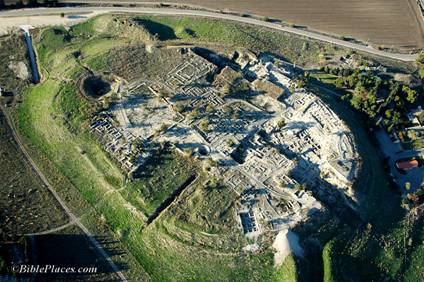
Ancient City of David and Solomon’s Megiddo – by BiblePlaces.com
The
Ancient City of David and Solomon’s Megiddo – by BiblePlaces.com

Gleanings on Global News at the Time of the End
“Globalist Israel and the Middle East”
By Robert Mock MD
robertmock@biblesearchers.com
www.BibleSearchers.com
Bamidbar/Numbers 14:17-21 - And now, I beseech You, let the power of Hashem be great, according as You have spoken, saying: The L-rd is slow to anger, and plenteous in lovingkindness, forgiving iniquity and transgression, and He will by no means clear the guilty; visiting the iniquity of the fathers upon the children, upon the third and upon the fourth generation. Pardon, I beseech You, the iniquity of this people according to the greatness of Your lovingkindness, and according as You have forgiven this people, from Egypt even until now.' And Hashem said: 'I have pardoned according to your word. But as truly as I live, all the earth shall be filled with the glory of the L- rd.
Topics
Archeological and Historical News
Animal “Omens” pointing to the Time of the End
Sabbatean Jews and Globalist Israel
Globalist Israel and Globalist America
Israel and the Palestinian State
Israel in International Sports
Archeological and Historical News
Jewish home found in City of David - June 5, 2005
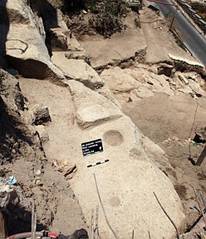
Jerusalem Post - A Second Temple Jewish house has been uncovered in Jerusalem's ancient City of David, Israel's Antiquities Authority announced Sunday. The 2,000 year old private home, which archeologists believe was part of a complex of homes belonging to affluent people, was discovered during an excavation at the history-rich site last month. Several rooms of the split-level house - as well as a ritual bath - were found at the compound, archeologist Tzvika Greenhaut who was charged with excavation at the site said.
Site of excavation at City of David. Photo: Israel Antiquities Authority
The plot of land, located across from the Kidron Valley in the present day Arab neighborhood of Silwan, is owned by the right-wing Elad organization, which works to resettle Jews in east Jerusalem. "We are talking about a house belonging to a very rich family," Greenhaut said, noting that the ruins were hewn into the rock in a very high standard. The newly uncovered site will be open to the public, he said.
Western Wall Hill - Out; Temple Period Finds – In – December 13, 2004
 Israel National News - The Jerusalem Municipality has decided to take down the hill that leads up from the Western Wall
(Kotel) entrance to the Temple Mount, for fear that it might otherwise
collapse. The walkway up the hill leads to the Mughrabim Gate, which is
currently the only entrance for Jews to the Temple Mount. The city plans to
replace the hill with a bridge that will lead into the Mughrabim Gate.
Israel National News - The Jerusalem Municipality has decided to take down the hill that leads up from the Western Wall
(Kotel) entrance to the Temple Mount, for fear that it might otherwise
collapse. The walkway up the hill leads to the Mughrabim Gate, which is
currently the only entrance for Jews to the Temple Mount. The city plans to
replace the hill with a bridge that will lead into the Mughrabim Gate.
Jerusalem city engineers will take down the hill jutting out from the Western Wall, replacing it with a bridge. Archaeologists expect to find treasures, such as a tall gate from the Second Temple.
The plans are a bonanza for students of Jerusalem history, as the removal of
the hill will uncover an eight-meter high gate leading into the Temple Mount. The gate, dating from the period of the Second Temple, is known as Barclay's
Gate, after the 19th-century American consul who first identified it.
In addition, archaeologist Dr. Eilat Mazar told Arutz-7 today, "it's not
every day that we get to excavate so close to the Western Wall. We expect to
find, as we did in other excavations nearby, the Roman street alongside the Temple Mount structure, and many other treasures." She said that Barclay's Gate
descends several meters below the current street level of the Western Wall
plaza. "Today, only the top of its lintel can be seen [from the women's
section]. It is very beautiful, and when it is uncovered it will be one of the
most beautiful scenes in the Old City."
The hill in question, located to the right of the women's section when facing
the Wall, is an ancient one, comprising several layers of old buildings. Dr.
Mazar said that some of them may be as old as the Mamluke Period, some 700
years ago, but under them are remnants from the Second Temple Period, 2,000
years ago. "I assume that they will study these structures, and document
whatever needs to be learned, but in the end, the real find lies behind them. I
assume, therefore, that the authorities will remove whatever now forms the
hill, so that the full glory of the Wall and the Gate can be seen... It should
be a matter of months."
The entire area that is currently the Western Wall plaza was filled with low
buildings when Israel liberated the area during the Six Day War of June 1967,
and was later cleared away – except for the area on which lies the walkway-hill
leading to the Mughrabim Gate.
City engineers fear that the collapse of the hill that began last winter could
continue this year, leading to a total collapse. Part of the women's section of
the Western Wall plaza is already closed off for fear that worshipers below may
be injured by falling rocks and earth, or by a major cave-in. The collapse
began last year following a week of heavy rains, a snowstorm and an earthquake.
The Western Wall Heritage Foundation launched a new website last night,
providing historical information on the Western Wall and real-time photos
thereof. The site's English version is scheduled to be ready on January 20. It
provides historical background, Jewish sources, historic photos, Bar/Bat
Mitzvah options, a virtual "tour" of the entire length of the Western
Wall – only a small portion of which is familiar to the public at large – and
educational programs, all using impressive and attractive technology.
The site also features three different real-time video views [clickable on the
right side of the screen] of the goings-on at the Kotel. One camera is a
wide-angle view of the entire plaza, while another one zeroes in on the prayer
area. A third camera shows the Wilson's Arch area, to the left of the men's
section.
Large underground reserve of hot water discovered in north – Jun3 14, 2005
 Haaretz - A large reserve
of hot water was discovered on Tuesday at a depth of over 1,000 meters by
the Water Commission who were conducting drillings near Kibbitz Shamir in the
north. The Water Commission decided to search for water in the lower lairs
of the Jura rock. The water, at the temperature of 45 to 47 degrees Celsius,
was found to contain high concentration of sulfate. It burst out of the ground
at a pressure of 750 cubic meters per hour.
Haaretz - A large reserve
of hot water was discovered on Tuesday at a depth of over 1,000 meters by
the Water Commission who were conducting drillings near Kibbitz Shamir in the
north. The Water Commission decided to search for water in the lower lairs
of the Jura rock. The water, at the temperature of 45 to 47 degrees Celsius,
was found to contain high concentration of sulfate. It burst out of the ground
at a pressure of 750 cubic meters per hour.
Ze'ev Achifaz, a commission official said that the water was
not potable but could be filtered for agricultural use. The water could also be
used for fish pools or to create a tourist center, he said. Although there are
no precise estimates of the size of the reserve, it is believed the reserve
could supply several millions of cubic meters per year.
Tuesday, June 14, 2005 06:00:52 PM EDT
JNF Opens 180th Reservoir – June 16, 2005
The Jewish National Fund has announced the opening of
its 180th water reservoir in Israel, noting the extra importance of the
reservoirs following this year's  lower than average
rainfall.
lower than average
rainfall.
JNFs 180 reservoirs have a total storage capacity of
over 35 billion gallons. Despite heavy rainfall during two of the last three
winters, Israel's three main water sources -the Kinneret (Sea of Galilee), the
mountain hill aquifer and the coastal aquifer - have suffered from chronic shortages
and instability. In light of the recent rain shortage, JNF reservoirs play an
even more crucial role in recycling water and catching rainwater. The recycled
water is used for irrigation, thus allowing fresh water to be used for drinking
water.
JNF is continuing to build new reservoirs,
especially in the Negev desert, where JNFs Blueprint Negev campaign is
underway. Five new reservoirs are now under construction: Essence of Life near
Mitzpeh Ramon in the Negev, Lachish in the northern Negev, Koren near Kibbutz
Gesher Haziv, and Amiad and Shamir Reservoirs in the north.
The Essence of Life Reservoir near the Ramon Air
Base, planned to recycle water from the base for use in irrigating the area and
maintaining a green area, including a park. The project is supported by
synagogues and congregations from around the United States, representing every
stream of Judaism.
Lachish,
with a capacity of 330 million gallons, will store treated wastewater from Jerusalem and surrounding areas to help irrigate the farm fields of Moshav Lachish and the
Etzion Bloc. The reservoir will enable agricultural water quotas to be expanded
for export-oriented produce grown on available farming lands, thus helping to
enlarge the sources of farm livelihood and strengthen Jewish communities in the
Northern Negev.
The Koren Reservoir in the north, will recycle
water from Nahariya and handle almost 740 million gallons. Water from Koren
will be used to irrigate farms in the surrounding villages. Amiad and Shamir
Reservoirs were recently opened in the north at a cost of about $2.5 million.
Amiad holds 66 million gallons and treats water from Amiad, Elifelet, Korazim,
Kachal and the military camps near them. Shamir is twice the size, and is
slated to treat water from Kibbutzim Shamir, Amir, Sde Nechemia and Kfar Szold
for the irrigation of the fields of Kibbutz Shamir.
Animal “Omens” pointing to the Time of the End
Rare white buffalo born at ranch – June 7, 2005
The
Courier-Journal - When a rare white buffalo was born Friday at a  buffalo ranch in Shelby County, owners
Bob and Julie Allen thought the baby had prophecy written in her genes.The
white calf, regarded as a sacred symbol by Lakota Sioux and other Plains Indian
tribes, is a granddaughter of the ranch's former big star, award-winning bull
Chief Joseph, a hefty 3,000-pound sire that had cost the Allens $101,000. The
bull was struck by lightning on Sept. 11, 2001, and died two weeks later. So
the Allens, who own the Buffalo Crossing Restaurant & Family Fun Ranch,
were delighted by the calf's birth. "It's just unbelievable," Bob
Allen said.
buffalo ranch in Shelby County, owners
Bob and Julie Allen thought the baby had prophecy written in her genes.The
white calf, regarded as a sacred symbol by Lakota Sioux and other Plains Indian
tribes, is a granddaughter of the ranch's former big star, award-winning bull
Chief Joseph, a hefty 3,000-pound sire that had cost the Allens $101,000. The
bull was struck by lightning on Sept. 11, 2001, and died two weeks later. So
the Allens, who own the Buffalo Crossing Restaurant & Family Fun Ranch,
were delighted by the calf's birth. "It's just unbelievable," Bob
Allen said.
The white buffalo calf stood with her mother yesterday at the Buffalo Crossing Restaurant & Family Fun Ranch in Shelby County. (By Michael Clevenger, The Courier-Journal)
The appearance of a white buffalo is regarded by some followers of American Indian spirituality as on par with the Christian idea of the second coming of Christ, said Bob Pickering, a researcher at the Buffalo Bill Historical Center in Cody, Wyo. "I've heard at least one Lakota elder make that claim," said Pickering, whose book "Seeing the White Buffalo" delves into the legend of the creatures.
As the story goes, Lakota Sioux rituals and beliefs were brought to the tribe by a spiritual being known as the White Buffalo Calf Woman, Pickering said. A white buffalo calf is interpreted as the sacred reincarnation of the woman, he said. Historically, the white buffalo is "probably about the most spiritual being on the prairie," he said. Pickering estimated the incidence of white buffalo births at about 16 per million. He said there are three reasons white calves sometimes appear: they can be albinos, they can be the result of crossbreeding with white cows, or they may be temporarily white and turn dark by their first winter.
The calf is not an albino, said Julie Allen, noting that its eyes are brown, not pink. Flicking her ears and whisking her tail back and forth, the 40-to-50-pound calf resembles a lamb. In the past, Indians sacrificed white buffalo as sacred offerings, but now they avoid doing that, Pickering said. About 600 buffalo roam the Allens' 1,000 acres. They raise buffalo primarily for meat and to serve in the restaurant on their property. But in keeping with tradition, the white calf, which has yet to be named, likely will be spared. "We probably won't put her on the dinner table," Bob Allen said, laughing.
Visitors
can see the white buffalo calf and other animals at the ranch from 11 a.m. to 9
p.m. daily, except Sundays, when the ranch is open from 11 a.m. to 6 p.m.
The ranch is at 1140 Bagdad Road, off Ky. 12 near Shelbyville. Admission is
free.
Phone: (502) 647-0377.
Web site: buffalocrossing.com.

The Legend of the
White Buffalo
Rare Black Deer Born In Colorado – June 15, 2005
Farm Family Names Fawn 'Midnight' - You see lots of
deer on Colorado's Western Slope but not very many that look like Midnight --
an all-black deer born this past weekend in Loma, Colo.  Wildlife experts
say an all-black deer is even more rare than an albino deer. They say most
hunters will never see a black deer in their lifetime. Midnight was born on a
family farm and his owners didn't know what they had at first. "It
reminded me of a bear cub, and it was just black and it was chasing that doe
around and I thought, 'What do we got in there?" said farmer Steve Bittle.
"Thought it as just ... it was weird," said Midnight's owner Hayley
Bittle. Midnight
also has a strange feature -- blue eyes. The Bittle family say they've never seen
anything like Midnight in all the years that they've been raising animals on
the farm.
Wildlife experts
say an all-black deer is even more rare than an albino deer. They say most
hunters will never see a black deer in their lifetime. Midnight was born on a
family farm and his owners didn't know what they had at first. "It
reminded me of a bear cub, and it was just black and it was chasing that doe
around and I thought, 'What do we got in there?" said farmer Steve Bittle.
"Thought it as just ... it was weird," said Midnight's owner Hayley
Bittle. Midnight
also has a strange feature -- blue eyes. The Bittle family say they've never seen
anything like Midnight in all the years that they've been raising animals on
the farm.
Black Deer with Human Eyes Born in Americas Signals Catastrophic Earth Changes soon to Come – June 18, 2005
More astounding about this birth of the Black Deer are that its eyes are blue when they should be brown, because as we know melanin is a protein and like other proteins the amount and type are coded into the genes. The irises of all eyes in mammals containing a large amount of melanin will always appear black or brown, but in this Black Deer, and whose colour of black can only be due to a high level of melanin, its eyes are Blue.
But to the older peoples of the Earth’s legends we always know that animals born with Blue Eyes are for showing to us humans that they are ‘seeing’ through our ‘eyes’ and that we should understand the message they are sending to us. And where once in the Americas the news of this Black Deer with Blue Eyes would serve as the warning it was meant to convey, in today’s Western world such an amazing event as this is looked upon as just a curiosity without any deeper meaning. To the older peoples of the Americas however the knowledge and wisdom of the Deer Clan’s legends are very well known and it is well worth our time to remember their ancient story: The Knowledge and Wisdom of the Deer Clan.
Balfour
Declaration draft sold for $884,000 – June 16, 2005
Jerusalem Post - A draft of the Balfour Declaration, the 1917 document in which
Britain expressed support for a Jewish state, sold for $884,000 at Sotheby's on
Thursday. The identity of the buyer, a collector bidding over the phone, was
not disclosed. The draft was written by Leon Simon, an English Zionist
leader, at a July 17, 1917, meeting at London's Imperial Hotel. The
document is the only known surviving handwritten draft of the declaration,
Sotheby's said. Written on hotel stationery, it reads:
``H(is) M(ajesty's) G(overnment) accepts the principle that P(alestine) should be reconstituted as the Nat(ional) Home of the J(ewish) P(eople). HMG will use its best efforts to secure the achievement of this object, and will discuss the necessary methods and means with the Z(ionist) O(rganization).''
The Balfour Declaration was issued Nov. 2, 1917, by British Foreign Secretary Arthur Balfour. It was the first political recognition of Zionism by a great power and became the basis for the creation of a Jewish state in Palestine. Thursday's sale came a day after another artifact of historical significance was auctioned, one that, in sharp contrast, had far-reaching negative repercussions for the fate of the Jewish people: A copy of Mein Kampf, personally autographed by Hitler was sold to an anonymous British citizen for 23,800 pounds. An entire collection of Nazi paraphernalia was auctioned off, including a signed Third Reich photograph. Mein Kampf, which translates as My Struggle, became the bible of Hitler's Nazi Party.
Muslim Professor: Koran agrees that Holy Land is Jewish – June 6, 2004
Arutz Sheva - Prof. Khaleel Mohammed, Assistant Professor at the Department of Religious Studies at San Diego State University, is the latest Muslim expert to say that the Koran - the holiest Muslim work - is actually Zionist. In an interview with Jamie Glazov of FrontPageMagazine.com (June 3, 2004), Mohammed quoted the Koran (5:20-21) as saying: "Moses said to his people: O my people! Remember the bounty of God upon you when He bestowed prophets upon you, and made you kings and gave you that which had not been given to anyone before you amongst the nations. O my people! Enter the Holy Land which God has written for you, and do not turn tail, otherwise you will be losers."
Mohammed emphasized that the above phrase, "God has written for you," is very significant: "In both Jewish and Islamic understandings of the term 'written,' there is the meaning of finality, decisiveness, and immutability...So the simple fact is then, from a faith-based point of view: If God has 'written' Israel for the people of Moses, who can change this?" He also quoted two of Islam's most famous exegetes - Ibn Kathir and Muhammad al-Shawkani - as supporting this explanation.
Imam Abdul Hadi Palazzi, secretary-general of the Italian Muslim Association, has long promoted that it is possible to be a Muslim scholar and leader and still support America, Israel, and democracy. Citing pro-Jewish verses in the Koran, Palazzi told a Jewish audience in Cleveland recently, "There are many good Muslims who value life on earth and the sanctity of their families. Israel should make every effort to support the growth of a pro-Israel movement among these Muslims... (But sadly, Muslims in Israel were emotionally and morally defeated by the Oslo Accords.) They felt that Israel was selling them out to Arafat. They need to be supported and encouraged to speak out in defense of Israel without fear of being assassinated by the PLO [Palestine Liberation Organization] or Hamas...Oslo signaled to many of us that Israel was ready to accept peace at any price, and make incredible concessions to ruthless criminals."
Arab-American Nonie Darwish has recently opened a Web site, www.ArabsforIsrael.com . The site states, inter alia, "We are Arabs and [Muslims] who believe we can support the State of Israel and the Jewish religion and still treasure our Arab and Islamic culture." Mohammed, in his interview with FrontPageMagazine, apportions at least partial blame for today's wars to the Muslims of the seventh century: "[W]hen the Muslims entered that land [the Holy Land] in the seventh century, they were well aware of its rightful owners [the Jews], and when they failed to act according to divine mandate (at least as perceived by followers of all Abrahamic faiths), they aided and abetted in a crime. And the present situation shows the fruits of that action - wherein innocent Palestinians and Israelis are being killed on a daily basis." "When the Muslims conquered Jerusalem," Mohammed continued, "it should have been left open for the rightful owners to return. It is possible that Jewish beliefs of the time only allowed such return under a Messiah - but that should not have influenced Muslim action...[The] Muslim occupation and building a mosque on the site of the Temple was something that was not sanctioned by the Koran. How honest is contemporary Islam with this? Given the situation in the Middle East, politicking, etc. stands in the way of honesty."
Mohammed says that Muslim groups have frequently denounced him because he is "out of line with the geopolitical movement toward fundamentalism." "What your readers must understand is that fundamentalism is rapidly becoming mainstream. Moderation is not. A perfect example is in Akbar Ahmed's "Islam Under Siege," where he points out that the Taliban are no longer a fringe group in Pakistan; many Pakistanis are finding themselves drawn to their teachings. Right here in the U.S., I present a problem to those at mosques who use social pressure to coerce others into accepting their extremism…Many Muslims stand against me for no other reason than I say that Israel has a right to exist...I in no way deny that Palestinians have rights. But this is generally not considered by those that criticize my position..."
'Lost tribe' of Israel faces summer evacuation - Group believing it descended from Joseph among those targeted for ouster in August – July 5, 2005
NEVE DEKALIM, Gaza - World Net Daily -- They claim to have been forcibly exiled from Israel 2,700 years ago. Following intense lobbying, hundreds recently arrived in the Jewish state from India to settle in what they believe to be their homeland. Now residing in the Jewish communities of Gaza, the group is once again facing exile, this time at the hands of the Israeli government. Meet the "Lost Tribe of Menashe." "It has been a long journey for all of us. This is our land. Jewish land. Now they want to kick us out and we will be forced from our homes and our lives once again," said Shimon Kolney, a resident of Gush Katif, the slate of Gaza's Jewish communities scheduled for evacuation Aug. 15 as part of Prime Minister Ariel Sharon's withdrawal plan.
Kolney is also a member of the "B'nei Menashe," a tribe from India who believe they are the lost descendants of Manasseh, one of biblical patriarch Joseph's two sons, and a grandson of Jacob, whose name was changed to Israel. According to B'nei Menashe oral tradition, the tribe was exiled from Israel and enslaved by the Assyrians 2,700 years ago. They later escaped to the east, eventually settling in the border regions of China and India, where most remain today.
In the 1950s, Konley's father, Tchelah, the chief of an Indian village, said he had a vision, which he shared with his people, that his community was the lost tribe of Menashe. Most in his town had customs very similar to Jewish tradition, but they couldn't explain why. He told his villagers to return at once to Israel and embrace the Jewish faith. Several thousand of Tchelah's followers set out on foot to Israel, but were quickly halted by Indian authorities. Undeterred, many in the village started learning Jewish tradition, and began practicing Orthodox Judaism.
Over the last decade, with the help of Shavei Israel, an organization founded to bring the B'nei Menashe to Israel, the first batch of the tribe arrived in the Jewish state, settling in Gush Katif. "We came here because of the beauty of Gush Katif, and because there was work for us in local greenhouses. We could sustain ourselves here, so we built a community," explained Allenby Sellah, one of the first B'nei Menashe members to immigrate. There are now about 800 tribe members in Israel, 60 of whom reside in Gush Katif. The remainder settled in Jerusalem and several West Bank towns.
On March 30, Israel's Sephardic Chief Rabbi, Rabbi Shlomo Amar, formally recognized the B'nei Menashe as "descendants of Israel," and is planning to send a rabbinical court to India to oversee the conversion of the remaining members of the community. Even though B'nei Menashe believe they are Jewish by birth, the tribe members must undergo traditional Jewish conversion to satisfy Israel's immigration laws. Here in Gush Katif, B'nei Menashe members lead full Orthodox Jewish lives, studying the Torah regularly, praying three times per day, observing the Sabbath and keeping strict kosher laws.
Most work in greenhouses as supervisors and laborers. Gaza features thousands of Jewish-owned greenhouses, which provide Israel with nearly 70 percent of its produce and feature some of the most advanced agricultural technology in the world, including high-tech temperature regulation and insect-free produce.
The B'nei Menashe here live in a cluster of apartments and houses in Neve Dekalim, a large Katif community. They have mostly integrated with the rest of the local Jewish population. "We go to synagogues with everyone else. Our children go to the same Jewish schools as everyone else. We're treated just like brothers and sisters. It's a beautiful way of life," said Sellah, who lives here with his wife. But after 10 years in Gush Katif and a journey of nearly 3,000 years to arrive here, the tribe is now slated to be expelled next month with the rest of Gaza's Jewish population. "It is very painful," said Kolney. "My father envisioned us returning to our homeland. Of all the things we were expecting once we got to Israel, the one thing we could never imagine was to settle down only to be expelled again." Michael Freund, Shavei Israel founder and chairman, told WND, "The B'nei Menashe have already gone through so much to return to the land and people of Israel, that it is simply unthinkable that the Israeli government would now consider throwing them out of their homes." Like most Katif residents, Kolney and Sellah said they made no plans to move elsewhere. "We have faith in God. Whatever is meant to be will be. But I don't believe the evacuation will take place. I hope it won't," said Sellah.
They say recent events have hit the B'nei Menashe here hard. Hamas now fires an average of three rockets or mortars per day at Gaza's Jewish communities. As the August evacuation draws closer, the rocket attacks are expected to increase exponentially so Palestinian terror groups can claim to their supporters they drove Israel from Gaza, security analysts contend. Critics worry the Gaza evacuation will be seen as a reward for Palestinian terrorism and argue territories evacuated by Israel will be used by Hamas to stage attacks against the Jewish state. "It's not easy now with all the rockets and mortars," said Daniel Hmar, 68, a resident of Neve Dekalim for 6 years.
One B'nei Menashe member, Donald Benyamin, 26, was hit in December by a mortar. "I was in my room, typing on my computer, when a mortar burst through the roof and landed right next to me," recalls Benyamin. "I was knocked unconscious and spent four months in the hospital with pretty bad wounds, but now I am all right." Benyamin suffered mostly flesh wounds and returned home in May. He now has a few scars, but has made a complete recovery. "It was a total miracle," said Benyamin of his recovery. When asked if the experience has made him bitter about living in Gaza, Benyamin replied, "Not at all. This is my home." The Gaza withdrawal plan has also affected some B'nei Menashe financially. Benyamin's uncle, Sharon Benyamin, 42, owns greenhouses and says his business is going downhill. "I am losing a fortune because of the evacuation. I can't afford to put the money down this year to plant all the vegetables if we're going to be uprooted from our homes in August."
Benyamin says he only planted chives this season, and not his usual array of fruits and vegetables, including cucumbers and tomatoes, which take longer to harvest.
According to community leaders, most Katif greenhouse owners this season planted their usual quotas of produce. "I planted it all," said Anita Tucker, one of the pioneer farmers of Gush Katif. "I'm not going anywhere. This is Jewish land and it will always be Jewish land. There have been so many plans to give up Gaza, but they never go through." Unlike most others, Benyamin says he is making plans for the evacuation. "We're still in the process of working out the logistics. I'll have a place to go. You have to think practically. I hope it doesn't happen, but I have a family. I need to prepare for the worst."
ETHIOPIAN JEWS CAUGHT BETWEEN A ROCK AND A HARD PLACE - June 30, 2005
 DONCASTER, UK (ANS) -- The plight of Ethiopian Jews
caught between a rock and a hard place has been raised by one of their number
on a tour of Britain.
DONCASTER, UK (ANS) -- The plight of Ethiopian Jews
caught between a rock and a hard place has been raised by one of their number
on a tour of Britain.
Mezmur Zemichael said that some 20,000 of them were absolutely destitute and
living in squalid conditions in Addis Ababa, the country’s capital. They had
been encouraged to come down from the mountainous area of Gondar, where
persecuted Falasha Jews have lived for thousands of years, by promises of being
able to start a new life in Israel. “Sickness and disease is spreading among
them as they live in cramped conditions, and people are dying,” said Mezmur,
who is actively helping them by supplying food and pastoral assistance.
Up to 100,000 Jews have emigrated to Israel from Ethiopia since 1984, but the
group now in Addis seem to be stuck there, barely surviving on handouts from
Christians. The reason for their dilemma is that, although now registered with
the Israeli authorities for emigration to the land of their forefathers, Israel is holding up their departure because they regard them as “no longer Jews” on
account of their conversion to Christianity. The truth is that although not
forsaking their Jewish identity, many of them see Jesus as their Messiah. This
is a result of the century-old work of the British missionary group CMJ (the
Church’s Mission to the Jews).
Now Israeli rabbis are being sent to their compound to persuade them to
renounce their Christian allegiance. So, persecuted for being Jews in their
home country, they are now being prevented from taking refuge in Israel because they see Christ as the fulfillment of Judaism. The average yearly income in Ethiopia today is less than $100, and the Jews are denied even that.
There are successes, however. One pastor found his way to Israel after telling the authorities: “I’m a Jew, I believe in Jesus and God has told me I’m going
to Israel.” He was laughed at, but miraculously the way was opened up. In a
day-long conference at a Baptist church in Doncaster, Mezmur outlined his
country’s ancient links with Israel. They date back thousands of years to the
time of the Queen of Sheba, who had a son by King Solomon, and to Moses, who
married an Ethiopian (Zipporah). Later an Ethiopian eunuch, the country’s
minister of finance, traveled to Jerusalem to worship the God of Israel and, on
his way back, was led to Christ through the early church evangelist Philip. And
so Jews believing in Jesus have lived in Ethiopia – usually referred to as “Cush” in the Bible – ever since. And the Ark of the Covenant is widely believed to have
been taken and hidden somewhere in the country. But they haven’t escaped the
persecution suffered by Jews in almost every part of the world. Mezmur’s
great-grandfather was murdered for being a Jew, but his father turned to
Christianity after Jesus appeared to him and now leads a large church of mostly
Jewish people. Prayer for Israel (PFI) has taken over from where CMJ left off
when they were thrown out by the communists.
Israel's Jewish population to outstrip U.S. by 2006 – July 11, 2005
Haaretz - Israel will have
the largest Jewish population in the world by 2006, when it will surpass the United States for the first time in history, the Jewish People Policy Planning Institute
said Monday. Planning institute director general Avinoam Bar-Yosef presented
the research group's annual report on "the situation of the Jewish
people" to the Knesset Immigration and Absorption Committee on Monday. The
institute, which is partly funded by the Jewish Agency, concluded that the
State of Israel is the single guarantee of the Jewish people's continued
existence. Bar-Yosef will submit the report to the government next week.
Today about 5.28 million Jews live in the U.S., with 5.235
million living in Israel.The report projects how many Jews there will be in
2020. Israel is the only country in the world expected to see significant
growth in the size of its Jewish population, while all other communities in the
world are expected to shrink or remain stable. The overall number of Jews in
the world is expected to rise by half a million people.
The Jerusalem-based institute predicts that there will be 6.25
million Jews in Israel in 2020, compared to 5.25 million Jews today. In North America the number of Jews is expected to remain stable, at about 5.5 million. The
number of Jews in Europe is expected to drop from 1.25 million to 1 million. In
the former Soviet Union, the number of Jews is expected to shrink from 380,000
to 180,000.The rate of assimilation is expected to be slightly less than 50
percent in the U.S., 60 percent in Germany and Hungary, and 80 percent in the
former Soviet Union.
Record
Number of No. Americans Moving to Israel Tomorrow – July 12, 2005
Lekerev Report - The Nefesh B'Nefesh organization has chartered two El Al flights to bring a record number of 500 Jewish immigrants from the U.S. and Canada tomorrow. This will be the largest number of North American immigrants to ever arrive in Israel on one day. On hand to greet them will be Prime Minister Ariel Sharon, Deputy Prime Minister Shimon Peres, Foreign Minister Silvan Shalom, Finance Minister Binyamin Netanyahu, new Jewish Agency Chairman Ze'ev Bielski and other officials. This summer's olim (new immigrants) originate from 31 US States and 6 Canadian provinces.
The two flights are only the first of seven scheduled Nefesh B'Nefesh (NBN) flights scheduled over the next six months. They are scheduled to bring a total of 3,200 new immigrants to Israel. NBN works in close cooperation with the Jewish Agency for Israel in bringing North Americans to live in Israel. This is Nefesh B'Nefesh's fourth year of finding potential new immigrants, providing them with financial and other aid, flying them to Israel, and helping their integration into Israeli society. Of the 4,000 Jews who have moved to Israel via Nefesh B'Nefesh since 2002, the organization reports, a full 99% have remained.
Eli
Cohen - May his memory be blessed – June 28, 2005
Lekerev Report - The State Memorial Service in commemoration of the 40th anniversary of the execution of Israel's greatest spy, Eli Cohen z"l, was held last night in the Jerusalem Convention Center. The program depicting his life and work was superbly planned and flawlessly executed, providing an inspirational and deeply moving tribute to the man whose spying achievements contributed significantly to Israel's success in the famed Six Day war of 1967. His widow and three children, along with Eli's brothers and sister, were seated with Prime Minister Ariel Sharon, Defense Minister Shaul Mofaz, Foreign Minister, Sylvan Shalom and Education Minister, Limor Livnat, each of whom spoke during the event, promising every effort to bring Eli Cohen's remains back to Israel from Syria for a proper Jewish burial in the homeland he served so well.
Hundreds of IDF soldiers were included in the audience and were no doubt inspired by the legacy of Eli Cohen. When Prime Minister Sharon got up to speak, there was a brief interruption as Anti- Disengagement protestors stood to their feet and started to shout "Jews don't expel Jews". They were quickly escorted out of the convention hall.
The evening was brought to a close with the singing of the "Hatikva", Israel's national anthemn, led by a superb choir of young people accompanied by the thousands of voices in the audience. I'm very thankful to have had the opportunity to participate in an event that portrayed an Israeli hero at his best. May Eli Cohen's legacy continue to inspire and motivate all of Israel to stand strong and defend this beloved country.
Schindler
Museum to Open in Poland – July 3, 2005
Lekerev Report - It was announced Friday that the factory where Oskar Schindler shielded more than 1,000 Jews from the Holocaust is to be turned into a museum commemorating the German industrialist, whose life was made famous in Stephen Spielberg's film. Since the 1993 release of the Academy Award- winning "Schindler's List," tourists to Krakow have sought out the factory where Schindler kept the emaciated Jews, claiming their work was essential to the survival of his metal works factory. The prisoners produced enameled pots and pans, and later munitions for the German army.
The Ministry of Culture and city of Krakow have earmarked USD 1.2 million for the museum project, which is to be completed by the end of the year, ministry spokeswoman Halina Pijanowska said. "This is a story which needs to be documented; it's part of Krakow history," Aleksander Janicki, a local artist designing the project, said. "Everyone has seen 'Schindler's List,' and they want to come and see the place," he said. "It's a natural place for such a museum." Schindler spent his fortune feeding the Jews he saved from the Nazi death camps. He emigrated to Argentina with his wife, Emilie, after World War II, but returned to Germany in 1958, where he died in 1974. He was buried in Jerusalem at his own request. Emilie died in 2001. May their memories be blessed forever for what they did to save Jewish people.
Sabbatean Jews and Globalist Israel
Probe sought on Gaza evacuation – Sharon accused of hatching plan to thwart criminal investigation – June 19, 2005
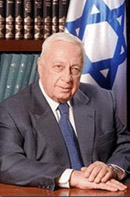 WorldNetDaily - A Knesset member today requested Israel's attorney general probe claims made in a newly released book that Prime Minister Ariel
Sharon introduced his plan to evacuate Jewish communities from Gaza and parts
of the West Bank to divert public attention from criminal investigations that
threatened his premiership last year, WND has learned. "I have sent a
formal request letter to Israel's attorney general [Meni Mazuz] asking him to
investigate the prime minister because of the revelations in the book that
prove Sharon is corrupt. We know exactly who are the people involved in the
scandal, what they did, so there needs to be an immediate investigation,"
National Union leader Uri Ariel told WND.
WorldNetDaily - A Knesset member today requested Israel's attorney general probe claims made in a newly released book that Prime Minister Ariel
Sharon introduced his plan to evacuate Jewish communities from Gaza and parts
of the West Bank to divert public attention from criminal investigations that
threatened his premiership last year, WND has learned. "I have sent a
formal request letter to Israel's attorney general [Meni Mazuz] asking him to
investigate the prime minister because of the revelations in the book that
prove Sharon is corrupt. We know exactly who are the people involved in the
scandal, what they did, so there needs to be an immediate investigation,"
National Union leader Uri Ariel told WND.
Ariel was referring to a book released last week by two veteran Israeli journalists charging the Gaza withdrawal plan was created to avoid Sharon's indictment in the Greek Island scandal, an investigation into the transfer to Sharon's family of $580,000 by developer David Appel, who was accused of soliciting Sharon's help with business deals. If Sharon had been charged in the affair, he would have been forced to resign his post as prime minister. The book's authors, Raviv Drucker of Israel's Channel Ten TV and Ofer Shelach of the Yediot Acharonot daily, claim Sharon was convinced then-State Prosecutor Edna Arbel would indict him in the scandal, and had to create a situation that would make an indictment politically difficult. They also say the specifics of the disengagement plan were hatched without the input of defense officials, Knesset members or Sharon's own Cabinet, and further charge Sharon asked a top general in the Israeli Defense Forces to be a "plant" and report to him on the goings-on in the general staff.
Drucker and Shelach say they based their findings on first-person accounts from individuals "very close to the prime minister." In an interview with Israel's Channel Two last week, the two journalists said Sharon's fear of indictment drove him to introduce the withdrawal plan. "The people who are closest to Sharon told us absolutely that if it wasn't for those police interrogations, this decision [to quit Gaza] would not have been made. This can be seen by the timetable of events," said Shelach in response to a question.
He outlined the charges of the Arbel investigation, a summons to Sharon for police interrogation regarding Appel's money transfer, the reports Arbel was about to indict Sharon, the appointment of Mazuz as attorney general, and a meeting of what they called the Farm Forum – Sharon, his sons and one or two others very close to the Prime Minister – at which they claim the Gaza withdrawal was originally hatched.
The Farm Forum "did not state it outright," Drucker said, "but it was in the air that something had to be done, that there had to be some major diplomatic process that would swallow up everything and would change the public agenda [away from the corruption headlines against Sharon] – and they came up with this plan."
Drucker, outlining the book, said top Sharon-aide Dov Weisglass laid the foundations for the disengagement plan in a private meeting with then-White House National Security Advisor Condoleeza Rice in December 2003. "In December '03, after Sharon's Herzliya speech introducing the disengagement concept but when this plan was still very vague – in fact, Sharon was still asking the defense minister and the chief of staff what they thought about taking down just one or two communities – Weisglass goes to Washington all by himself – without his Military Secretary Moshe Kaplinsky or National Security Advisor Giora Eiland, who usually accompany him – and speaks to then-U.S. National Security Advisor Condoleeza Rice privately. "Very senior army officials told us that this was the trip in which Weisglass made the following offer: in the first stage, we would quit Gaza, in the second stage there would be a deep withdrawal from Judea and Samaria, and in the third stage we'd even be willing to talk about the '67 lines."
Drucker and Shelach charged those in the army and government who could have helped formulate the plan were left out of the decision-making process. "[National Security Advisor] Giora Eiland was in the midst of preparing a plan as to how Israel could get some benefit from its withdrawal," they said, "when suddenly he was presented with this new [unilateral] plan – and even now he objects to the plan [as it now stands]." Continued Drucker: "Sharon wanted only to survive politically. Weisglass led the whole plan. In October 2003, before the plan had started, Weisglass asked staffers in the Prime Minister's Bureau for data on Gaza because he said he felt we had to withdraw from Gaza. Sharon did not yet agree then – but he would come around later. At that time, Weisglass also started spreading hints to other people that if Sharon didn't agree to this plan, he would end up leaving the political arena as an 'insignificant old man.' Weisglass also started pressuring [Defense Minister Shaul] Mofaz at this time. But more than anything – Weisglass felt that he had the right key to persuade Sharon. ... "The important thing to note is that from that moment, there is no contact with those elements who were supposed to help Sharon decide about the plan, figure out what Israel would get in return, and help Israel get the best deal it could. And from that moment, the plan essentially rolls along on its own."
The two journalists go on to claim Sharon asked a top IDF general to be a mole in the army's General Staff Office, but refused to name the official. "The general himself told us that Sharon asked him to agree to report back to him on the goings-on in the General Staff. ... All along, Sharon was unhappy with the army, and always tried to form direct channels of communication [in this way]," they said. They said many top defense officials, including Mofaz, Intelligence Chief Ze'evi-Farkash, and others, originally opposed the evacuation plan. "Several months before Sharon's adoption of the Disengagement Plan, there was a deliberation amidst the top brass of the IDF in the presence of the chief of staff. Many options were presented. One of the options was unilateral disengagement from Gaza. There was unanimous agreement regarding the idea: absolutely no. Mofaz said at the beginning, 'Whoever supports a unilateral retreat, apparently wasn't here for the last two and a half years,' and Farkash said it would be a catastrophe, and the head of IDF Research said it would be the worst thing ... but after several months, when they saw that Sharon was so strongly in favor, they amazingly all fell in line and backed it."
In June 2004, after the withdrawal plan had gained considerable momentum, Attorney General Mazuz announced there was "insufficient evidence" to prosecute Sharon. Both Sharon's and Mazuz's offices could not be reached for comment before press time. It is not immediately clear whether Mazuz will open an investigation into the charges outlined in the book. Ariel told WND, "[If Mazuz does not open an investigation] I will bring the case to the high court."
Sharon's Gaza evacuation plan has drawn criticism from many in his government, with several ministers of his own Likud Party, including Finance Minister Benjamin Netanyahu and Foreign Minister Silvan Shalom, opposing the plan. Critics worry the withdrawal will be seen as a reward for Palestinian terrorism and argue territories evacuated by Israel will be used by Hamas to stage attacks against the Jewish state. Netanyahu, in a WND interview earlier this month, said, "Palestinian terrorists don't view our departure [from Gaza] as a reasonable move but as a flight from terror and a sign that terrorism works. If you flee from terror, then terror continues to chase you. This plan simply emboldens the terrorists to continue their tactics until the completion of their ultimate goal: the destruction of Israel."
Update June 20: Reached this morning for comment, Raanan Gissin, senior adviser to Sharon, told WND: "This book is all a big lie. You'll look at the dates involved and the events and you'll see it's all a big lie. We're not worried."
Bank Leumi Forgave 600,000 NIS of Sharon´s Debts - July 3, 2005
 Lekerev Report - The
Marker, a Hebrew-language website reporting on business news in Israel, reports today that the erasure of the debt took place in 1996, when Sharon was appointed
Minister of National Infrastructures - a newly-created post - in the government
of Binyamin Netanyahu.
Lekerev Report - The
Marker, a Hebrew-language website reporting on business news in Israel, reports today that the erasure of the debt took place in 1996, when Sharon was appointed
Minister of National Infrastructures - a newly-created post - in the government
of Binyamin Netanyahu.
The Sharon-family farm owed some three million
shekels at the time, and the bank erased a debt of about 20% of that sum -
amounts that had piled up in interest and bank fees. Banking sources say that
banks often erase such debts for financial customers, but that the wiping out
of such a large proportion of the original debt is definitely uncommon.
The Shikmim Farm's 3-million shekel debt is the
basis of the Sharon-Cyril Kern scandal that the police are currently
investigating. Kern allegedly gave the Sharon family an illegal donation to pay
off the debt.
Just last week, Prime Minister Sharon decided to
overrule the decision by Finance Minister Binyamin Netanyahu to distribute Bank
Leumi shares to the public, free of charge. Instead, Sharon decided that
controlling interest in the bank will be sold. This latter plan was worked on
for several months, costing the public much money. Sharon was not the only one
who objected, however; Bank of Israel Governor Stanley Fisher was among those
who opposed Netanyahu's plan.
Bank Leumi's decision to erase the Sharons' debts departed from custom in that it was made without an official legal-financial
advisory.
Bank Leumi responded to the reports by saying it
does not issue public pronouncements on its customers' accounts. The Marker reported
that it had not received a response from the Prime Minister's Bureau by press
time.
First-Hand Testimony: "Sharon Beat Up Etzel Fighters" – June 28, 2005
"Sharon would go around with his shovel-handle against us,"
says Ben-Ami Zamir, who says Sharon struck him in his head - putting in a
different light  Sharon's warnings about
"civil war."
Sharon's warnings about
"civil war."
Just
two months ago, Prime Minister Ariel Sharon told NBC that Israel is on the brink of a civil-war disaster. "The tension here, the atmosphere here looks
like the eve of the civil war," he said. "All my life I was defending
the lives of Jews. Now, for the first time, security steps are taken to protect
me from Jews."
Revelations by a former Etzel [nationalist army
organization] member show that this is not quite true. Ben-Ami Zamir says that Sharon was involved in violence against nationalist Jews during pre-State days, and was
forced to run away to protect himself.
The NBC interview promoted the perception that
"Jewish settlers" are the main threat to stability in the Middle East. "Israelis are bracing for a violent summer," the narrator opened,
"but it's not the Palestinians they are worried about - it’s the Jewish
settlers."
Knesset Members from both left and right said
that Sharon's remarks about a "civil war" atmosphere and his need for
protection from Jews are incendiary and provocative.
Extreme left-wing MK Zahava Gal'on (Meretz/Yahad)
accused Sharon of "making cheap and provocative use of threats of civil
war." Former Justice Minister Tommy Lapid of the left-wing Shinui Party
said, "Remarks like these by the Prime Minister cause more extremism and
tension, instead of calming things down. I don't think that such dangers exist."
MK Tzvi Hendel (National Union), a resident of
Gush Katif and one of Sharon's most bitter opponents, said, "Sharon is a
liar. He knows that the only one who can lead to a civil war is he
himself."
Hendel's words received strong backing this week
- from a man who himself suffered from Sharon's ideological-based violence. It
occurred during the period known as the Saison of the mid-1940's, when
left-wing Haganah activists pursued and beat up nationalist Etzel and Lechi
activists, and others even turned them over to the hated ruling British forces.
Speaking with Arutz-7's Shimon Cohen, Ben-Ami
Zamir, who is today a member of the Likud Party Bureau, gave the following
harrowing account:
"I was given the mission of establishing an
Etzel cell in our moshavah [townlet] of Magdiel, and I did so. I gathered some
youths in our cafe, and I would often give shelter to Etzel men who needed to
hide from the British police. Everyone knew everyone, and it was known that I
was an Etzel man, as were all my neighbors; residents of the surrounding
moshavim were rival Haganah people."
One of these towns was Kfar Malal, home to young
Ariel "Arik" Sharon. "One Motzaei Shabbat [Saturday night], a
truck arrived at the cafe, and out of it jumped a group of uniformed Haganah
men, led by Ariel Sharon holding a hoe-handle. We knew him in the area as
someone who always holds a hoe-handle to catch Etzel and Lechi people. They
tried to break into the cafe, which was still closed because of the Sabbath. I
came close to him, and he said, 'Give me some soda,' and pointed to a box of
drinks on the ground. I bent down to the bottles, and then he picked up his arm
and smashed me with all his might with the hoe-handle. My head was covered in
blood, which dripped down all over me."
Zamir said that a fight ensued, and "for ten
minutes, they destroyed everything they could... The next morning, I went to
the Sharon home... His mother came out, saw me all bandaged up and immediately
realized what was going on. I asked where Arik was, and she said he wasn't
home. I said that if I would see him, I would get him. Later people in Kfar
Malal told me that he was afraid to go home. We didn't see him again in
Magdiel."
Zamir said that this was not the only violent
incident against Etzel people in which Sharon was involved. He noted
specifically the case of someone named Hayuma, who died six months ago, whose
arm was broken by Sharon's gang.
Zamir's story was publicized 15 years ago by
Yediot Acharonot reporter Shlomo Nakdimon. That article also quoted similar testimony
by Etzel member Daniel Basamnik. "Sharon threatened to sue [following
Nakdimon's article]," Zamir told Arutz-7's Cohen, "but for his own
reasons decided not to."
Not long ago, Zamir met Sharon at a Likud
gathering at the party's headquarters in Metzudat Ze'ev. "Sharon passed me," Zamir said, "and I told him that he would be remembered in
history as a traitor. I said that apparently only when a shell lands in his own
farm, will he understand what he's doing."
Cohen said that no response to his inquiries on
these accusations had been received from the Prime Minister's Bureau by press
time.
Just today, Mr. Sharon issued a call against
violence in response to threats received by Chief of Staff Lt.-Gen. Dan Halutz.
"Everything must be done to stop the violence of a small minority of the
settlers," he said today. Apparently unaware of the old/new accusations
against him, Sharon said that the Land of Israel faithful living in the Maoz
HaYam Hotel in Gush Katif are "vocal and dangerous," as well as
"law-breaking."
New Book: Disengagement Rooted in Sharon´s Fear of Prosecution – June 16, 2005
Two veteran journalists, based on talks with persons very close to the Prime Minister, say that the Disengagement Plan was hatched up simply to avoid Sharon's indictment in the Greek Island scandal.
 Israel National News -
Journalists Raviv Drucker of Channel Ten TV and Ofer Shelach of Yediot
Acharonot newspaper appeared on Nissim Mishal's Channel Two television program
last night, and summarized the results of their research. The main findings:
Israel National News -
Journalists Raviv Drucker of Channel Ten TV and Ofer Shelach of Yediot
Acharonot newspaper appeared on Nissim Mishal's Channel Two television program
last night, and summarized the results of their research. The main findings:
· The evacuation plan was born because Sharon was sure that then-State Prosecutor Edna Arbel would indict him.
· The decisions on the disengagement plan were made by marginalizing the army people, and without the participation of the ministers and the Cabinet.
· Sharon proposed to one of the army's top generals that he be a "plant" and report to him on the goings-on in the General Staff.
Click here to view
the 7-minute Channel Two TV segment - in Hebrew (or right click and select
"Save Target As…" to download)
Drucker and Shelach said that Sharon's fear of
State Prosecutor Arbel was a determining factor in making this plan. "If
not for the interrogations, this historic decision would not have been
made," they said. "This can be seen by the timetable of events in
February 2004" - the appointment of Gen. Eiland to begin working on the
plan, the appointment of Meni Mazuz as Attorney General, a summons to Sharon
for police interrogation, the rumors that Arbel was about to indict him, and
finally the meeting of the Farm Forum [Sharon, his sons and one or two others
very close to the Prime Minister]. This
Farm Forum "did not state it outright," Drucker said, "but it
was in the air that something had to be done, that there had to be some major
diplomatic process that would swallow up everything and would change the public
agenda [away from the corruption headlines against Sharon] - and they came up
with this plan."
Drucker and Shelach further found that top
Sharon-aide Dov Weisglass (pictured) led the way in preparing the disengagement
plan, particularly in a private meeting with Condoleeza Rice in December 2003,
and that those in the army and government who could have helped improve the
plan for Israel were left out of the decision-making loop. "[National
Security Advisor] Giora Eiland was in the midst of preparing a plan as to how
Israel could get some benefit from its withdrawal," they said, "when
suddenly he was presented with this new [unilateral] plan - and even now he
objects to the plan [as it now stands]."
Narrator Nissim Mishal noted that the image of
Prime Minister Sharon as depicted in the new book, entitled Boomerang, does not
jibe with the common perception of him as strong and determined.
"Instead," he said, "your book portrays him as one who is scared
of police interrogations and led along by the Farm Forum and [top Sharon-aide]
Duby Weisglass." Raviv Drucker
responded, "We too were surprised by what we found. One government
minister told us, 'This is the weakest Prime Minister I have seen, and I have
seen many Prime Ministers.' The point is that Sharon is very strong at
enforcing his decisions, but is weak at making decisions; he has no spine of
his own today, and the best example of this is Duby Weisglass and the
disengagement plan... "Sharon wanted only to survive politically.
Weisglass led the whole plan. In October 2003, before the plan had started,
Weisglass asked staffers in the Prime Minister's Bureau for data on Gaza because he said he felt we had to withdraw from Gaza. Sharon did not yet agree then -
but he would come around later. At that time, Weisglass also started spreading
hints to other people that if Sharon didn't agree to this plan, he would end up
leaving the political arena as an 'insignificant old man.' Weisglass also
started pressuring [Defense Minister Sha'ul] Mofaz at this time. But more than
anything - Weisglass felt that he had the right key to persuade Sharon."
Drucker's colleague Ofer Shelach continued:
"When Sharon arrived in office, he didn't know what to do; he was great in
tactics, but had no strategy - not on the personal level, and not on the
diplomatic-international level. He just doesn’t know what to do. Don't forget:
after two years in office, he finds himself - the great terror-fighter Arik
Sharon - with the highest amount of terror victims ever. And Weisglass -
together with the Farm Forum, but mainly Weisglass - takes advantage of this to
lead Sharon [by the nose]... "In December '03, after Sharon's Herzliya
speech introducing the disengagement concept but when this plan was still very
vague - in fact, Sharon was still asking the Defense Minister and the Chief of
Staff what they thought about taking down just one or two communities -
Weisglass goes to Washington all by himself - without his Military Secretary
Moshe Kaplinsky or National Security Advisor Giora Eiland, who usually
accompany him - and speaks to then-U.S. National Security Advisor Condoleeza
Rice privately. Very senior army officials told us that this was the trip in
which Weisglass made the following offer: In the first stage, we would quit Gaza, in the second stage there would be a deep withdrawal from Judea and Samaria, and in the third stage we'd even be willing to talk about the '67 lines. "The
important thing to note is that from that moment, there is no contact with
those elements who were supposed to help Sharon decide about the plan, figure
out what Israel would get in return, and help Israel get the best deal it
could. And from that moment, the plan essentially rolls along on its own."
In answer to a question, Shelach said, "The
people who are closest to Sharon told us absolutely that if it wasn't for those
police interrogations, this decision [to quit Gaza] would not have been made.
This can be seen by the timetable of events..."Shelach and Drucker
revealed that Sharon sought out a top IDF general to be a mole in the IDF
General Staff. The authors refused to divulge the name of the general whom Sharon asked to be his "plant." They said, "The general himself told us that
Sharon asked him to agree to report back to him on the goings-on in the
General Staff... All along, Sharon was unhappy with the army, and always tried
to form direct channels of communication [in this way]..."
They said that many top officers, such as former
Chief of Staff Mofaz, Intelligence Chief Ze'evi-Farkash, and others, were
originally very much against the disengagement plan. "Several months
before Sharon's adoption of the Disengagement Plan, there was a deliberation
amidst the top brass of the IDF in the presence of the Chief of Staff. Many
options were presented. One of the options was unilateral disengagement from Gaza. There was unanimous agreement regarding the idea: absolutely no. Mofaz said at the
beginning, 'Whoever supports a unilateral retreat, apparently wasn't here for
the last two and a half years,' and Farkash said it would be a catastrophe, and
the head of IDF Research said it would be the worst thing... but after several
months, when they saw that Sharon was so strongly in favor, they amazingly all
fell in line and backed it...""We have a very biting claim,"
Drucker concluded. "In the past four and a half years, there were many
opportunities to end or change the course of the intifada, but because of the
way decisions were made, these chances were missed, and the bottom line - it's
terrible to say - is that there were many people who were killed [by terrorists
during the Oslo War] in vain."
Shteinitz: Gov´t is Misleading Us Regarding Egypt - June 23, 2005
The Chairman of the Knesset's Foreign Affairs and Defense Committee, Likud MK Shteinitz, says the gov't is "misleading the nation" regarding its plans to allow Egyptian soldiers to deploy in Sinai.
Shteinitz
has long led what is practically a one-man crusade against the plans to allow
Egyptian forces to patrol along and near the Philadelphi Route between Gaza  and
Egypt. He has long warned that the agreement is "bad and dangerous"
and that it "will harm Israeli security and destabilize the peace between Egypt and Israel."
and
Egypt. He has long warned that the agreement is "bad and dangerous"
and that it "will harm Israeli security and destabilize the peace between Egypt and Israel."
It has long been reported that Israel and Egypt have agreed on the placement of 750 Egyptian soldiers along the 14-kilometer Philadelphi Route. Their job will be mainly to ensure that no weapons are smuggled from Egypt into Gaza. Over the past months, thousands of rifles and even some rocket launchers have been
smuggled into Judea and Samaria via that route - leading many IDF sources to
believe that the terrorists are preparing a post-disengagement war.
However, the deployment of Egyptian forces in the
Sinai is a violation of the peace treaty signed between Israel and Egypt in 1979. The legal counsel of the Knesset Foreign Affairs and Defense Committee,
Miri Frankel-Shorr, has prepared a legal opinion stating that because the
treaty was ratified by the Knesset, any violation of it must similarly receive
Knesset approval.
Defense Minister Sha'ul Mofaz and Associate Prime
Minister Shimon Peres have offered a "compromise" proposal to Egypt, which was reportedly accepted. No details have been forthcoming on its nature,
though Prime Minister Ariel Sharon reported on it to the Foreign Affairs and
Defense Committee this week.
Sharon
said that the treaty is not being abrogated: "The Sinai will continue to
be demilitarized. All we're doing is switching 750 soldiers who are doing
nothing with soldiers who can do the job."
"The legal opinion submitted to the
committee," Shteinit says, "states that even if one Egyptian soldier
is allowed into the Sinai, this is a material change in the peace agreement and
must be ratified by the Knesset."
Almost a full year ago, U.S. Congressman Tom
Lantos of California, the ranking Democrat in the House International Relations
Committee, warned that Egypt was building up its military in preparation for a
future war with Israel. He proposed legislation last year to convert half of
the $1.3 billion Egypt receives annually in U.S. military aid to economic aid -
but the bill was turned down in the House of Representatives. He even announced
plans to phase out military aid to Egypt altogether.
"Egyptian military exercises are ominously
geared toward an Israeli enemy that doesn't obviously exist," he said at
the time. He added that Egypt's threatening behavior is "a policy choice
of the Mubarak regime. Lantos also pointed out that Egypt supplemented its navy
last year with 11 new battle units, in addition to other weapons procurements.
Israeli military sources have reported that
Egyptian war games consistently feature the IDF as the enemy force.
Author Stands By
Claim: Withdrawal Due to Sharon Corruption - June 21, 2005
The co-author of a book alleging that fear of indictment led Prime Minister Ariel Sharon to decide to carry out the Disengagement Plan says an unelected circle of people are running Israel.
Israel
National News - Ofer Shelach, together with fellow left-wing journalist and
commentator Raviv Drucker, has just published Boomerang, an insider's
narrative of the backroom goings- on that led to a prime
minister defying the platform upon which he was elected and his determined
pushing through of a political plan despite its overwhelming rejection by the
members of his own Likud party. Shelach (pronounced with a guttural
"kh") spoke with Israel
National Radio's Eli Stutz on Monday about why he wrote the book, how he
obtained the information for it, and why decided to publish it on the eve of
implementation of the Disengagement Plan. "Why now?" Shelach was
asked, with the implication being that the revelations on the reasoning for the
expulsion plan could have made a difference had they been publicized earlier.
"It is simple," he responded. "We have been working for three
years on a book that covers the whole of the Intifada - all the fighting that
has been going on for almost five years. The chapters on disengagement are only
three chapters out of 28 in the whole book. Of course, because disengagement is
very much in the news right now, those passages from the book [dealing with it]
were taken out and presented, but that was not the purpose or goal of the book.
We just completed it now."
on that led to a prime
minister defying the platform upon which he was elected and his determined
pushing through of a political plan despite its overwhelming rejection by the
members of his own Likud party. Shelach (pronounced with a guttural
"kh") spoke with Israel
National Radio's Eli Stutz on Monday about why he wrote the book, how he
obtained the information for it, and why decided to publish it on the eve of
implementation of the Disengagement Plan. "Why now?" Shelach was
asked, with the implication being that the revelations on the reasoning for the
expulsion plan could have made a difference had they been publicized earlier.
"It is simple," he responded. "We have been working for three
years on a book that covers the whole of the Intifada - all the fighting that
has been going on for almost five years. The chapters on disengagement are only
three chapters out of 28 in the whole book. Of course, because disengagement is
very much in the news right now, those passages from the book [dealing with it]
were taken out and presented, but that was not the purpose or goal of the book.
We just completed it now."
The authors did not intend for the book to be an
expose of the scandalous roots of the Disengagement Plan. Shelach says that the
book was intended to demonstrate to the Israeli people that the government had
several windows of opportunity in which it could have ended the Arab terror
offensive and failed to do so due to the flawed nature of the government.
"What we did in the book is this: We present about five or six possible
turning points since September 2000, the way the fighting was presented to the
Israeli people, the way various powers-that-were acted and the decisions they
took at several key points along the way." "For example," said
Shelach, "after 9/11, once the effect of 9/11 was fully understood by
Arafat, he told his people to stop the violence. The tide began to turn, but
then certain events happened, culminating in the targeted killing of a
terrorist leader in the West Bank that prevented the tide from turning. I want
to be clear about this. We are not blaming the Israelis for what happened. The
Palestinians are also to blame - maybe more to blame, but this book aimed to
examine the way the Israeli leadership works - the way the military works
vis-a-vis the political leadership and vice versa." "If you asked
Ariel Sharon in 2001, if four years later he would lead Israel to unilaterally
withdraw from the Gaza Strip, build a fence that precludes 94% of the West Bank
and watch almost helplessly as Hamas becomes the leading force in Palestinian
society - all the while calling this a victory - he would have looked at you
like you were crazy," Shelach said.
The veteran journalist says that the material on Sharon's involvement in the Greek Island scandal and its connection with his decision to
withdraw became available only recently. "In the last couple of months, a
lot of things started to come out of the woodwork," he said. "Maybe
it is because disengagement is just around the corner, maybe it is because
people are less busy now protecting their own skin and are realizing that there
is going to be historical judgement on this." What he found over the past
months of speaking to the people close to Sharon was repeated stories of the
tight-knit "Farm Forum" - consisting of the Sharon family and their
confidantes - making critical decision without any regard for government
procedure, and behind the backs of the military. "A lot of things are
starting to come out showing the whole confused, disorderly process culminating
in the disengagement plan," Shelach said. "For example, the whole
military was purposely cut off from the entire process of planning the
Disengagement Plan. It was led by Sharon and his close unelected circle. By
law, in Israel, the Commander in Chief of the army is not just the prime
minister, but rather the entire government. But [in fact] the government - and
some of the ministers quite willingly - was not a part of the disengagement
decision making process."
"What we are saying is that Sharon was at a dead end by the end of 2003. After the fall of Abu Mazen as Palestinian
prime minister [under Arafat], it was obvious that the whole idea of imposing
someone on Arafat was ridiculous - that it wouldn't work. You have to remember
who Ariel Sharon is. In his own mind, he is the person whose life's mission is
to protect Israelis and Jews in general and there he was, the prime minister in
whose term more Israelis lost their lives in terrorist actions than under any
other prime minister. There he was without a plan, and there he was with his
legal troubles. And then his close allies, led by Dov Weisglas, told him, 'You
have got to do something big or else you will go down in history as a failing
prime minister. You have to do something big to give hope to the public.'"
"Nobody says this [outright], but we heard
from people very close in the inner circle that behind all this, of course,
was, 'If you don't do this you will also go down because of your legal
troubles.' We don't have a smoking gun on this. There is no smoking gun or
paper in which Sharon or somebody wrote down, 'You have to do this or you are
going to be indicted' - but it is part of a whole story. We are talking about
people getting together and saying things like 'This week a new attorney
general is coming into office, we have got to do something big.' "Shelach
says he hopes people will read what he has written and judge for themselves
whether it affects the way they view the Disengagement Plan. "We are
showing people how these things came about," he said. "It is up to
people to judge whether this was right or wrong."
Sharon on Record: Sinai Precedent Was a Mistake - June 28, 2005
Prime Minister Sharon is on record as saying that the evacuation of the Jewish towns in Sinai was a mistake in that they led to talk of evacuation of other towns in Judea, Samaria, Gaza and Golan.
 Israel National News - Eleven
years ago, on the 12th anniversary of Israel's pullout from the Sinai and the
expulsion of the Jewish residents there, Arutz-7 interviewed Ariel Sharon - the
man who is most closely associated with that evacuation. He said that in light
of the developments since then - which included at the time only the
"consideration" of dismantling Jewish communities in Judea, Samaria and Gaza - "it was a grave mistake to dismantle the Jewish communities in
Sinai." The then-Knesset Member also
explained why a withdrawal from Gaza, Samaria or Judea would be totally
unacceptable.
Israel National News - Eleven
years ago, on the 12th anniversary of Israel's pullout from the Sinai and the
expulsion of the Jewish residents there, Arutz-7 interviewed Ariel Sharon - the
man who is most closely associated with that evacuation. He said that in light
of the developments since then - which included at the time only the
"consideration" of dismantling Jewish communities in Judea, Samaria and Gaza - "it was a grave mistake to dismantle the Jewish communities in
Sinai." The then-Knesset Member also
explained why a withdrawal from Gaza, Samaria or Judea would be totally
unacceptable.
Excerpts from the interview with Ariel Sharon in
1994: Arutz-7: "MK Sharon, some of
the public remembers you - possibly to your consternation - as the man who
evacuated Yamit [the lone city among the Jewish communities in Sinai]. Can you
take us back to this day 12 years ago? Where were you, what did you do?"
Sharon:
"First of all, I would like to note that it was very hard to leave Sinai,
an area in which we fought during the Six Day War, the War of Attrition and the
Yom Kippur War, and an area whose landscapes we came to know and love, and of
course an area that gave Israel great strategic depth. It was especially
painful to evacuate the communities and their residents. This was very painful.
We made great efforts with the Egyptians to retain these areas, but it was
impossible to do this and at the same time to make peace with them; we tried
many other avenues, including an exchange of territory, but these did not
succeed. On the one hand it was very sad, but it also aroused not a small
amount of jealousy to see how the Egyptians related to their land as a sacred
value..."
A-7: "Your formulation at the time was,
'Peace in exchange for territory" - something we are hearing now as well
[in the framework of the then-six-month-old Oslo agreement, to which Sharon and
the Likud strongly objected - ed. note]."
Sharon:
"I think it is very hard to compare that which occurred in Sinai, or what
we could have done then, with what we face now. Sinai was a land far from our
population centers, and we were able to reach an agreement that an area 200
kilometers wide would remain demilitarized forever. In addition, we signed an
agreement with a sovereign country that controls its territory - and not with a
terrorist organization that cannot and does not want to control terror
organizations, nor even its own internal factions that continue to employ
terrorism... In addition, Egypt had no other territorial demands [other than
what we gave them], and this is different than the present situation."
It is noteworthy that each of the four points
Sharon made in comparing the Sinai agreement with the Oslo Accords work to the
detriment of the Disengagement/Expulsion plan he is now pushing forward with
full force:
* Gaza is very close to Israeli population
centers.
* No agreement on demilitarization has been
reached.
* No agreement has been signed with a sovereign
country; in fact, no agreement is to be signed at all!
* The entity that is to take control of the area
still has major territorial demands upon Israel.
Sharon
repeated, in the 1994 interview, his firm stance that Israel must not withdraw from the Golan, Judea, Samaria or Gaza, adding, "Every leaving of a
Jewish community is a most difficult thing." He then said, "I would also like to note now and emphasize
again, in light of the government's attempt to use the precedent of Sinai as a
precedent for what it wants to do now in Judea and Samaria regarding the
dismantling of Jewish communities - [this] shows that it was a grave mistake to
make this decision [in Sinai] about the dismantling of Jewish communities,
because we see what this leads to... In my opinion, in light of what has
developed, it was very hard there [in the negotiations in 1982 with Egypt], but no one ever thought that an Israeli government would arise that would use the precedent
of Sinai, in totally different circumstances, to justify the dismantling of
Jewish communities in the Golan or Judea/Samaria or Gaza. In light of this, I
must say that we made a mistake in this area [Sharon emphasized this
clearly - ed.], if this is what it has led to. Of course, if there would have
been a different government today, it would not have made similar decisions."
Likud Leader: Sharon Wants to Take Over Jewish Nation's Assets - June 20, 2005
Sam Schachter, former Deputy Chairman of the World Likud Organization, says that if Boomerang's allegations are true, "Ariel Sharon should be tried for misleading and endangering the nation."
 Israel National News -
Speaking with Arutz-7's Elkanah Perl, Schachter emphasized both the corruption
and high-handed methods of Sharon and his close cronies, and the dearth of
accurate information available to Israel-supporters in the U.S. "The voice
of those who oppose the disengagement plan is not heard the way it should be
amongst U.S. Jewry," Schachter said. "There is a feeling here as if Sharon is the great savior of Israel, because he's a great general who knows exactly what
he's doing... I myself received the information about Boomerang just
from friends in Israel, but nothing was mentioned in any newspaper. Only those
who follow Arutz-7 know [this], but aside from that, there's nothing - and
that's the problem. It's important that this news is publicized in the U.S. in
order to strengthen those who are fighting for the Land of Israel and to have
people get to know the facts."
Israel National News -
Speaking with Arutz-7's Elkanah Perl, Schachter emphasized both the corruption
and high-handed methods of Sharon and his close cronies, and the dearth of
accurate information available to Israel-supporters in the U.S. "The voice
of those who oppose the disengagement plan is not heard the way it should be
amongst U.S. Jewry," Schachter said. "There is a feeling here as if Sharon is the great savior of Israel, because he's a great general who knows exactly what
he's doing... I myself received the information about Boomerang just
from friends in Israel, but nothing was mentioned in any newspaper. Only those
who follow Arutz-7 know [this], but aside from that, there's nothing - and
that's the problem. It's important that this news is publicized in the U.S. in
order to strengthen those who are fighting for the Land of Israel and to have
people get to know the facts."
To this end, it should be noted that Aviv
Mizrachi, a strong expulsion opponent currently living in Los Angeles, reported
that 50,000 copies of an anti-disengagement CD were recently handed out in New York and Los Angeles. He, too, agreed that the next step was to turn these many individual
voices of opposition to the retreat into a concerted public voice that will be
heard in the U.S. media and in Washington, D.C. Schachter said that he raised
concerns of Sharon's corruption several months ago in a letter to the members
of the Likud Central Committee. He said that he himself was deposed from his
leading World Likud organization position "when [Sharon's son MK] Omri
came to power and amassed power... Omri led the Central Committee members
astray, and in the meanwhile has succeeded in appointing those close to
him...""You have to look at the whole picture, and then you can
understand what's going on," Schachter said. "Just like we see Sharon is objecting to Sharansky [as the Likud's candidate for Jewish Agency Chairman.
Sharansky in fact received the nomination - ed.], and he is also trying to take
over the Lands Authority - trying to take over all of the Jewish People's
assets. People don't understand what's going on. Sharon and his son are against
Sharansky because they know he is an honest man who won't allow them to
continue running things corruptly..."
Schachter demands that a public commission of
inquiry be established "to check whether the authors of Boomerang
were accurate - and if so, Sharon should be put on trial for misleading and
endangering the nation, and the country should shake him off. Every normal
nation would do this, if the corruption allegations are correct. We saw in Ukraine how the nation protested massively and silently until the government resigned...
"It's inconceivable that the nation should be endangered merely in order
to purify his corruption. The media are sabotaging the transmission of the
message to the world, and therefore the people must bring this message. It's
important that the disquiet in Israel be announced to the world."
Schachter also decried the relative lack of
freedom to express one's anti-disengagement opinions in Israel. "In the U.S. you can certainly express your opinion as long as you don't hurt someone
else, but in Israel if you express your opinion, you could be
fired, and there's a chance you'll be put under administrative
detention." Schachter said that
American Jews underestimate Israel's need for strategic depth: "They think
that Israel is strong and can defend itself, and therefore they don't realize
that Israel needs land in order to protect itself. You need a buffer zone, and
not war inside the citizens' homes."
In August of 2004, Schachter told Arutz-7,
"The Likud members must wake up, otherwise
the Likud will be liquidated by Sharon and his group of supporters, who are not
even members of the Nationalist Movement. Mr. Olmert, for instance, who might
very well be a Shinui Party leader in the next election. He [as Mayor of
Jerusalem] abandoned Jerusalem; he did nothing about our hundreds of complaints
of illegal Arab construction in the city... "Why is the Prime Minister
turning the Likud into the [left-wing] Mapai? The Likud people must wake up
before the Prime Minister breaks the nation's spirit. Statements by Sharon and
by [Shabak head Avi] Dichter that the right-wing is extremist and dangerous
break the nation's spirit - it reminds me very much of the Saison period [in
the 1940's] when I [as a member of the Etzel] was persecuted by the Mapai
leadership... "Sharon sent the settlers to the hilltops; why is he now
persecuting them?... It is not due to American pressure... "I think that
everyone who is concerned for the Jewish Nation's existence in the Land of Israel who does not wake up now, is abandoning his children and future
generations."
Sharon Humiliated at the Knesset; New Elections? – June 15, 2005
 Lekerev Report - Knesset
Speaker Reuven Rivlin (Likud) said yesterday that the government must call for
early elections, following an embarrassing loss in not one, but three,
no-confidence votes Tuesday. It is the first time the current government has
lost three straight no- confidence votes; however, the majority necessary to
topple government was not achieved. "As of today, (Prime Minister Ariel) Sharon has support on only one issue - disengagement," said Rivlin. "Any normal
parliament would now be asking not whether to dissolve parliament (and call
early elections), but when to do it." Rivlin said Sharon has lost his
political base, and that the government has lost the ability to win support for
its policies, creating a situation in which there is "no choice" but
to move up general elections, currently slated for late 2006.
Lekerev Report - Knesset
Speaker Reuven Rivlin (Likud) said yesterday that the government must call for
early elections, following an embarrassing loss in not one, but three,
no-confidence votes Tuesday. It is the first time the current government has
lost three straight no- confidence votes; however, the majority necessary to
topple government was not achieved. "As of today, (Prime Minister Ariel) Sharon has support on only one issue - disengagement," said Rivlin. "Any normal
parliament would now be asking not whether to dissolve parliament (and call
early elections), but when to do it." Rivlin said Sharon has lost his
political base, and that the government has lost the ability to win support for
its policies, creating a situation in which there is "no choice" but
to move up general elections, currently slated for late 2006.
Adding to Sharon's troubles, opposition leader Yosef Lapid (Shinui) told the prime minister Tuesday's vote was a sign of Sharon's "eroding power", at a time when the government must display a strong hand. "It will be hard (for Sharon) to carry out the (disengagement) program if there is a general feeling that the Knesset isn't behind him. Sharon admits he knows this and says he knows a solution must be found," said Lapid. "The prime minister must talk about his post-disengagement plans."
"It will be hard (for Sharon) to carry out the (disengagement) program if there is a general feeling that the Knesset isn't behind him. Sharon admits he knows this and says he knows a solution must be found," said Lapid.
After sitting through four hours of speeches by Knesset members vilifying his government, Sharon gave the last speech which was promptly rejected by the Knesset in a vote of 43 - 30. Sharon's days appear to be numbered.
Meanwhile, it is being reported here that American and British analysts agree that the government of Prime Minister Ariel Sharon will not survive the implementation phase of the Gaza/Shomron Disengagement plan. Aides to US President George W. Bush and British Prime Minister Tony Blair feel that national elections will be forced within 12 months following the expulsion, if not sooner. They have come to the realization Sharon only succeeds in remaining in office presently by the grace of disengagement proponents.
On all counts, it certainly appears that Prime Minister Sharon's days are numbered.
Rivlin calls to disband government – June 14, 2005
Jerusalem Post - After a series humiliating if symbolic defeats for the government on Tuesday, when the opposition managed to pass three no-confidence measures, Knesset Speaker Reuven Rivlin called to disband parliament and hold early elections to replace the government. The prime minister has lost his political base, Rivlin told Israel Radio, and any other parliament would immediately rule to hold early elections. "The opposition is a coalition, and the coalition is an opposition, and this government won't be able to pass anything other than the disengagment," Rivlin said.
Prime Minister Ariel Sharon, summoned to the Knesset Tuesday for a discussion on recent corruption episodes, said the current public anti-corruption campaign was aimed solely at "smearing the Likud" as the source of all ills. But the Knesset rejected his position in a 43-30 vote. Only six Labor MKs backed Sharon, with the rest skipping the vote. Before the vote on Sharon's speech, the opposition won a symbolic victory in three no-confidence motions. A regular majority was mustered in all three votes, with the heaviest defeat, of 37-34, in a Shas motion on rising violence. Since 61 MKs must support a no-confidence motion for it to topple the government, the motions all failed.
However, the small number of Sharon supporters signaled the reality of his shattered parliamentary power base on all issues other than disengagement. Shas leader Eli Yishai said that if the government could not even muster a regular majority it had "no right to exist." Sharon said he was confident that the campaign against political corruption, which he said was initiated by Ma'ariv to "smear the Likud," would fail. He said there was a false campaign being waged that presented the Likud central committee as the source of all evils in the nation and that it was aimed at "undermining the democratic decision" of the people.
Sharon said the country was ruled by law, and that the law enforcement authorities had been instructed to fight against all corruption. "The Likud party is bound by the same laws as other parties," he said. Yahad's Zehava Gal-On, who initiated the discussion, said political corruption was "running wild" and without hindrance, as the disengagement plan moved forward. According to Gal-On, examples of corruption included political appointments and kickbacks, government financing and support for illegal settlements, and putting lawmakers above the law.
In an attack on the Labor Party, Michael Eitan (Likud) criticized former prime minister Ehud Barak for "daring to become a candidate" for the Labor leadership when his previous campaign staff had "invoked the right to silence" in a previous investigation into alleged illegal party funding. Leader Yosef Lapid demanded that Sharon reveal his post-disengagement plans. "Where is this train heading?" he asked. Sharon reprimanded MKs for engaging in "slander" during the debate and expressed hope that the next Knesset debate would be cleaner. Only a few of the Likud MKs who oppose disengagement supported Sharon in the vote on corruption.
Rivlin Sees Gov´t Collapse Ahead – June 14, 2005
Knesset Speaker Rivlin, a long-time friend and oft-time political ally of Ariel Sharon, predicts that the government's days are numbered. MK Benny Elon says Rivlin knows what he's talking about.
 Israel National News - "Sharon has support on only one subject," Rivlin told NRG-Maariv last night, "and
that is the disengagement. In any normal Knesset, we wouldn't be asking whether
the Knesset would be dissolved - but rather when it will happen." "The only alternative is to hold early
elections," Rivlin said. "The government is unable to pass anything.
Anyone who doesn't get what he wants, even if he is a member of the coalition,
goes and votes against the government." Sharon himself agrees that the situation is
problematic. After yesterday's Knesset session, the Prime Minister met with
opposition leader Tommy Lapid to discuss yesterday's results. Sharon and his
government lost in four consecutive votes yesterday - three no-confidence
motions and one on Sharon's speech on government corruption.
Israel National News - "Sharon has support on only one subject," Rivlin told NRG-Maariv last night, "and
that is the disengagement. In any normal Knesset, we wouldn't be asking whether
the Knesset would be dissolved - but rather when it will happen." "The only alternative is to hold early
elections," Rivlin said. "The government is unable to pass anything.
Anyone who doesn't get what he wants, even if he is a member of the coalition,
goes and votes against the government." Sharon himself agrees that the situation is
problematic. After yesterday's Knesset session, the Prime Minister met with
opposition leader Tommy Lapid to discuss yesterday's results. Sharon and his
government lost in four consecutive votes yesterday - three no-confidence
motions and one on Sharon's speech on government corruption.
Lapid, who is widely assumed to be overly anxious
to return to the coalition, told Sharon that yesterday's votes are a "sign
that the regime is losing its grip, precisely when a strong regime is
needed." Rivlin's remarks were
encouraging to opponents of the expulsion plan, but it is still not clear how
exactly the government could fall. Only 17 Knesset days remain before the
summer recess, and no-confidence motions are not brought during Knesset breaks.
MK Benny Elon (National Union) told Arutz-7, "Rivlin's parliamentary
experience, plus his wisdom and his personal knowledge of the people involved,
especially Sharon, give great weight to his remarks. Sharon knows with
certainty that immediately after the uprooting from Gaza and northern Shomron,
MKs on both the left and right are planning to topple him. It could be that we
can't stop the bull from running into the wall - but the bull himself might
understand that if he continues his plan, he will [be toppled and then] remain
only with a record of uprooting and destruction that will erase the
accomplishment of his past. Under such circumstances, early elections before
the uprooting are a very reasonable scenario - for his sake as well."
Opposition leader Lapid and his Shinui Party were
dead-set against a unilateral withdrawal from Gaza during the last election
campaign, but since then have changed their tune. Lapid has now gone even
further, saying that Sharon must not rest on his disengagement
"laurels," but must rather delineate his next move - i.e., his next
withdrawal. "And don't tell us that the Palestinians will have to do this
or that," Lapid yelled out yesterday in the Knesset. "The question is
what this government plans to do." Lapid
also asked this question of Sharon during their meeting last night, and
reported afterwards that Sharon said that the next move must be for the PA to
disarm all terrorists. Labor Party leader
Shimon Peres said that Rivlin's remarks on early elections are rooted only in
his desire to prevent the withdrawal from Gaza.
Natan Sharansky elected Jewish Agency Chairman - June 23, 2005
Debkafiles - The ex-minister’s election Wednesday, June 22, by the Zionist Executive, gave the anti-Sharon opposition a victory. The prime minister was forced to withdraw his challenger Zeev Bielsky after a district judge ruled that Sharansky was the only legitimate Likud candidate. The new chairman quit the government earlier this year in protest against the coming Gaza-N. West Bank withdrawals.
Poll: 73% want Sharansky to head Jewish Agency – June 18, 2005
Jerusalem Post - Seventy-three percent of the public supports Natan Sharansky in the Jewish Agency chairmanship race, a poll ordered by the World Likud has found. Army Radio reported that Ra'anana Mayor Ze'ev Bielski, who is backed by Prime Minister Ariel Sharon, was supported by only 28% of the respondents.
The new JA chairman will be chosen on Monday.
Globalist Israel and Globalist America
‘The Oslo Syndrome’ – June 1, 2005
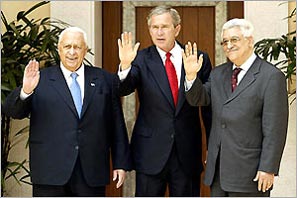 Jewish World Review - Last week, the President of the United States effusively praised Mahmoud Abbas, Yasser Arafat's right-hand man for some forty years.
In the White House Rose Garden, Mr. Bush described Abbas as a "man of
courage," explaining that he takes "great faith in not only [Abbas']
personal character, but the fact that he campaigned on a platform of peace — he
said, 'Vote for me, I am for peace.' And the Palestinians voted overwhelmingly
to support him."
Jewish World Review - Last week, the President of the United States effusively praised Mahmoud Abbas, Yasser Arafat's right-hand man for some forty years.
In the White House Rose Garden, Mr. Bush described Abbas as a "man of
courage," explaining that he takes "great faith in not only [Abbas']
personal character, but the fact that he campaigned on a platform of peace — he
said, 'Vote for me, I am for peace.' And the Palestinians voted overwhelmingly
to support him."
In light of what is actually happening in the proto-state Abbas (a.k.a. Abu
Mazen) was elected last January to govern, such characterizations seem at best
to be wishful thinking, at worst willful and dangerous self-delusion. As a new
web ad produced by my organization makes clear, if the Palestinian people truly
want peace, there is very little evidence that they are moving in that
direction under Abu Mazen. To the contary, terrorist organizations are not
being dismantled by Abbas. Instead, groups like Hamas with the avowed mission
of destroying Israel are ascendant. They are winning local elections and taking
full advantage of the "hudna" (temporary suspension of hostilities)
to rebuild their offensive capabilities against Israel.
Hamas and other terrorists are being integrated into Palestinian security
forces, receiving valuable training and even arms from American and European
personnel. In addition, burgeoning quantities of ever-more powerful weapons
are being smuggled into Gaza from Egypt. Meanwhile, Palestinians are being
encouraged by official imams whose sermons are broadcast on Abbas-controlled
media to kill Jews and destroy America. For example, less than two weeks
before Mr. Bush welcomed Abu Mazen to the White House, Sheik Ibrahim
Mudeiris claimed on Palestinian Authority TV that history showed the torture,
exile and murder of Jews to be legitimate and the Muslim conquest of the United States inevitable.
If the evidence is so clear that the Palestinian state Abu Mazen is a-building
will be but a new state-sponsor of terror, how could President Bush — who in
June 2002 rejected that prospect and has devoted his presidency to eliminating
such sponsors — possibly be turning a blind eye to the facts on the ground? How
could he be insisting that Israel make still further territorial and political
concessions, including over Jerusalem, let alone be handing over directly to
the Palestinian Authority $50 million in U.S. taxpayers' funds?
Call it "the Oslo Syndrome."
This is the title of an important new book by Dr. Kenneth Levin, a psychiatrist and historian who is a clinical instructor at Harvard Medical School. As the subtitle — "Delusions of a People Under Siege" — makes clear, Dr. Levin is concerned with a pathology that has prompted the Jews of Israel to embrace the false promise of peace ostensibly on offer first from Arafat, now from his former right-hand man. A similar malady appears to be afflicting official Washington, as well.
Dr. Levin describes the roots of this pathology as follows: "[It] lies
in psychological responses common among chronically besieged populations,
whether minorities subjected to defamation, discrimination and assault or small
nations under persistent attack by their neighbors. People living under such
stressful conditions often choose to accept at face value the indictments of
their accusers in the hope of thereby escaping their predicament."
"The Oslo Syndrome" chronicles the delusions of successive groups
within the Jewish world, with a particular focus on the most prominent and
contemporary of the phenomena — that of politicians and organizations
associated with "the Peace Movement." Dr. Levin explains:
"The Peace Movement's stance in fact was as divorced from reality as had been
German Jews' blaming of Polish Jews for anti-Semitism, or secular European
Jews' blaming of the religious, or socialist Jews' blaming of the Jewish
bourgeoisie. But proponents of the Movement, cowed by the persistence of the
siege and desperate to see its end, chose to delude themselves. They grasped at
any seemingly positive statement coming from an Arab political figure and
ignored all the countervailing evidence."
For example, the self-deluded chose to ignore unwelcome statements by Faisal
al-Husseini, an Arafat and Abbas crony who was for years the Palestine
Liberation Organization's proxy representative in Jerusalem. Al-Husseini
declared in 2001 that the Oslo "peace" accords of 1992 between Israel and Arafat were but a "Trojan Horse," designed to advance the Palestinians' abiding
goal of liberating their "country," whose boundaries would be
"from the [Jordan] river to the [Mediterranean] sea." In other words:
No Israel.
Al-Husseini's ambitions were of a piece with those long espoused by his relative,
Haj Amin al-Husseini, the notorious Grand Mufti of Jerusalem, whose complicity
with Adolf Hitler helped advance the Fuhrer's "Final Solution" for
the Jews and deny the latter refuge in their historic homeland. Incredibly,
even the Holocaust Museum in Washington — a magnificent institution designed
to serve as a conscience for all time — is in denial and contributing to the
Oslo Syndrome: It refuses to include in its permanent exhibition
anything about the Mufti's role in past Arab anti-Semitism, or to address
manifestations of this form of systemic racism so evident in the Muslim world
today.
Dr. Levin notes in an article published at www.JewishPress.com that, "The
ongoing Arab siege does cast a shadow over the lives of Israelis. At the same
time, they have created a free, vibrant, extraordinarily successful society. It
remains to be seen whether they are prepared to go on nurturing what they have
built as they await changes in the Arab world that will open it to genuine
peace, or they will instead, in their eagerness for 'normalcy' and an end to
the siege, once more delude themselves into pursuing fantasies of peace that
will threaten everything they have created." Or, he might have added,
whether the U.S. government will, in its own act of self-delusion,
encourage or compel Israel to do the latter?
Rice: Progress on details of Gaza Pullout - June 20, 2005
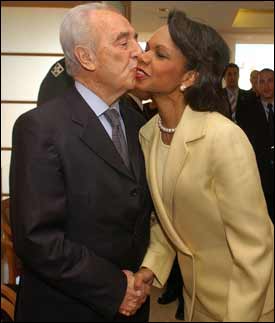 AMMAN, Jordan (Arizona Daily Sun) --
Israel and the Palestinians agreed on Sunday to demolish homes built by Jewish
settlers on land that eventually would be part of a Palestinian state, U.S.
Secretary of State Condoleezza Rice said.
AMMAN, Jordan (Arizona Daily Sun) --
Israel and the Palestinians agreed on Sunday to demolish homes built by Jewish
settlers on land that eventually would be part of a Palestinian state, U.S.
Secretary of State Condoleezza Rice said.
The fate of hundreds of Israeli houses in the Gaza Strip has been a sticking point ahead of the planned August pullout by Israeli settlers and troops after more than three decades.
U.S. Secretary of State Condoleezza Rice, right, is kissed by Israeli Vice Premier Shimon Peres during their meeting in Jerusalem Sunday June 19, 2005. Rice is on a two-day visit to Israel and the Palestinian territories. (AP Photo/Yossi Zamir, Pool)
Rice spent the past two days trying to convince Israeli Prime Minister Ariel Sharon, Palestinian President Mahmoud Abbas and leading members of their governments to work together, and do it quickly. "I saw committed parties on both sides that are doing the necessary planning," Rice said at a news conference in Jerusalem, where she met with Sharon on Sunday. "The people who are engaged in this planning are working harder than you could possibly imagine to try and make it work. That's all human beings can do," Rice said before stopping in Jordan as part of a Middle East tour intended to renew support for the peace process.
In the latest violation of a shaky 4-month-old cease-fire, Palestinian militants on Sunday ambushed Israeli soldiers doing construction work along the Gaza-Egypt border. One soldier died and an attacker was killed, the Israeli army said. U.S. and Israeli officials said Israel will raze about 1,200 Israeli homes in Gaza to make way for a fresh start with high-rise apartments or other more space-saving housing. The Israeli homes are larger, and much farther apart, than typical Palestinian homes. Demolition was the Palestinians' preference, said Israel's foreign affairs spokesman, Mark Regev. "If they wanted them they could have had them," he said.
Abbas said Palestinians will cooperate with Israel to remove the rubble and may use the debris for construction projects elsewhere in the area.
Abbas also told Israel TV that he expects to reach agreement with Israel on allowing Palestinian security forces to enter the settlements after the withdrawal. That would prevent theft and looting of other buildings or improvements the Israelis leave behind, Abbas said. The houses are among that issues left hanging for months, either because the two sides disagreed or because they were not talking to one another. Rice was clear that many hurdles remain and promised further U.S. help.
Houses are part of the larger question of what to do with Israeli-built infrastructure in Gaza and, eventually, in the larger West Bank. Rice indicated she favors a plan to turn over Israeli-built commercial buildings and greenhouses in Gaza. But there is no agreement on that point. "This is not easy and the next several months ahead of us are complicated and consequential to the future," she said.
Gaza is a sliver of Mediterranean coastline that Israel seized from Egypt in 1967. The densely populated land has about 1.3 million people, including about 8,500 Jewish settlers. A proposed Palestinian state would combine Gaza with the larger West Bank area. The pullout will be the first time Israel has withdrawn from land that Palestinians claim for a future state. Some settlers claim they are fulfilling a holy mandate, and settlements are an emotionally freighted issue even among secular Israelis. Public opinion polls show Israeli support for the withdrawal is dropping, but Sharon said he will stay the course. "Israel is a peace-seeking country," Sharon said before meeting with Rice. "After so many years of terror and bloodshed the achievement of security, peace and tranquility is not an easy task."
In the Jordanian capital, Rice asked for wider Arab support for the Gaza pullout plan. "I think they will work to coordinate and make this a success, but we all have to say to any who might reject this and might try to disrupt the withdrawal -- and I mean by this terrorist organizations -- that it is simply unacceptable to the international community and particularly in the Arab world that the Palestinians would be denied this chance."
A government statement released after Rice met with King Abdullah II said, "The Gaza withdrawal must be a step on the road for a withdrawal from the West Bank as well." The king told Rice it was important for the U.S. to keep pushing the peace process forward "until it achieves its true objectives," according to the statement.
Rice’s Twin Middle East Missions Impossible – June 18, 2005
DEBKAfile Special Analysis - The US secretary of
state Condoleezza Rice undertook tough, some would say impossible, missions in
the first stops of her current Middle East tour - Ramallah and Jerusalem –
although her projected trip to Cairo will not be a bed of roses either.  She
held heart-to-heart talks Saturday, June 18, with Palestinian prime minister
Ahmed Qureia and chairman Mahmoud Abbas to demand that the Palestinians stick
to a state of “partial calm” for the duration of the Israeli pullback from the
Gaza Strip in August. She sought their promise to cooperate with Israel to ensure it takes place in a “secure environment.” Later Saturday, she also
arranged to see Israeli defense minister Shaul Mofaz.
She
held heart-to-heart talks Saturday, June 18, with Palestinian prime minister
Ahmed Qureia and chairman Mahmoud Abbas to demand that the Palestinians stick
to a state of “partial calm” for the duration of the Israeli pullback from the
Gaza Strip in August. She sought their promise to cooperate with Israel to ensure it takes place in a “secure environment.” Later Saturday, she also
arranged to see Israeli defense minister Shaul Mofaz.
DEBKAfile’s Washington and Cairo sources say that her work will really be cut out in her second mission: to haul Egyptian-Israeli relations out of the mud. This issue will be broached in Jerusalem Sunday June 19, in her second round of talks with prime minister Ariel Sharon, vice prime minister Shimon Peres, foreign minister Silvan Shalom - and later in Cairo. The temperature between Jerusalem and Cairo has dropped so precipitously that Rice decided to place this crisis near the top of her travel agenda.
Last Tuesday, June 15, visiting Egyptian intelligence minister Omar Suleiman set out to please reporters in Jerusalem by promising Hosni Mubarak would pay a presidential visit to Israel after the Gaza withdrawal. The promise was made cynically because Cairo does not expect the disengagement to go forward. In the privacy of their conference rooms, Suleiman informed Israeli officials in no uncertain terms that Egypt had gone back on its promised role in securing the Gaza Strip and Philadelphi border strip. He thereupon laid out a series of harsh terms to buy Egypt’s re-entry to the process.
One group of Egyptian demands would effectively annul the military clauses of the 1979 Israel-Egyptian peace treaty under which the Sinai Peninsula was restored to Egypt against an irrevocable pledge that it stayed demilitarized.
1. Egyptian troops must be deployed not merely along the Gaza border strip known as the Philadelphi Route, but the full length of the Egyptian-Israel border south of the Gaza Strip, i.e. from the Mediterranean up to the Red Sea. This deployment would bring thousands of Egyptian troops up to Israel’s border in direct contravention of the peace treaty.
2. Egypt wants to further contravene the treat by introducing soldiers armed with helicopter units which would be allowed freedom of flight over border areas.
3. Egypt also sought to bring tanks to the border region (on the pretext that infra-red instruments were needed for night surveillance).
4. Egypt is claiming sweeping control of all the border crossings in Gaza (contesting the Palestinian demand) and denies Israel the right to post security personnel or carry out security screenings of arrivals. Egypt thinks Israeli customs officials should suffice.
The second group endorses Palestinian demands for full sovereignty over the land, sea and air space of the Gaza Strip (where terrorists would continue to remain armed and at large) as well as a sovereign Palestinian land link to the West Bank.
The Egyptian official turned down the offer to build a rail link as “an Israeli ruse to buy time.” As long as Jerusalem refuses to pay Cairo’s price in full, Suleiman declared, Egypt will abstain from any security or stabilizing role in the evacuated Gaza Strip. Egypt’s hard-line posture has produced some unforeseen untoward effects:
1. It has shorn Israel’s disengagement plan of the security safeguards that were built into the process on the strength of Egyptian pledges. Israeli officials warned Sharon after Suleiman left that Cairo decided to opt out of its undertakings after discovering that control of the Gaza Strip had passed out of Abbas’ hands to those of his opponents, primarily the violent Hamas and the Fatah-al Aqsa Brigades. At most, Cairo may repeat for the secretary’s benefit token gestures that were never kept, such as an offer to train a few Palestinian security officers.
2. Egypt’s withdrawal also topples the US-British security plan for the CIA and the British secret service MI6 to train and set up new Palestinian security and intelligence bodies for the Gaza Strip. The two agencies have invested work and funds in the project on both the West Bank and Gaza Strip, an effort that has gone to naught.
DEBKAfile’s Washington sources point to the advance guard Rice sent to the Middle East as indicative of the tough challenges ahead. Director of the state department’s Middle East department David Welsh is a former US ambassador to Egypt with long experience in grappling with often confrontational relations the Mubarak regime. He arrived with Rice’s former aide, the deputy head of the national security council Eliot Abrams. Welsh was first assigned to carry out a shuttle mission to iron out the issues between Jerusalem and Cairo before she landed. This mission did not come off. Cairo is also at loggerheads with Washington over administration criticism of the inadequacy of its democratic reforms. Both issues landed therefore squarely in the secretary’s lap.
In Ramallah, Rice found herself making demands of Palestinian leaders whose authority had been usurped by armed lawless terrorist chiefs and local warlords. Her appeal to Palestinian prime minister Qureia, Abu Ala, for a secure environment in Gaza was made on the very day that the Palestinian legislative council demanded his resignation. She talked to him two days after his sumptuous winter villa in Jericho was broken into and thoroughly vandalized by Fatah-al Aqsa Brigades thugs. They slashed curtains, smashed furniture and extinguished burning cigarettes on every surface, venting their fury on the prime minister for daring to denounce the mayhem paralyzing the Palestinian government in a speech earlier this week. Jericho was transferred to Palestinian security control only a few weeks ago as a personal gesture from Mofaz to Palestinian interior minister Nasser Yousef. Rice met the Palestinian minister Saturday, knowing he was helpless to halt even that one incident in Jericho and therefore did not try. Jericho is usually calm compared with most other Palestinian towns. The Americans must be aware of how far law and authority have collapsed across the two territories. They know that Abu Mazen, Abu Ala and Yousef have as little say on the ground as the Jaafari government has in Iraq’s Sunni Triangle. This does not stop Washington leaning hard on the Shiite-Kurdish dominated government for gestures to Sunni factions in the effort to stifle the flames of Iraqi guerrilla and Arab Islamic terror in Iraq, although it is an open secret that the roots of the violence and its controllers are located elsewhere.
And it will not stop Rice demanding Israeli concessions and “confidence-building” gestures as a lifebelt for the lifeless Palestinian Authority – at least to smooth things over until the evacuation is over. Israel’s chief of staff, Lt. Gen. Dan Halutz has pledged the Israeli pull-back will not take place under Palestinian fire – but insists that it will take place. He explains: if they shoot, we’ll shoot back. On the Palestinian side, preparations, training and an injection of weapons are going forward at a hectic pace for a bloodbath planned for the pull-back in Gaza and across the border in Israel. The terrorists intend to put Israeli military, police and intelligence forces under the strain of having to divide their strength between evicting reluctant Jewish evacuees and fending off Palestinian attacks.
This Palestinian plan is going forward on a separate planet from Rice’s talks in Ramallah and from US security coordinator General William Ward’s assurance Thursday, June 16, that both sides are making efforts to prevent the disengagement taking place under Palestinian fire. Halutz, however, must look to realities beyond the evacuation process. His job must then focus on the threat the Gaza Strip as an out-of-control terrorist hotbed presents to southern Israel and its strategic centers, in the absence of a government in Ramallah willing or able to assert its authority. DEBKAfile’s military sources do not rule out a major Israeli military operation to root out the terrorists, destroy their bases and arms caches and break the stranglehold gang chiefs maintain on the Gaza Strip.The Israeli military has developed advanced technology for an operation of this kind that will not demand substantial ground strength. But Palestinian fire on the pull-back may well bring this operation forward - to be carried out on the spot.
Iran Off the Hook; Israel On – June 17, 2005
Israel National News - More and
more analysts are coming to the conclusion that the Bush Administration intends
to do nothing to effectively prevent Iran from becoming a nuclear power. One
sign of this is the US acquiescence to the re-election of Mohammed El-Baradei
as head of the International Atomic Energy Agency. El-Baradei has been, to say
the least, very forthcoming when it comes to understanding Tehran's violations
of its IAEA agreements. He seems more eager to 'close the Iranian file' than to
pursue those hidden Iranian programs that Tehran has forbidden the IAEA access
to. Moreover, it is very likely that, pushed by such friendly-to-Israel states
as Egypt and Saudi Arabia, El-Baradei will make a major effort to put Israel's
nuclear dossier at the top of the IAEA agenda. Whether he succeeds in this will
depend in no small part on the Bush Administration.
The Bush Administration recently seems to have gone
through a serious strategic reevaluation. Not only does it no longer threaten Iran with military action against its nuclear facilities, it seems to have given up the hope that
Security Council action would somehow induce Iran to abandon its nuclear
program. It also seems more and more subdued in relation to the much-publicized
campaign to democratize the Middle East and, in fact, the world as a whole. The
war in Iraq is proving more difficult than the US thought it would be. There is
less and less enthusiasm for it at home.
The world energy situation has not, as initially
expected, gone through dramatic improvement because of the war, but has, in
fact, deteriorated. Two of the greatest benefactors of the boon of high oil
prices are the two major terror-supporting states in the world, Iran and America's "own", Saudi Arabia. In this situation, in which the US seems unable to act against its own real enemies, it finds itself being more and more 'testy' and
demanding of Israel. Whatever one might think of the whole quarrel over Israeli
arms sales to China (and here it must be admitted that the US has a serious
concern), the US demand that Israel fire high officials in the Israeli Defense
Department is without question arrogant and unreasonable behavior, the behavior
of a suzerain to a vassal, and not of a senior ally to a junior one.
Moreover, the constant US ignoring of Palestinian
violations of all agreements between the Palestinians and Israel means it has bought the Saudi Arabian line here also. The US has shown no force whatsoever in
insisting that the Palestinians stop their incitement, and disarm Hamas and
Islamic Jihad. Instead, there is the old, unending litany about Israel having to make more and more concessions, including those which would make for a
'contiguous Palestinian state'. Long underplayed by Israeli champions of the
Bush Administration is that the US decision to support an independent
Palestinian Arab state seriously threatens the very existence of Israel, not to
say additional, vital US interests in the Middle East.
More and more, it would seem, the US is unable to withstand the difficulty of its own international isolation, and is tilting in the
direction of joining with the Europeans and finding primary fault with Israel. This is a truly alarming situation, especially when we have an Israeli prime
minister who seems convinced that everything is alright so long as the US does not declare out loud that it is no longer the friend of Israel. As Iran continues to move
ahead with its nuclear program, as it moves closer to receiving European and
IAEA legitimization for its right to enrich uranium, Israel, it seems, is being
set up for closer IAEA supervision and for greater US criticism.
All this does not bode well for Israel, especially when one considers that the Iranian leadership continues to maintain that the
very existence of Israel is a "crime" and "illegitimate".
And it most especially does not bode well that Israel's one real ally and
friend seems to be going farther and farther in appeasing those Saudis whose
support of terror worldwide has, from the beginning, undermined the Bush
Administration's campaign against terror.
When one does not wish to face the real enemy, one
often chooses a scapegoat for oneself. It is to be hoped that however great its
dependence on Saudi oil and money, the US administration will not sink so low
as to completely abandon its sole democratic friend in the Middle East, and its
very own principles.
Israel
Apologizes to US for Sale of Drones to China – June 20, 2005
Lekerev Report - Following harsh criticism from US Secretary of State Condoleezza Rice, and sanctions against its defense contractors, Israel has apologized to the United States for selling unmanned drones to China. Foreign Minister Silvan Shalom said, "If things were done that were not acceptable to the Americans then we are sorry but these things were done with the utmost innocence." Shalom's apology coincides with Rice's visit to Israel to pave the way for the destruction of Gush Katif in two months time.
The latest row with the United States over Israel's weapons sales to China surrounded sales of Harpy unmanned attack drones designed to take out radar systems. The U.S., concerned over China's arms build-up, claims the Israeli-made weapons could be used against Taiwan, a U.S. ally which China claims as a renegade province. Last week, Rice conveyed the administration's displeasure over Israeli arm sales to the Chinese, saying she was conducting "very serious discussions" with Israel over the issue. Since the U.S. is Israel's major arms supplier, Rice said that Israel should be more "sensitive" to U.S. concerns over arms sales to China. The United States is worried that China might rival the U.S. in the future as a military power in the Far East. With more money to spend on arms purchases, China has been shopping around for weapons.
The U.S. demanded that Israel place its military exports under American supervision and dismiss Defense Ministry director general Amos Yaron for his involvement in the weapon's sale to China. Chairman of the Knesset Foreign Affairs and Defense Committee, Yuval Steinitz (Likud), has characterized these American demands as "illegitimate and humiliating".
 Clark: New Zealand restores
ties after Israel apologizes – June
26, 2005
Clark: New Zealand restores
ties after Israel apologizes – June
26, 2005
Debafiles - The row blew up over the arrest and conviction of Uri Kelman and Eli Kara on charge of fraudulently obtaining New Zealand passports as alleged Mossad agents.
 Indictments expected against
two sacked AIPAC officers – June 26,
2005
Indictments expected against
two sacked AIPAC officers – June 26,
2005
Debkafiles - Steve Rosen, the American Israeli Public Affairs Committee – AIPAC’s former policy director and its Iran analyst, Keith Weissman, May be facing indictment in the coming weeks for allegedly passing classified information to an Israeli embassy official Naor Gilon.
Bill Kristol and Israel Want to Draft Your Kids - June 12, 2005
 Mathaba Net - Are you ready to suit up or
suit up your kids (and the kids of your kids) in body armor and die for Israel? Before you dismiss me as an anti-Semitic crank, consider the following: “Ephraim
Halevy, the former chief of Israel’s Mossad intelligence service and the
current national security adviser to Israeli Prime Minister Ariel Sharon, says
plans have been made for a substantial U.S. military presence in the Middle
East lasting decades,” al-Jazeera reports. “High-ranking U.S. policymakers have ‘raised the idea of establishing an American trusteeship regime in
the areas of the Palestinian Authority, if it should turn out that the
Palestinians are not ripe for self-rule. That arrangement would require an American
operational military presence along Israel’s border with the Palestinian
territories.’”
Mathaba Net - Are you ready to suit up or
suit up your kids (and the kids of your kids) in body armor and die for Israel? Before you dismiss me as an anti-Semitic crank, consider the following: “Ephraim
Halevy, the former chief of Israel’s Mossad intelligence service and the
current national security adviser to Israeli Prime Minister Ariel Sharon, says
plans have been made for a substantial U.S. military presence in the Middle
East lasting decades,” al-Jazeera reports. “High-ranking U.S. policymakers have ‘raised the idea of establishing an American trusteeship regime in
the areas of the Palestinian Authority, if it should turn out that the
Palestinians are not ripe for self-rule. That arrangement would require an American
operational military presence along Israel’s border with the Palestinian
territories.’”
Of course, if Israel has its way, the Palestinians will never be “ripe for self-rule” (many Israelis even refuse to consider the word “Palestinian” and believe most Arabs are recent immigrants to Palestine, or instead of Palestine Judea and Samaria, the Hebrew biblical names for the land stolen from the non-Palestinians) and since the Arab demographic is against the Israelis (Arabs have more kids than Israelis) and there is no way the Israelis will ever have enough soldiers to muster an “operational military presence” on the so-called border, it will be up to your kids and your kids kids (since Halevy says this will last decades) to keep the Arabs in check (and suffering from malnutrition and disease). But wait. It’s worse. “U.S. entanglement in the Middle East in the name of ‘democracy’ has further destabilized the region and made more likely violent revolutions to occur, especially in countries such as Saudi Arabia,” notes al-Jazeera. “In [an early April] visit to the United States,” remarked Halevy, “I was told by several well-informed observers that should one of the more severe scenarios come to pass, the United States will have no choice but to deepen its presence in the Middle East. To that end, it will have to renew the draft, to ensure that there are enough forces to deal with developing situations in countries like Saudi Arabia” (emphasis added).
“Speaking in a semi-closed forum during a visit to Israel a few months ago,” continued Halevy, “Bill Kristol, one of the most influential ‘neocons’ in the United States, noted in this connection that the American presence in Europe after World War II lasted for nearly 60 years. Israelis who are trying to promote a role for NATO in the region, in one form or another, are actually promoting a generation-long American presence” (emphasis added). “The war-strained all-volunteer U.S. military has a growing manpower problem and a cross-section of Washington policymakers has proposed a solution—increase the size of the regular military by 30,000, 40,000 or even 100, 000 or more,” the San Francisco Chronicle opined in April. “The military draft, which coughed up its last conscript in 1973, could make a comeback if recruiting doesn’t pick up and if America’s commitments in Iraq and Afghanistan turn into long-term occupations or if the Bush administration’s tough-minded foreign policy means military action in places like Iran or North Korea,” or Saudi Arabia and “Israel’s border with the Palestinian territories,” as indicated by the straight talking Ephraim Halevy. In January, Bill Kristol signed a Project for the New American Century letter addressed to Congress demanding the government take “steps necessary to increase substantially the size of the active duty Army and Marine Corps,” in other words a return to the draft since dangling paltry bonuses and go-to-college-free tickets in the faces of high school students does not do the trick. PNAC, of course, are the folks who brought us the invasion and occupation of Iraq, predicated on lies and dissembling. Like I said, suit up the kids in body armor—or move to New Zealand.
“Stratfor accurately predicted in October 2002 that a war in Saudi Arabia would erupt between al Qaeda and the ruling House of Saud. That war is under way. Al Qaeda’s tactics have become all too clear, with killings and kidnappings of Westerners having become a common event…. Al Qaeda’s endgame is simple: complete control of the oil-rich kingdom. It hopes to establish a transnational empire. At the heart of this pan-Islamic Ummah (nation) would be Saudi Arabia, the home of Islam’s two holiest cities, Mecca and Medina, and the world’s top oil exporter. This pan-Islamic state—with the Arabian Peninsula as the seat of sovereign authority—would serve as both the political and the religious leader of the Islamic world.”
It would also make it a prime target since no way will the United States allow the world’s largest pool of oil to be controlled by al-Qaeda—even an intel op al-Qaeda.
“On December 15, 2004, in an audio recording, bin Laden said ‘oil prices should be at least $100 a barrel,’ and called upon Persian Gulf militants to exert themselves to prevent the West from getting Arab oil by attacking oil facilities all over the region. This was the first time that al-Qaeda’s leadership had openly divulged its strategy of hitting the Western economy by disrupting oil supplies and causing prices to skyrocket. The following day, NYMEX crude spiked by 5 percent to $46.28 a barrel,” writes Mordechai Abir for the Jerusalem Center for Public Affairs, an Israeli think tank headed by Israel's former UN ambassador Dore Gold. “Bin Laden’s call for an ‘oil jihad’ was followed by a web site message from the Arabian Peninsula al-Qaeda to all the mujahidin in Arabia, wherever they are, to focus on oil targets in their struggle against the infidels and their Saudi allies.”
Bill Kristol and the neocons have Saudi Arabia in their gun sights—and have for some time now. According to veteran investigative reporter Bob Dreyfuss, the neocons are using al-Qaeda (or what passes for al-Qaeda) as a blunderbuss to buckshot through their anti-Islam, pro-Israel agenda. “Before the war in Iraq, a former ambassador to Saudi Arabia, James Akins, told me that by invading Iraq the Bush administration would accelerate the spread of Al Qaeda-style movements in Saudi Arabia, and it's happening. The country is said to be in a state of incipient civil war, and the royal family is apparently unable to stem the spread of the bin Ladenite poison. Saudi Arabia's ambassador to the United States has called on the kingdom to conduct an all-out war against the terrorists, but it could be too little, too late. Make no mistake, however: if Saudi Arabia falls to radicals, U.S. forces will occupy that country's oil fields faster than you can say ‘imperialism.’ And if that happens, it will be Phase 2 of the neocons' expanded plans for the Middle East: first topple Saddam and ‘flatten Iraq,’ as another former ambassador to Saudi Arabia described the essence of the neocon Iraq strategy, and then move on to Saudi Arabia.”
“In sum, we should not be attempting to preserve our past relationship with Saudi Arabia but rather forging a new approach to the greater Middle East,” Kristol told the House Committee on International Relations. In 2003, Kristol wrote The Neoconservative Persuasion, where he declared “it [is] necessary to defend Israel today, when its survival is threatened. No complicated geopolitical calculations of national interest are necessary.” Of course, Israel’s survival is not threatened—but the survival of Iraq, Iran, Syria, Saudi Arabia, and the lives of your kids (or your life if you are 20-something) are at risk. It may be time to start looking for real estate in Auckland.
The Jewish State-icide – July 12, 2005
Jewish
World Review - Suddenly, the world is seized with the danger of ignoring the
Islamofascists in our midst. Lengthy front-page articles in Sunday's New York
Times and Washington Post describe how British authorities allowed this
virulent ideology-masquerading-as-a-religion to establish — and
metastasize — into a veritable "Londonistan" in the
years preceding last week's murderous attacks on the host community.  The
complacency shattered by the four bombs in London has been replaced with hard
questions about the threat posed to other West societies. The French, Dutch,
Germans and Italians are suddenly seized with the prospect that their own
Londonistans are festering Islamist breeding grounds, sores that can at any
time subject transportation and other soft targets in these democracies to the
sort of bloodletting seen over the past fifteen months in Spain and Britain.
The
complacency shattered by the four bombs in London has been replaced with hard
questions about the threat posed to other West societies. The French, Dutch,
Germans and Italians are suddenly seized with the prospect that their own
Londonistans are festering Islamist breeding grounds, sores that can at any
time subject transportation and other soft targets in these democracies to the
sort of bloodletting seen over the past fifteen months in Spain and Britain.
Here in America, political correctness still compels the conversation to focus
mostly on the vulnerabilities of our infrastructure and what is —
or is not — being done to mitigate them. There is, however, a
growing appreciation post-London that we can no longer ignore the fact that
Islamofascists are hard at work here as well, seeking to dominate their
co-religionists as the prerequisite for forcing the rest of us to submit to a
new, global Caliphate under an unforgiving religious law called Shari'a.
The one place we apparently are indifferent to the rising power of the
Islamists is in the would-be state of "Palestine." There, the
establishment of an Islamofascist Gazastan is not only being tolerated by the
West. It is being enabled by the government of Israel, the G-8 and the Bush
Administration. To be sure, the government of Ariel Sharon (which is determined
to unburden itself next month of Palestinian populations in Gaza and parts of
the West Bank), the leaders of eight industrial nations (who last week pledged
$3 billion for Palestine) and President Bush (who has been a steadfast
supporter of Israel and opponent of terror) have something different in mind.
They envision a democratic Palestinian state living peaceably side-by-side with
Israel.
Unfortunately, this prospect is no more likely at the moment than was that of
an Islamofascist Londonistan living side-by-side in peace with its non-Islamist
neighbors. If anything, it is less likely since the West's behavior can
only be seen as a reward for Palestinian terror. Alan Dershowitz put it well in
Front Page Magazine on July 8: "The Palestinian Authority, and its
leaders, are the godfathers of international terrorism. They developed airplane
hijacking into a high art. They invented the high-profile murder of athletes
and other prominent public figures. Were it not for their employment of
terrorism, the Palestinian cause would today be regarded as the fifth-rate
human rights issue that it rightfully is. But because the Palestinian
leadership has always used terrorism (from the 1920's on) as the tactic of
first resort, their cause has received worldwide recognition."
Now, that recognition will be extended to a Palestinian terrorist state. Such will be its character whether the Islamofascists' ally — Mahmoud Abbas, the Palestinian Authority's recently elected president — somehow manages to hold onto power or, as seems more likely, his ruling clique is soon replaced by the Islamists of Hamas. (Abbas celebrated the London bombings in Damascus, where he was the guest Thursday night at a festive meal hosted by Syrian dictator Bashir Assad, along with Hamas' Khaled Mashal, Islamic Jihad's Ramadan Abdullah Shallah and Ahmed Jibril, head of the Popular Front for the Liberation of Palestine, all designated as terrorist organizations by Britain and the United States.)
The emergence of a new Arab state-sponsor of terror that is flush with Western
cash and enjoys the protection of the international community will, of course,
be a mortal threat to Israel. Having enhanced the stature of terrorists
determined to destroy the Jewish State, Israelis will find the Islamists making
a redoubled effort to do just that from their new safe-havens. The existential
threat to Israel is made all the greater by the deep domestic divisions now
evident over Sharon's so-called "disengagement" plan. There is
serious talk that a civil war may ensue over that initiative, which is now
opposed by a majority of Israelis. Such a conflict is being fueled, in part, by
secular Jews who seek to destroy the political power of their religious
countrymen.
Should anything approaching a civil war eventuate, Israel's Arab enemies must
be expected to exploit what would thus be afforded: the best chance ever to
realize their unrequited ambition to "drive all the Jews into the
sea" — especially if, as is now being proposed, Israel were
to allow Egyptian and Jordanian/Palestinian armies to return to Gaza and the
West Bank, respectively. Gazastan will be a terrible menace for the United States, too. Such an Islamofascist state will not only threaten the very existence
of Israel, our closest, democratic ally in the Middle East. Given the
Palestinians' record of past treachery towards other Arabs, it should be
expected to undermine the Bush strategy of bringing to power moderates
elsewhere in the region.
The creation of a new Palestinian safe-haven for terrorist recruitment,
training and planning will also endanger Americans and their interests in Iraq, Europe, Asia and here at home. The fact that such terrorists will benefit from the
counter-terrorist training, funding and arms we are giving the Palestinian
Authority will only exacerbate this threat. For states as for individuals, the
rule should be that friends don't let friends commit suicide. It's not too late
for the U.S. to discourage Israel from doing just that by abandoning Gaza and parts of the West Bank under present circumstances — and the
lessons of Londonistan make clear that we must.
Cabinet:
FENCE WILL DIVIDE JERUSALEM – July 11, 2005
Lekerev Report - The government decided Sunday on a new route for the separation fence surrounding the Jerusalem area, which will result in some 55,000 Palestinian residents of East Jerusalem being cut off from the rest of the city. The number includes more than 3,000 school children, who will have to pass through the fence each day in order to get to school. The decision, which dramatically changes the demographics of Jerusalem, was made despite strident Palestinian objections and some U.S. misgivings.
The route not only cuts off tens of thousands of Palestinian residents of the capital, but also places the largest West Bank settlement, Ma'aleh Adumim, with almost 30,000 residents, on the Jerusalem side. The cabinet was told that the Jerusalem fence will include 12 passage gates, and that schools, post offices and National Insurance branches will be built on the other side of the fence to facilitate the residents who will be on the other side.
Jerusalem has about 700,000 residents, including some 230,000 Palestinians who carry blue Israeli identity cards that identify them as permanent residents, grant them freedom of movement and make them eligible for Israel's social services. September 1 was set as the new deadline for completing the construction of the fence.
Massive Sabbath Protest Regarding Haifa Road Opening - June 26, 2005
Israel National News - The
roadway, Warburg Blvd. in the Kiryat Shmuel neighborhood of Haifa, has been
closed on Sabbaths and Jewish holidays since 1973. A clause in the Haifa  Municipality decision even states that
the road will remain closed "forever." The neighborhood is,
for the most part, a religious-Zionist one.
Municipality decision even states that
the road will remain closed "forever." The neighborhood is,
for the most part, a religious-Zionist one.
A study carried out by the Ministry of
Transportation, however, has shown that there has been an increase in traffic
accidents on the alternative route used by the Sabbath travelers. At the same
time, the anti-religious Shinui Party says there has been an increase in
non-religious residents in the area - and therefore initiated a campaign to
open the road for Sabbath traffic. The
result of a three-year legal battle was, earlier this month, that the road
would in fact be opened. Prime Minister Sharon, fearful of upsetting his
hareidi-religious coalition partner United Torah Judaism, managed to delay the
opening by a week - but this past Sabbath, it happened.
The religious public banded together and received
police permission to hold a public prayer service on the road Friday evening,
as the Sabbath began. An hour later, when the prayers ended, the worshipers
refused to leave. Hundreds of policemen then began to forcibly push the
worshipers away, while the latter sang and hooted. Police also used water
cannons against them. Witnesses described the situation as "wild,"
"very difficult," and the like. "The ease with which the police
bring out such massive forces, as well as water cannons, merely in order to
repress a public protest, is astonishing," said commentator Gidi Gov on
Army Radio today. The police arrested 24
people in the course of the demonstration.
Pro-Sabbath demonstrators said, "The
holiness of swimming in the ocean is apparently more important to them than the
holiness of the Sabbath." Regarding the rise in traffic accidents, a
representative said, "There are accidents all over the country; maybe we
should close down the whole country?"
MK
Effie Eitam (Religious Zionist Renewal Party), who moved recently to Gush
Katif, said he plans to spend the coming Sabbath in Kiryat Shmuel. "The
government has opened a new front against the religious public," he said.
"In addition to the disengagement from parts of the Land of Israel, it now
wants to disengage from the country's Jewish identity."
MK Eli Yishai, head of the Shas Party, said,
"If there is an increase in traffic accidents, it would be proper to
invest whatever is needed in infrastructures and traffic safety teaching, and
not to choose the easy way, trampling the sanctity of the Sabbath." He
said that his party might submit a no-confidence motion on the issue.
MK Sha'ul Yahalom (National Religious Party)
said, "The behavior of the government and the police strikes a deathblow
at the fabric of religious-secular relations in the country. An agreement that
was maintained for decades was destroyed in a one-sided decision, destroying
the status quo and the residents' rest schedules."
Yahalom condemned the police's "violent
behavior," and called upon the Transportation Ministry, the Haifa Municipality
and the neighborhood secretariat to find a "mutually-agreeable solution in
the spirit of tolerance, understanding and co-existence."
Labor Party Election Scam Uncovered - June 21, 2005
Lekerev Report - Ten residents of the Galilee community of Kfar Kabul told the press that they woke up in the morning and learned they had become members of the Labor Party, registered as new members ahead of the party's primary race. The only problem they explained, they never joined Labor nor do they wish to be members of the party. It was also disclosed today that Arab inmates of a mental hospital in the Galilee were also "registered" as members of the Labor Party.
Amazingly, according to Labor figures, 421 of the village's 5,000 eligible voters signed up to Labor, despite the low voter turnout registered in the last election, a mere 200 people. Village residents explain unemployment among community residents is 11%, and they are interested in jobs, not voting. In addition, 90% of the village votes in the last national election went to Arab parties, not Labor. Leaders of the various camps within Labor are already trading accusations. Newly-elected party secretary Eitan Cabel has announced that if a special election committee uncovers improprieties, the party's leadership race would not be held on June 28th as scheduled.
Occult
and Esoteric Influences Spreading in Israel - Messianic Leader: Christians
Should Confront "Spiritual Darkness” – June 9, 2005 LEINFELDEN (ANS) -- Esoteric, occult
and Far Eastern religious influences are spreading throughout Israel, according
to a Messianic Jewish leader. Rev Samuel Aweida, Haifa, Chairman of the Caspari
Center for Biblical and Jewish Studies in Jerusalem, addressed this problem at
the annual meeting of the German "Evangeliumsdienst fuer Israel" (Gospel
for Israel) in Leinfelden near Stuttgart, June 5.
In his opinion people should not only marvel at Israel as the country where
Jesus lived but also consider the growing "spiritual darkness". Haifa,
for example, had become a center for Satanists. The police are said to be
concerned about plans of child sacrifices. On Jewish religious festivals a
number of young Israelis celebrate New Age Festivals with Buddhist and Hindu
ceremonies, according to Aweida. After their military service tens of thousands
travel to South East Asia in search of spiritual fulfillment. Schools invite
fortunetellers, who show pupils how to use a pendulum and tarot cards.
There are no protests from Jewish leaders, says Aweida. He is the head of a
congregation where Jewish members believe in Jesus as the Messiah. Aweida
claims that the Israeli public seems to accept representatives of occult
movements more readily than Jewish believers in Jesus. Reportedly there is no
chance for Messianic Jews to present their faith in schools. According to
Israeli experts there are more than 100 Messianic congregations with over 6,000
members in the Holy Land. Aiming at a better comprehension of Judaism, the Caspari
Center makes study documents available to volunteers and full-time employees.
Ankara Haunted by Armenian Massacre - June 17, 2005
 DW-World.de - When the
German parliament condemned the mass killing of Armenians by Turks 90 years
ago, it sparked angry protest from Ankara. But if it wants to be taken
seriously by the EU, it needs to face up to its past.
DW-World.de - When the
German parliament condemned the mass killing of Armenians by Turks 90 years
ago, it sparked angry protest from Ankara. But if it wants to be taken
seriously by the EU, it needs to face up to its past.
In a vote Thursday, Germany's main parliamentary parties joined forces to deplore the systematic murder of 1.5 million Armenians between 1915 and 1916. Berlin is now urging Turkey to set up an independent committee of Turkish, Armenian and international historians to document what happened.
Armenians honor the 1.5 million victims of Turkish violence
The resolution looks set to test relations between Ankara and Berlin. So far, the German government has been a key supporter of Turkish EU aspirations. Turkish Foreign Minister Abdullah Gul described the resolution as one-sided and "provocative," and said German lawmakers had ignored repeated warnings of the harm the resolution would do to bilateral ties.
Time for reconciliation
Faruk
Sen is the director of the center for Turkish studies in Essen in Germany. He
feels disapointed by the Turkish Foreign Minister's harsh criticism of the  resolution, and says Turkey has to look forward. "80,000
Armenians live in Turkey," he told DW Radio. "Each year, more than
100,000 come to Turkey to work there. It is time for reconciliation. I think to
look back on 90 years of history doesn't help at all. Turkey and Armenia need
good relations today."
resolution, and says Turkey has to look forward. "80,000
Armenians live in Turkey," he told DW Radio. "Each year, more than
100,000 come to Turkey to work there. It is time for reconciliation. I think to
look back on 90 years of history doesn't help at all. Turkey and Armenia need
good relations today."
Genocide?
 Turkey is worried that it will come under mounting pressure to
recognize the killings as "genocide" after it starts EU entry talks
in October. Other European nations, including Poland and Greece, have also
passed resolutions condemning the genocide.
Turkey is worried that it will come under mounting pressure to
recognize the killings as "genocide" after it starts EU entry talks
in October. Other European nations, including Poland and Greece, have also
passed resolutions condemning the genocide.
President Jacques Chirac of France, home to Europe's largest Armenian diaspora, said failure by Turkey to recognize the genocide could harm the country's EU bid. Faruk Sen, however, is critical of the EU's stance. "If that's the opinion of the EU, it is a shame," he insisted. "Because then, Turkey and the EU cannot negotiate anymore. The EU would have to do without Turkey."
Turkey gets impatient
The
German resolution comes at a time when the EU is already displeased with Turkey
over its dragging human rights and judicial reform. Faruk Sen says the EU has  tested Turkey's patience. "People in Turkey are increasingly
against the EU and now the Armenia debate has been added to Turkey's
obligations to join the EU. I think if the EU-membership fails because of the
Armenia-issue, the people in Turkey won't be too sad."
tested Turkey's patience. "People in Turkey are increasingly
against the EU and now the Armenia debate has been added to Turkey's
obligations to join the EU. I think if the EU-membership fails because of the
Armenia-issue, the people in Turkey won't be too sad."
Turkey denies the claims that 1.5 million Armenians were slaughtered in a systematic genocide between 1915 and 1923 as the multi-ethnic Ottoman Empire collapsed. It accepts that hundreds of thousands of Armenians were killed, but says even more Turks died in a partisan conflict in which many Armenians backed invading Russian troops.
Ignorance and taboos
 But political
theorist Ahmet Insel pointed out that the reason so many Turks deny the extent
of the massacre has nothing to do with nationalistic or racist sentiment --
it's simply ignorance. "Generations of Turks have grown up never learning
about this tragedy," he said. "Now that it's being discussed, they're
realizing how little they actually know. At the moment, we're experiencing a
time of complete confusion." He explained that much of the population is
appalled by the wave of recent media reports depicting the crimes
perpetrated by their forefathers. "The cat is out of the bag," he
said. "Turkish society is finally beginning to talk about these matters.
We have to come to terms with our past, and the first step is to face up to our
history."
But political
theorist Ahmet Insel pointed out that the reason so many Turks deny the extent
of the massacre has nothing to do with nationalistic or racist sentiment --
it's simply ignorance. "Generations of Turks have grown up never learning
about this tragedy," he said. "Now that it's being discussed, they're
realizing how little they actually know. At the moment, we're experiencing a
time of complete confusion." He explained that much of the population is
appalled by the wave of recent media reports depicting the crimes
perpetrated by their forefathers. "The cat is out of the bag," he
said. "Turkish society is finally beginning to talk about these matters.
We have to come to terms with our past, and the first step is to face up to our
history."
German Bundestag Passes Document on Armenian Genocide – June 16, 2005
 Dw-World.de - All
factions of the German Bundestag today have approved a resolution regarding the
Armenian Genocide. The word “genocide” is used in the resolution only once. The
German Bundestag states that “numerous independent historians, parliaments and
international organizations qualified the deportation and extermination of
Armenians as genocide.”
Dw-World.de - All
factions of the German Bundestag today have approved a resolution regarding the
Armenian Genocide. The word “genocide” is used in the resolution only once. The
German Bundestag states that “numerous independent historians, parliaments and
international organizations qualified the deportation and extermination of
Armenians as genocide.”
In an RFE/RL interview, analyst and journalist Ashot Manucharian, who has lived
and worked in Germany for long years, called the document “a statement of
cowards.” “The Germans know well that a genocide was perpetrated, their
archives are full of documents reaffirming that,” said Manucharian.
Nevertheless, in his opinion, ‘it is better than nothing’.”
The document calls on the German government to press Turkey to investigate the
killings and foster reconciliation. In its motion, the German parliament said
it was "convinced an honest historical review is needed and represents the
most important basis for reconciliation." The resolution also recommends
establishing a commission composed of Turkish, Armenian and foreign historians
to study the past events. It is said in the document that the Turkish
authorities “oppress attempts to start a debate on this issue inside the
country.” The resolution states that “Germany bears a special responsibility in
the matter of reconciling the Armenians and the Turks, because the German Reich
once turned a blind eye to the actions of its allies in World War I.” The
lawmakers called on the Foreign Ministry of Germany to open its archives
related to that period.
Israeli Gets Top UN Post – June 14, 2005
 Lekerev Report - In a
historic move, the U.N. Assembly unanimously elected Israeli Ambassador to the
U.N. Danny Gillerman as vice president of the organization's General Assembly,
which is scheduled to commence September 30.Gillerman was elected by the bloc
of western U.N. countries, including Canada, Australia, New Zealand, and the
western European countries. This will be the first time in 53 years that an
Israeli has served as vice-president of the U.N. General Assembly. The last one
to do so was Israeli envoy to the U.N. Abba Eban in 1952.
Lekerev Report - In a
historic move, the U.N. Assembly unanimously elected Israeli Ambassador to the
U.N. Danny Gillerman as vice president of the organization's General Assembly,
which is scheduled to commence September 30.Gillerman was elected by the bloc
of western U.N. countries, including Canada, Australia, New Zealand, and the
western European countries. This will be the first time in 53 years that an
Israeli has served as vice-president of the U.N. General Assembly. The last one
to do so was Israeli envoy to the U.N. Abba Eban in 1952.
Last week Foreign Minister Silvan Shalom met with U.N. Secretary-General Kofi Annan. The two discussed the possibility Gillerman would be appointed to the prestigious post. Shalom congratualted Gillerman on his new position and said that "Israel will continue to improve and normalize its position in the U.N. until it becomes a country will equal rights, including membership in the Security Council."
Israel takes rare
step forward at UN – June 14, 2005

Israel Today - Israel has welcomed its election as one of 21 vice-presidents of the next UN General Assembly session, describing the move as historic. It's the first time Israel has served in the post in 53 years. Jerusalem has long considered the UN an anti-Israel forum, controlled by Arab and Moslem elements, so Israeli officials see the move as a positive change. They attribute it to Israel's commitment to move forward with the peace process.
Judaism
Under Attack in Russia – June 27, 2005
Lekerev Report - Russia's state prosecutor has ordered an examination into the Shulhan Arukh - a code of Jewish halakhic law compiled in the 16th century - to ascertain whether it constitutes racist incitement and anti-Russian material. The prosecutor ordered the probe against a Jewish umbrella organization in Russia for distributing a Russian translation of an abridged Shulhan Arukh.
Last Thursday, attorneys from the Russian State Prosecutor's Office questioned Rabbi Zinovy Kogan, chairman of the Congress of Jewish Organizations - one of the two large Jewish umbrella organizations in Russia. Kogan was asked to explain the contents of Shulhan Arukh, especially regarding its treatment of non-Jews.
Jerusalem sources following the affair said that this is the first time since Stalin's regime that Russian officials have described the Scriptures as "prohibited incitement". (The Shulhan Arukh constitutes a commentary and explanation of how to live by the Torah and therefore the Scriptures themselves are in question, along with the Shulhan Arukh). The affair has been covered widely by the Russian news media, eliciting sharp reactions from Jewish organizations in Russia. This inquiry was launched following a letter signed a few weeks ago (which I reported to you) by 500 public figures, including some 20 members of the nationalist Rodina party, urging the state prosecutor to outlaw the Jewish religion and all the Jewish organizations operating in Russia.
Vandals spray swastikas on graves in Jewish cemetery in London - June 16, 2005
London
(Haaretz) - Vandals desecrated 86 gravestones in a Jewish cemetery and sprayed
some of them with swastikas, police said Thursday. The doors to a mausoleum
building in east London's West Ham Jewish Cemetery were also forced open and
the structure was sprayed with swastikas, London police said. "This was a
despicable racist attack," said Steve Lane, a police detectiveTwo of the damaged
graves belonged to children aged 13 and 4 and had stood undisturbed since the
1870s, said Melvyn Hartog, head of burials for the United Synagogue, which
maintains the cemetery and 10 others in the London area. "It's the lowest
of the low," Hartog said of the vandals. The caretaker at the burial site,
which opened in the mid 19th century, discovered the vandalism on Sunday.
Earlier this month, staff at a Jewish cemetery in Manchester, northern England,
discovered that at least 96 graves had been toppled or smashed. Some of the
stones, which are up to 70 years old, may have marked the graves of Holocaust
survivors who came to Britain after the war, Jewish community leaders said. The
latest attack is the third desecration of a Jewish cemetery in Britain this
year. The first involved the painting of Nazi swastikas and SS signs on 12
gravestones in a cemetery in Hampshire.
Earlier this week, Europe's top human rights watchdog expressed concern at the
"considerable and steady rise of anti-Semitic incidents" in Britain. "While
these incidents usually mirror tensions in the Middle East, representatives of
the Jewish communities report that there now seems to be a higher level of
background violence against these communities," said the European
Commission against Racism and Intolerance, the Council of Europe's body on
combating racism. There were 532 anti-Semitic incidents in Britain last year,
the highest figure in 20 years, said Michael Whine, a spokesman for the
Community Security Trust, a Jewish group that works against anti-Semitism. The
incidents included life-threatening assaults, criminal damage to property, hate
mail and abusive behavior.
The CST compiled its figures from victim and witness accounts as well as media
and police reports. It didn't yet have figures for this year.The damaged
mausoleum at the West Ham cemetery, which is mostly closed for new burials,
contained members of the wealthy Rothschild banking dynasty, Hartog said.
Israel and the Palestinian State
US Planning $3 Billion Int'l Aid Package for Gaza After Withdrawal – June 19, 2005
 Lekerev Report - The
United States is putting together a $3 billion international aid package for
the Gaza Strip after Israeli withdrawal, according to a report in Friday's
edition of The New York Times. The money, which the U.S. hopes to raise from
the G-8 countries, will be invested in various projects in the Gaza Strip to
improve quality of life and bring economic recovery to the area.
Lekerev Report - The
United States is putting together a $3 billion international aid package for
the Gaza Strip after Israeli withdrawal, according to a report in Friday's
edition of The New York Times. The money, which the U.S. hopes to raise from
the G-8 countries, will be invested in various projects in the Gaza Strip to
improve quality of life and bring economic recovery to the area.
The Quartet's special envoy for disengagement, James Wolfensohn, is reportedly
developing the projects, among them the upgrading of the border facilities with
Israel, to allow faster crossing of goods, the establishment of a new port in
the Gaza Strip, and infrastructure and housing projects. The photo above shows
downtown Gaza City. It's not the squalid 'refugee camp' image that much of the
media tries to portray.
There is also talk of re-opening the airport in Gaza, and upgrading it to international status. Excuse me, but has anybody given thought to what can happen with an UNSUPERVISED seaport and airport in Gaza after Israel withdraws? Tons of ammunition and weapons can easily come in via the port and terrorists galore will find an easy entry via the airport. A well-equipped army, committed to the destruction of Israel, can be easily developed a few miles from Tel Aviv! This is insanity!
Israeli delegation in Washington seeks $2.2 bn. in post-pullout funds – July 12, 2005
 Jerusalem Post - Israeli officials were in Washington
Monday night trying to secure billions of dollars in post-disengagement funds
from the US government. As reported earlier in The Jerusalem Post, Israel is
looking for some $1 billion in aid to the Negev and Galilee. A similar sum is
being discussed to address military needs resulting from the withdrawal,
chiefly the relocation of IDF bases, forces, and supplies following Israel's
evacuation. Prime Minister's Office Director-General Ilan Cohen and Finance
Ministry Director-General Yossi Bachar were leading the delegation, which
included security officials, in talks headed by US Deputy National Security
Adviser Elliott Abrams. The meeting had not concluded by press time.
Jerusalem Post - Israeli officials were in Washington
Monday night trying to secure billions of dollars in post-disengagement funds
from the US government. As reported earlier in The Jerusalem Post, Israel is
looking for some $1 billion in aid to the Negev and Galilee. A similar sum is
being discussed to address military needs resulting from the withdrawal,
chiefly the relocation of IDF bases, forces, and supplies following Israel's
evacuation. Prime Minister's Office Director-General Ilan Cohen and Finance
Ministry Director-General Yossi Bachar were leading the delegation, which
included security officials, in talks headed by US Deputy National Security
Adviser Elliott Abrams. The meeting had not concluded by press time.
Israel also went fishing for international funds in meetings with EU, US, and Quartet officials held in Jerusalem Monday. In particular, Israel wants help paying for the construction of a passage for Palestinians between Gaza and the West Bank. Either of the two main options – a railway and a sunken highway – would cost hundreds of millions of shekels. Israel is also looking for help securing the crossing points between Gaza and Israel. There is some suggestion that international assistance will be made available to Israel so that it can meet its security needs in terms of checking goods and people looking to cross into Israel.
Vice Prime Minister Shimon Peres discussed potential aspects of the arrangements during meetings with James Wolfensohn, Quartet special envoy for the disengagement, David Welch, the US assistant secretary for Near East affairs, and Javier Solana, the European Union's foreign policy chief. After the meeting, Solana slammed the new route of the Jerusalem security fence Monday on legal and humanitarian grounds, though he acknowledged Israel's security needs. "We think that Israel has a right to defend itself but we think that the fence, when it is done outside the territory of Israel, is not legally proper and it also creates humanitarian problems," Solana said during a day of meetings with Israeli officials while on a tour of the region. In a meeting with Foreign Minister Silvan Shalom, he stressed that the EU had no intention of changing its policy toward Hamas, which remains on its list of terrorist groups. "As long as Hamas refuses to recognize Israel's right to exist," a European official explained, "the European Union is not going to deal with Hamas."
Shalom in recent weeks has repeatedly called for EU representatives to avoid all contact with the group, after reports surfaced that some low-level officials had met with Hamas members since they were running for office. Post-disengagement security matters are to be addressed by the security cabinet on Tuesday. It will convene to discuss what status to assign the northern Samarian areas to be evacuated by the IDF during the disengagement, among other outstanding issues. The territory could either be designated "Area C," which means it would remain under full Israeli control, or "Area B," with the Israeli army in military control but giving the Palestinians responsibility over civil affairs, according to the Prime Minister's Office. Details of the plan for Egyptian troop deployment along the Philadelphi Route is not currently on the agenda, but could potentially be added, the Defense Ministry said.
Survey:
Israelis want Palestinians booted - Grass-roots effort sets up polling
booths throughout country – June 14, 2005
 WorldNetDaily - A grass-roots
organization that has set up survey stations across the country says it is
finding a large majority of Israelis favor transferring the Palestinian
population out of Israel instead of implementing Prime Minister Ariel Sharon's
plan to evacuate Jewish settlements from Gaza and parts of the West Bank this
summer.
WorldNetDaily - A grass-roots
organization that has set up survey stations across the country says it is
finding a large majority of Israelis favor transferring the Palestinian
population out of Israel instead of implementing Prime Minister Ariel Sharon's
plan to evacuate Jewish settlements from Gaza and parts of the West Bank this
summer.
Israelis filling out survey ballots. Photo: WND.
Mishalot Yisrael a group formed to assess public opinion with regard to the Gaza withdrawal, has been sending teenage volunteers throughout the country to man survey stations in public areas. The teens stop pedestrians of all kinds who pass by their ballot booths, usually situated outside bus stations and shopping malls in Jerusalem, Tel Aviv and other cities. Participants are given a ballot card asking whether they "prefer the 'Sharon/Peres Disengagement Plan,' which includes transferring Gaza and parts of the West Bank to Palestinian control and expulsion of all Jews who live there. Or do you prefer the 'Jewish Alternative Disengagement Plan,' which includes annexing these territories and expulsion of the Arabs living there to an area outside Israel, deep beyond a safe security buffer zone?"
What Mishalot is finding, it says, is staggering: Upwards of 90 percent of respondents are checking the box in favor of the mass transfer of Palestinians. "This number is remarkable," said Mishalot Director Yekutiel Ben Yaacov. "We aren't taking these polls in the heart of so-called nationalist communities in [the West Bank.] Our polling stations are in the busiest sections of major cities, like Jerusalem. We get all kinds of people, religious, secular, old, young, Israeli-born, immigrants ... you name it."
Last week, WND monitored a polling station outside Jerusalem's central bus station. A ballot table was set up at the station from 4 p.m. to 7 p.m., considered the most popular commute hours. Hundreds of Israelis – both secular and religious – participated. During the three hours, 807 ballots were filled out and later tallied by WND. Nine ballots favored evacuating Jews from Gaza, while 798 were in favor of kicking the Palestinians out. Mishalot says it decided to conduct its own survey after Israel's Knesset rejected a bid in March to hold a national referendum regarding the Gaza withdrawal.
But Ben Yaacov admits his poll is not scientific. The group does not keep track of demographic trends, allows minors to participate, and does not verify that those polled are even Israeli. People can also vote on Mishalot's website, which does not ask for registration information or certify its traffic. Said Ben Yaacov: "Of course this is not being conducted by an expert company that can guarantee it is a scientific cross section of Israeli society. Ours is a grass-roots effort. We want to get to as many Israelis as we possibly can, and see what the general trend is. And that trend – to get the Palestinians out – is hands down what almost everyone tells us they favor."
The trend seems to conform with recent polls that show a drop in support for the Gaza evacuation. A public opinion poll conducted Thursday for Israel's daily Yediot Aharonot showed 53 percent of Israelis favor the Gaza disengagement and 38 percent are opposed. In a previous poll, conducted for Yediot in February, 69 percent said they supported the evacuation and 27 percent opposed. Another poll, released yesterday, determined 51 percent of Israelis are against the planned evacuation if it is carried out under fire, while only 37 percent support it. "There is a silent majority opposed to the plan" said Ben Yaacov. "And in the Yediot polls, Israelis were not even offered an alternative, just whether they favored the Gaza evacuation or not. We find when actually given another plan, namely the expulsion of Palestinians instead of Jews, most Israelis absolutely want to boot the Palestinians."
In January, Mishalot commissioned Mutagim, a major Israeli polling company, to conduct a survey regarding the Palestinian transfer plan. The certified results showed a plurality – 39 percent of the general Israeli population – said they favor the mass transfer of Palestinians, while 37 percent favor Sharon's Jewish evacuation plan. The poll was considered controversial by many in Israel. Politicians who in the past raised the possibility of expelling the Palestinian population, including the late Rabbi Meir Kahane and former Tourism Minister Rehavam Zeavi, were largely sidelined by the mainstream Israeli media and general population. Both were later assassinated.
Several
Israeli polling companies, including Israel's renowned Dahav Institute, refused
to conduct the survey altogether. Veteran Israeli pollster and Dahav chief Dr.
Mina Tzemach told WorldNetDaily: "Yes, I refused to do it. The so-called
alternative plan [calling for a Palestinian population transfer] is
unrealistic, immoral and it will never happen. Such ideas are damaging to the
state of Israel."
Is the PA About to Collapse – June 12, 2005
 Lekerev Report - A
defense expert told Israel Radio yesterday that the Palestinian Authority (PA)
is in a state of paralysis as terrorists' authority has been gaining strength
in the past few days. Yesterday's statement (reported above) that Arab
terrorists should remain armed, signals a crisis for the PA, according to
defense expert Moshe Elal. He recommended that Prime Minister Ariel Sharon
should immediately demand that PA chairman Abu Mazen (Mahmoud Abbas) denouce
the comment, which contradicts the American roadmap plan and the Sharm
el-Sheikh summit accord. "Al-Kidwa is trying to bypass Abu Mazen and hints
that there will be a more militant leadership," Elal said. "His words
are very harsh, and we must take him seriously because of his past and his
importance," referring to his being the nephew of former PLO leader Yasser
Arafat.
Lekerev Report - A
defense expert told Israel Radio yesterday that the Palestinian Authority (PA)
is in a state of paralysis as terrorists' authority has been gaining strength
in the past few days. Yesterday's statement (reported above) that Arab
terrorists should remain armed, signals a crisis for the PA, according to
defense expert Moshe Elal. He recommended that Prime Minister Ariel Sharon
should immediately demand that PA chairman Abu Mazen (Mahmoud Abbas) denouce
the comment, which contradicts the American roadmap plan and the Sharm
el-Sheikh summit accord. "Al-Kidwa is trying to bypass Abu Mazen and hints
that there will be a more militant leadership," Elal said. "His words
are very harsh, and we must take him seriously because of his past and his
importance," referring to his being the nephew of former PLO leader Yasser
Arafat.
Elal pointed out that Abu Mazen is dealing primarily with internal Arab issues such as elections. "The matters that interest Israel are being dealt with by ministers Nasser Yousef and Mohamed Dahlan. The PA is paralyzed and cannot execute any decision. Abu Mazen should resign because he is not in control." The PA chairman, successor to Yasser Arafat, recently has surrendered to Hamas and Islamic Jihad terror leaders' demands. After they refused to speak with PA chairman Abu Mazen this past week, the PA agreed to release two terrorists from a Jericho jail who had been charged with involvement in the February suicide bombing at The Stage nightclub in Tel Aviv, which killed five Israelis.
Palestinian Press Rabidly Anti-American – June 15, 2005

Lekerev Report - The Palestinian press has been using the political cartoon as a vehicle for expressing the public's intense opposition to American policies, especially the war in Iraq. The one pictured here is among the milder of them. Other examples, if you're interested, may be found on the website of Palestinian Media Watch, www.pmw.org.il.
While verbal attacks, primarily calls to kill Americans are repeatedly broadcast in the Palestinian media, some of the most rabid anti-American incitement appears in the form of political cartoons published in PA daily newspapers
Gaza security
chief: Israel allowing attacks on Jews - Failing to stop Hamas rockets
ahead of planned withdrawal – June 16, 2005
NEVE DEKALIM, Gaza (WorldNetDaily –
Political decision makers associated with Prime Minister Ariel Sharon have
directed the Israeli Defense Forces to do little to stop Palestinian militants
from firing mortars and rockets into Gaza's Jewish neighborhoods so residents
will want to leave when this summer's withdrawal plan is implemented, the
security chief for Gaza's Jewish communities told WND in an exclusive interview
yesterday. "The political leaders supporting the evacuation from Gaza
have told the IDF not to stop the mortars and Qassams. I know this, but anyway
it is obvious to everyone," said Ami Shaked, chief security coordinator for
the Gush Katif Block, the slate of Jewish communities in Gaza scheduled for
evacuation August 15.
Hamas has been launching almost daily rocket and mortar attacks against Gush Katif. The terror group yesterday fired three Qassam rockets, and last week launched over 15 mortars and six Qassams at several Gaza Jewish neighborhoods. The Israeli Defense Forces responded last week to mortar fire by striking a truck filled with rocket launchers. The retaliation followed the death a day earlier of two workers in a Jewish Gaza greenhouse hit by a Hamas Qassam rocket. But rocket attacks here have rarely prompted an Israeli response, with IDF officials routinely citing a cease-fire agreement signed by Sharon and Palestinian Authority President Mahmaud Abbas as restricting their ability to conduct military operations within the Gaza Strip.
There have been over 300 attacks since February and only about a dozen IDF anti-rocket operations. "There is a huge difference between the army's anti-terror operations in the West Bank and those in Gaza. They are not even using 5 percent of their capabilities to stop the rockets," Shaked said.
Shaked claimed the IDF has the capabilities to stop a majority of the rocket attacks. "The IDF has a whole lot of mechanisms, including a drone that can easily identify and take out most of the Qassam launchers. But they have been told not to do the operations. They are allowing Hamas to make life miserable here. This way people don't want to stay after it comes time for the withdrawal."
As WND first reported, the IDF has a drone it says is capable of quickly identifying and targeting Palestinian rocket launchers. Military officials warned they would use the pilotless aircraft to effectively eliminate the rocket threat. "Use of this drone should send shivers down the spines of terrorists planning further attacks," an Israeli official previously told WorldNetDaily. "Israel is using it to serve as a deterrent for further attacks. It provides us with constant intelligence in real time from afar, and enables us to respond immediately and forcefully."
But lawmakers, and Gush Katif residents and leaders told WND the rocket attacks are being permitted and are meant to disrupt their lives. Brig. Gen. Effie Eitam, a Knesset member who recently moved to Gush Katif, told WND: "The IDF knows who is launching the mortars, from where exactly and when. They have been instructed by the political echelon, by Sharon, to do nothing about the attacks. The goal is to make life as bad as possible so people will want to leave and not spoil the disengagement process. We see the military is indeed actually doing nothing. They are just watching the mortars and Qassams fall." Eitam, who served in Sharon's Cabinet as housing minister until he resigned last year in protest of the Gaza evacuation, said the IDF is occasionally pressured into responding to Hamas attacks. "[Last week], two people were killed by rockets. Suddenly we see an IDF anti-rocket operation," he said. Arab Druze Knesset member Ayoob Kara, an anti-disengagement lawmaker, agreed.
Israeli
Invention Enables Divers to Shed Oxygen Tanks –
June 20, 2005
–
June 20, 2005
Israeli inventor Alon Bodner has found a way to use the small amounts of air already in the water to provide oxygen to divers and even to submarines, according to an exclusive interview on Isracast. Bodner's device has the potential to overcome limitations imposed on divers by oxygen tanks which limit not only the amount of time a diver can remain under water, but also affect the diver's buoyancy.
Nuclear submarines and the international space station have long used systems that generate oxygen from water by performing 'Electrolysis' - the separation of oxygen from hydrogen. However, these systems require too much energy for standard submarines, let alone divers, to use.
Bodner got the idea for his invention from fish, who do not perform chemical separation of oxygen from water but use instead, the dissolved air that exists in the water in order to breathe. His system uses a physics principle known as "Henry's Law," which states that the amount of gas that can be dissolved in a liquid body is proportional to the pressure on the liquid body. Using a rapidly rotating centrifuge to create increased pressure inside a small sealed chamber containing sea water, Bodner was able to extract enough oxygen from the water for a human being to breathe. A laboratory model of the system has already been built and tested. It runs on rechargeable batteries, and can be worn in the form of a vest. Bodner is now building a full-sized prototype, has already received a patent for the invention in Europe, and is expecting to receive one in the US as well.
Rajoub: Cease-fire to Hold ONLY Until Evacuation Complete – June 14, 2005
 Jibril Rajoub, PA
security advisor and former head of its secret police, says all terrorist gangs
agree that the "period of calm" will remain in effect at least
until Israel withdraws from Gaza, clearly signalling that once the
evacuation is completed, terrorism will return. "Following the withdrawal,
we'll be able to consider the matter again, as we did when we agreed on a
cease-fire," he said, referring to intra-Palestinian understandings to
maintain a de facto truce with Israel. Rajoub's latest comments came after
Palestinian terror group warned the fragile lull was nearing its end.
Jibril Rajoub, PA
security advisor and former head of its secret police, says all terrorist gangs
agree that the "period of calm" will remain in effect at least
until Israel withdraws from Gaza, clearly signalling that once the
evacuation is completed, terrorism will return. "Following the withdrawal,
we'll be able to consider the matter again, as we did when we agreed on a
cease-fire," he said, referring to intra-Palestinian understandings to
maintain a de facto truce with Israel. Rajoub's latest comments came after
Palestinian terror group warned the fragile lull was nearing its end.
T
hey are telling Israel bluntly that they have no intention of 'keeping the peace'. How many times do they have to say it before it hits home in the corridors of power??? Meanwhile, at least some terrorists totally ignored Rajoub's comments as a number of mortar shells were fired at the Gaza Jewish community of Netzarim and a Kassam rocket at a home in Moshav Katif in the very early hours of this morning. An IDF position was targeted by sniper fire near the town of Gadid. Over the Shavuoth festival, two mortar shells were fired at northern Gush Katif and a 135-pound bomb was found and neutralized near the northern Gaza security fence.

New Gaza sea barrier
– June 17, 2005

Israel Today - The Israeli navy is building a sea barrier off the coast of the Gaza Strip, ahead of the planned withdrawal from the territory this summer. The aim is to prevent Palestinian terrorists from swimming to Israel and infiltrating by sea. Military sources say the barrier is necessary because Israel will lose surveillance systems when it pulls out of Gaza. The sea barrier follows the construction of the controversial land barrier in Judea and Samaria, which aims to keep suicide bombers out. The Palestinians are furious. "I hope the Israeli mentality of barriers will end," said chief negotiator Saeb Erekat, adding that Israel is turning the "West Bank" and Gaza into prisons.
Victory for Lebanon’s anti-Syrian Opposition Was Predetermined – June 20, 2005
DEBKAfile - Saad Hariri declared success for
his anti-Syrian opposition alliance shortly after the voting booths of northern
Lebanon shut down Sunday night, June 19. He knew before the final tally that he had pocketed the
necessary majority of the 128-member parliament in the final round of the
four-stage general election. His main rival, Maronite Christian Gen. Michel Aoun, admitted defeat. In the third round of voting a
week ago in Central Lebanon, Aoun had given him a nasty shock by picking up an
unexpected 21 seats. The returned  exile, campaigning on an
anti-corruption ticket, has become one of the most powerful voices in Lebanon
even after his latest defeat.
exile, campaigning on an
anti-corruption ticket, has become one of the most powerful voices in Lebanon
even after his latest defeat.
Both rivals now accuse the other of reviving Lebanon’s sectarian and religious animosities for their political ends. Hariri is also accused of using his vast wealth for wholesale vote-buying. There was a rumor that he paid $100 per vote.
Pro-Syrian Suleiman Franjieh, a former interior minister, said the north had split on sectarian lines. Anti-Syrian Druze leader Walid Jumblatt shot back that Franjiah was stirring up the threat of civil war. Turnout in the fourth round of poll was fairly low at 49% One voter explained she supported Aoun as “the only honest man in Lebanon.” Rafiq Hariri’s assassination was the catalyst for the eviction of Syria, the government’s fall and the new election which placed his son in line as next prime minister of Lebanon.
DEBKAfile’s Lebanese experts wonder how the Sunni Muslim interloper from the south who has a blood reckoning with Damascus managed to sweep the traditionally pro-Syrian north, which is dominated by such Damascus-friendly clans as the Maronite Franjiehs and the Sunni Karamis (Rashid Karami was the pro-Syrian prime minister unseated by the wave of popular protest in Beirut after the Hariri murder.) The solution lies in the secret event that took place outside the country between rounds three and four of the Lebanese election, as disclosed in DEBKA-Net-Weekly’s exclusive account on June 17. Thursday, June 16, the ambassadors or the United States, Britain and France and the UN Secretary’s representative Terje Larsen went into a very private conference in Paris to decide how to repair the damage to their master-plan wrought by Aoun’s unforeseen success against the anti-Syrian coalition in the central Lebanon poll. At that point, he posed a real threat to cut into the Hariri bloc’s prospects of a parliamentary majority in the northern vote. DEBKA-Net-Weekly’s intelligence sources reveal that the Paris session ended by proposing two top-secret alternatives for salvaging its participants’ pre-planned Lebanon strategy.
One, the three Western governments would deploy undercover agents to boost the number of votes for Hariri’s anti-Syrian list in the pro-Syrian north, working through local vote-getters and laying out money.
Two, a five-point post-election program was drafted for presentation to the election winners and prime movers:
A. Aoun and his supporters would help Saad Hariri get elected by the new lawmakers as prime minister.
B. The same combination of factions would sack incumbent president Emil Lahoud.
C. The new parliament would amend the constitution to curtail the president’s powers. This amendment is necessary to elicit Jumblatt and Hariri’s consent to endorse Aoun’s appointment as president.
D. Aoun would take over as president.
E. These steps would obviate the dependence on Hizballah votes. Steps to disarm the Shiite terrorists could then begin.
This program was designed to fill the gaps left by the democratic process in the execution of the US-UK-French-UN plan to purge the Lebanese government of its last supporters of Syria.
Israel
Shines at Opening of Maccabiah Games – July 12, 2005
Lekerev Report - Some 40,000 fans packed the stadium in Ramat Gan last night for the gala opening ceremonies of the Maccabiah Games, dubbed the "Jewish Olympics". No effort was spared by Israel to present a brilliant performance, complete with stunning costumes and choreography. The ceremonies were very moving, particularly when the large company of dancers appeared to turn the entire field into a replica of the tents of Israel in the wilderness, reminiscent of the biblical phrase "How lovely are Your dwelling places, O Jacob". It was truly stunning, much more so than the photo here conveys.
Fifty five nations have sent the best of their sportsmen to compete in the games throughout this week. Already one record has been broken by 17 year old American swimmer, Daniel Madwed who broke the previous record in the 100-meter butterfly event, coming in with 55.2 seconds. "Welcome to Israel," Prime Minister Ariel Sharon, addressed the crowd and athletes, "welcome home." He wasted no time in exhorting the 5,000 foreign athletes to make the move permanent, informing them that, "by the next Maccabiah you will all make aliya to the Jewish homeland and be a part of the Jewish delegation." President Moshe Katsav officially opened the ceremony and said, "The Maccabiah symbolizes our being one people, one large family. You represent the Jewish people throughout all the generations here tonight," he told the audience.
Israel and International Sports
Legend
Swimmer, Mark Spitz, Returns for Maccabiah Games – July 11, 2005
Lekerev Report - Mark Spitz has returned to where he won his first gold medal 40 years ago, this time leading the 800- member U.S. delegation at the 17th Maccabiah Games. Spitz, considered the swiftest swimmer of all time, made his big splash during the 1972 Olympics, becoming the first athlete to win seven gold medals in an Olympiad. His performances were even more remarkable considering world records were set in all seven events. His achievements then have never been equalled. He has been cited as the greatest Jewish athlete of all time, and certainly among the top athletes of the world.
The official opening ceremonies will be held tonight. But competition in swimming and other events began on Sunday, when the northern Israeli Arab village of Sakhnin, already a sports Cinderella story in soccer, notched a new honor. Their swimmer, Asala Shehadeh, 17, captured Israel's first gold medal of the Maccabiah Games in the women's 200 meter breaststroke.
Although often called the Jewish Olympics, competition in the Maccabiah is open to Israeli citizens of all religions. "The Maccabiah is not just for all Jews, it is for all Israelis as well, and I am a proud Israeli," Shehadeh told Yedioth Ahronoth newspaper. Sakhnin rode to Israeli sports glory last year, when the soccer team, with meager training facilities and no local stadium, upset all predictions to win the nation's State Cup championship. In March, the town celebrated again, as Sakhnin captain Abbas Suan, playing for Israel's national team, stunned Ireland in the 91st minute of a key World Cup qualifying match in March, scoring a tying goal that rescued Israel from elimination. When so much of our news is often dominated by the conflict between Jew and Arab, it's such a great feeling to be able to tell you a success story of meaningful and happy relationships between the two. Sports seems to be an avenue where cooperation and friendship are allowed to blossom between Arabs and Jews in a wholesome manner and we are thankful for it.
FAIR
USE NOTICE
This site contains copyrighted material the use of which has not always been
specifically authorized by the copyright owner. We are making such material
available in our efforts to advance understanding of environmental, political,
human rights, economic, democracy, scientific, and social justice issues, etc.
We believe this constitutes a 'fair use' of any such copyrighted material as
provided for in section 107 of the US Copyright Law. In accordance with Title
17 U.S.C. Section 107, the material on this site is distributed without profit
to those who have expressed a prior interest in receiving the included
information for research and educational purposes. For more information go to: http://www.law.cornell.edu/uscode/17/107.shtml