 Return to the Home Page | Translate this Page
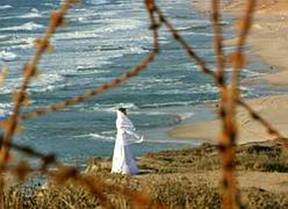 A Bride on the
Seashore of Gush Katif
A Bride on the
Seashore of Gush Katif

Gleanings on Global News at the Time of the End
“The Expulsion of the Jews from Gaza by the Government of Israel”
Psalms 46:2 - Hashem is our refuge and strength, a help in time of trouble. He is most accessible.
Topics
The Globalist Israel and the Road to Peace – the Unilateral Expulsion of the Jews from Gaza
Supporters of the Gaza Settler’s Right to Remain in their own Homes
Provocation by Anti-Expulsion Activist and the Blame to the Orthodox “Right”
“Peace, Peace and Sudden Destruction Shall Come Among You”
Terror Against the Jewish People
The Palestinians and the Gaza Disengagement
The Globalist Israel and the Road to Peace – the Unilateral Expulsion of the Jews from Gaza
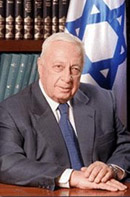 Probe sought on Gaza
evacuation – Sharon accused of hatching plan to thwart criminal investigation – June 19, 2005
Probe sought on Gaza
evacuation – Sharon accused of hatching plan to thwart criminal investigation – June 19, 2005
WorldNetDaily - A Knesset member today requested Israel's attorney general probe claims made in a newly released book that Prime Minister Ariel Sharon introduced his plan to evacuate Jewish communities from Gaza and parts of the West Bank to divert public attention from criminal investigations that threatened his premiership last year, WND has learned. "I have sent a formal request letter to Israel's attorney general [Meni Mazuz] asking him to investigate the prime minister because of the revelations in the book that prove Sharon is corrupt. We know exactly who are the people involved in the scandal, what they did, so there needs to be an immediate investigation," National Union leader Uri Ariel told WND.
Ariel was referring to a book released last week by two veteran Israeli journalists charging the Gaza withdrawal plan was created to avoid Sharon's indictment in the Greek Island scandal, an investigation into the transfer to Sharon's family of $580,000 by developer David Appel, who was accused of soliciting Sharon's help with business deals. If Sharon had been charged in the affair, he would have been forced to resign his post as prime minister. The book's authors, Raviv Drucker of Israel's Channel Ten TV and Ofer Shelach of the Yediot Acharonot daily, claim Sharon was convinced then-State Prosecutor Edna Arbel would indict him in the scandal, and had to create a situation that would make an indictment politically difficult. They also say the specifics of the disengagement plan were hatched without the input of defense officials, Knesset members or Sharon's own Cabinet, and further charge Sharon asked a top general in the Israeli Defense Forces to be a "plant" and report to him on the goings-on in the general staff.
Drucker and Shelach say they based their findings on first-person accounts from individuals "very close to the prime minister." In an interview with Israel's Channel Two last week, the two journalists said Sharon's fear of indictment drove him to introduce the withdrawal plan. "The people who are closest to Sharon told us absolutely that if it wasn't for those police interrogations, this decision [to quit Gaza] would not have been made. This can be seen by the timetable of events," said Shelach in response to a question.
He outlined the charges of the Arbel investigation, a summons to Sharon for police interrogation regarding Appel's money transfer, the reports Arbel was about to indict Sharon, the appointment of Mazuz as attorney general, and a meeting of what they called the Farm Forum – Sharon, his sons and one or two others very close to the Prime Minister – at which they claim the Gaza withdrawal was originally hatched.
The Farm Forum "did not state it outright," Drucker said, "but it was in the air that something had to be done, that there had to be some major diplomatic process that would swallow up everything and would change the public agenda [away from the corruption headlines against Sharon] – and they came up with this plan."
Drucker, outlining the book, said top Sharon-aide Dov Weisglass laid the foundations for the disengagement plan in a private meeting with then-White House National Security Advisor Condoleeza Rice in December 2003. "In December '03, after Sharon's Herzliya speech introducing the disengagement concept but when this plan was still very vague – in fact, Sharon was still asking the defense minister and the chief of staff what they thought about taking down just one or two communities – Weisglass goes to Washington all by himself – without his Military Secretary Moshe Kaplinsky or National Security Advisor Giora Eiland, who usually accompany him – and speaks to then-U.S. National Security Advisor Condoleeza Rice privately. "Very senior army officials told us that this was the trip in which Weisglass made the following offer: in the first stage, we would quit Gaza, in the second stage there would be a deep withdrawal from Judea and Samaria, and in the third stage we'd even be willing to talk about the '67 lines."
Drucker and Shelach charged those in the army and government who could have helped formulate the plan were left out of the decision-making process. "[National Security Advisor] Giora Eiland was in the midst of preparing a plan as to how Israel could get some benefit from its withdrawal," they said, "when suddenly he was presented with this new [unilateral] plan – and even now he objects to the plan [as it now stands]." Continued Drucker: "Sharon wanted only to survive politically. Weisglass led the whole plan. In October 2003, before the plan had started, Weisglass asked staffers in the Prime Minister's Bureau for data on Gaza because he said he felt we had to withdraw from Gaza. Sharon did not yet agree then – but he would come around later. At that time, Weisglass also started spreading hints to other people that if Sharon didn't agree to this plan, he would end up leaving the political arena as an 'insignificant old man.' Weisglass also started pressuring [Defense Minister Shaul] Mofaz at this time. But more than anything – Weisglass felt that he had the right key to persuade Sharon. ... "The important thing to note is that from that moment, there is no contact with those elements who were supposed to help Sharon decide about the plan, figure out what Israel would get in return, and help Israel get the best deal it could. And from that moment, the plan essentially rolls along on its own."
The two journalists go on to claim Sharon asked a top IDF general to be a mole in the army's General Staff Office, but refused to name the official. "The general himself told us that Sharon asked him to agree to report back to him on the goings-on in the General Staff. ... All along, Sharon was unhappy with the army, and always tried to form direct channels of communication [in this way]," they said. They said many top defense officials, including Mofaz, Intelligence Chief Ze'evi-Farkash, and others, originally opposed the evacuation plan. "Several months before Sharon's adoption of the Disengagement Plan, there was a deliberation amidst the top brass of the IDF in the presence of the chief of staff. Many options were presented. One of the options was unilateral disengagement from Gaza. There was unanimous agreement regarding the idea: absolutely no. Mofaz said at the beginning, 'Whoever supports a unilateral retreat, apparently wasn't here for the last two and a half years,' and Farkash said it would be a catastrophe, and the head of IDF Research said it would be the worst thing ... but after several months, when they saw that Sharon was so strongly in favor, they amazingly all fell in line and backed it."
In June 2004, after the withdrawal plan had gained considerable momentum, Attorney General Mazuz announced there was "insufficient evidence" to prosecute Sharon. Both Sharon's and Mazuz's offices could not be reached for comment before press time. It is not immediately clear whether Mazuz will open an investigation into the charges outlined in the book. Ariel told WND, "[If Mazuz does not open an investigation] I will bring the case to the high court."
Sharon's Gaza evacuation plan has drawn criticism from many in his government, with several ministers of his own Likud Party, including Finance Minister Benjamin Netanyahu and Foreign Minister Silvan Shalom, opposing the plan. Critics worry the withdrawal will be seen as a reward for Palestinian terrorism and argue territories evacuated by Israel will be used by Hamas to stage attacks against the Jewish state. Netanyahu, in a WND interview earlier this month, said, "Palestinian terrorists don't view our departure [from Gaza] as a reasonable move but as a flight from terror and a sign that terrorism works. If you flee from terror, then terror continues to chase you. This plan simply emboldens the terrorists to continue their tactics until the completion of their ultimate goal: the destruction of Israel."
Update June 20: Reached this morning for comment, Raanan Gissin, senior adviser to Sharon, told WND: "This book is all a big lie. You'll look at the dates involved and the events and you'll see it's all a big lie. We're not worried."
Sharon
Demands “Iron Fist” against Protestors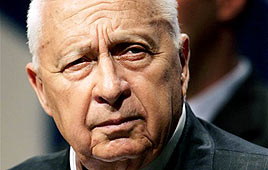 – July 29, 2005
Israel National News - Prime Minister Ariel Sharon today ordered police and defense forces to adopt an "iron fist" policy against anti-evacuation protestors who resort to violence. The Prime Minister also ordered the police to take all necessary steps against anti-evacuation protestors if they try to carry out their planned 4 p.m. blocking of traffic throughout the country. That's in less than two hours from now.
It is also presently being reported that Palestinians and Jews have become embroiled in a stone throwing battle in Tel Yam in the Gaza Strip. IDF soldiers are shooting warning shots in the air but according to a direct report on Israeli radio, soldiers are not able to control the situation. Fears of civil war are increasing - may Hashem help us!
We will not allow a "bunch of gangs" to bring down the country, Prime Minister Ariel Sharon said during a political-security cabinet meeting called ahead of the mass anti-pullout road blocking protest planned for this afternoon. Sharon told ministers that sanctions should be imposed against rabbis who send children to block intersections and junctions. "Police must deter the criminals and not the citizens, and instead of calling on people to stay home adopt a heavy hand against the law-breakers," he said. Parents were warned by a police spokesman on radio this morning that if they allow their young people to participate in the protest and their children are arrested, that a criminal file will be opened against them that will follow them througout life.
The "iron fist" approach is deeply troubling many Israelis and there is great concern over what will happen in this country over the next few hours. We desperately need your prayers.
Likud Leader: Sharon Wants to Take Over Jewish Nation's Assets - June 20, 2005
 Sam Schachter, former
Deputy Chairman of the World Likud Organization, says that if Boomerang's
allegations are true, "Ariel Sharon should be tried for misleading and
endangering the nation."
Sam Schachter, former
Deputy Chairman of the World Likud Organization, says that if Boomerang's
allegations are true, "Ariel Sharon should be tried for misleading and
endangering the nation."
Israel National News -
Speaking with Arutz-7's Elkanah Perl, Schachter emphasized both the corruption
and high-handed methods of Sharon and his close cronies, and the dearth of
accurate information available to Israel-supporters in the U.S. "The voice of those who oppose the disengagement
plan is not heard the way it should be amongst U.S. Jewry," Schachter
said. "There is a feeling here as if Sharon is the great savior of Israel, because he's a great general who knows exactly what he's doing... I myself received
the information about Boomerang just from friends in Israel, but nothing was mentioned in any newspaper. Only those who follow Arutz-7 know [this], but
aside from that, there's nothing - and that's the problem. It's important that
this news is publicized in the U.S. in order to strengthen those who are
fighting for the Land of Israel and to have people get to know the facts."
To this end, it should be noted that Aviv
Mizrachi, a strong expulsion opponent currently living in Los Angeles, reported
that 50,000 copies of an anti-disengagement CD were recently handed out in New York and Los Angeles. He, too, agreed that the next step was to turn these many
individual voices of opposition to the retreat into a concerted public voice
that will be heard in the U.S. media and in Washington, D.C.
Schachter said that he raised concerns of
Sharon's corruption several months ago in a letter to the members of the Likud
Central Committee. He said that he himself was deposed from his leading World
Likud organization position "when [Sharon's son MK] Omri came to power and
amassed power... Omri led the Central Committee members astray, and in the
meanwhile has succeeded in appointing those close to him..." "You have to look at the whole picture, and then
you can understand what's going on," Schachter said. "Just like we
see Sharon is objecting to Sharansky [as the Likud's candidate for Jewish
Agency Chairman. Sharansky in fact received the nomination - ed.], and he is
also trying to take over the Lands Authority - trying to take over all of the
Jewish People's assets. People don't understand what's going on. Sharon and his
son are against Sharansky because they know he is an honest man who won't allow
them to continue running things corruptly..."
Schachter
demands that a public commission of inquiry be established "to check
whether the authors of Boomerang were accurate - and if so, Sharon should be put on trial for misleading and endangering the nation, and the country
should shake him off. Every normal nation would do this, if the corruption
allegations are correct. We saw in Ukraine how the nation protested massively
and silently until the government resigned... "It's inconceivable that the nation should be
endangered merely in order to purify his corruption. The media are sabotaging
the transmission of the message to the world, and therefore the people must
bring this message. It's important that the disquiet in Israel be announced to the world."
Schachter also decried the relative lack of
freedom to express one's anti-disengagement opinions in Israel. "In the U.S. you can certainly express your opinion as long as you don't hurt someone
else, but in Israel if you express your opinion, you could be
fired, and there's a chance you'll be put under administrative
detention." Schachter said that
American Jews underestimate Israel's need for strategic depth: "They think
that Israel is strong and can defend itself, and therefore they don't realize
that Israel needs land in order to protect itself. You need a buffer zone, and
not war inside the citizens' homes."
In August of 2004, Schachter told Arutz-7,
"The Likud members must wake up, otherwise
the Likud will be liquidated by Sharon and his group of supporters, who are not
even members of the Nationalist Movement. Mr. Olmert, for instance, who might
very well be a Shinui Party leader in the next election. He [as Mayor of
Jerusalem] abandoned Jerusalem; he did nothing about our hundreds of complaints
of illegal Arab construction in the city... "Why is the Prime Minister turning the Likud into
the [left-wing] Mapai? The Likud people must wake up before the Prime Minister
breaks the nation's spirit. Statements by Sharon and by [Shabak head Avi]
Dichter that the right-wing is extremist and dangerous break the nation's
spirit - it reminds me very much of the Saison period [in the 1940's] when I
[as a member of the Etzel] was persecuted by the Mapai leadership... "Sharon sent the settlers to the hilltops; why is he now persecuting them?... It is not due
to American pressure... "I think that everyone who is concerned for the
Jewish Nation's existence in the Land of Israel who does not wake up now, is
abandoning his children and future generations."
 Likud
"Rebels" Begin Move to Oust Sharon - June 28, 2005
Likud
"Rebels" Begin Move to Oust Sharon - June 28, 2005
Lekerev Report - The Likud "rebels", party members who oppose Prime Minister Sharon's disengagment plan, began a new effort to oust him from the leadership of the Likud party with a rally at Tel Aviv's Ramat Aviv Hotel last night. Participants called upon Likud central committee members to sign a petition to convene the group to approve moving up the next Likud leadership election.
They will also work on pressuring Likud ministers to leave the government and bring thousands of hawks, who left the Likud party, back into the party by its July 10 membership drive deadline. Landau has told Finance Minister Binyamin Netanyahu that he will run against him and Sharon for the Likud leadership unless Netanyahu leaves the government and starts taking an active role in the fight against disengagement. It has been widely reported that Netanyahu is seriously considering doing so.
Likud Petition Demands Vote on Replacing Sharon - July 6, 2005
Likud Party Central Committee members have gained enough signatures on a petition demanding that the party convene its legislative body to elect a new chairman.
 Israel National News - Prime
Minister Ariel Sharon is the current leader of the Likud party. The Likud
Central Committee can convene to elect a new chairman if at least 20 percent
the 3,000 Central Committee members sign a petition to this effect. More than
1,000 members, one-third of the committee, have, in fact, signed such a
petition. Organizers have not yet handed it to Central Committee chairman
Tzachi HaNegbi, because they are waiting for Finance Minister Binyamin
Netanyahu, the leading contender to wrest party leadership from Sharon, to return from abroad.
Israel National News - Prime
Minister Ariel Sharon is the current leader of the Likud party. The Likud
Central Committee can convene to elect a new chairman if at least 20 percent
the 3,000 Central Committee members sign a petition to this effect. More than
1,000 members, one-third of the committee, have, in fact, signed such a
petition. Organizers have not yet handed it to Central Committee chairman
Tzachi HaNegbi, because they are waiting for Finance Minister Binyamin
Netanyahu, the leading contender to wrest party leadership from Sharon, to return from abroad.
At a rally organized by the Darkecha Darkeinu
(Your Way is Our Way) forum of the committee scheduled for tonight in Tel Aviv,
some 500 Central Committee members are expected to urge MK Uzi Landau to run
for the party leadership. Dr. Landau, who heads the faction of Knesset Members
loyal to the Likud's founding principles, is not expected to declare his
candidacy, but may hint that such an announcement is imminent. Hundreds of
central committee members already have signed a petition calling on Landau to
run. Darkecha Darkeinu head Eli Kornfeld
says, "We see Uzi as the man who should lead us now and the most fitting
to challenge Sharon. We have no other leader. Uzi was fired from the cabinet
and gave everything up to lead the battle against the disengagement. I didn't
see any other minister do that. I still hope that Bibi leaves the government
and starts doing with actions what he has thus far only said in words."
Sharon
Called Before Knesset Committee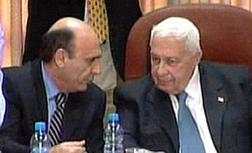 – July 5, 2005
Lekerev Report - Two prominent Knesset committees - Law, and Foreign Affairs and Defense - are conducting a joint session, questioning Prime Minister Sharon on the government's measures to prepare for the expulsion. The MKs have prepared some 100 questions to ask Mr. Sharon regarding the housing solutions, the police presence in Gush Katif and elsewhere around the country during the disengagement, the future of the buildings in Gush Katif, and more. Sharon was presented with the questions in advance. The session is expected to last some four hours.
Statistics released yesterday show that no fewer than 17 battalions of IDF reserve soldiers will be called up to implement the expulsion. The soldiers are supposed to replace the hundreds of standing-army soldiers who will take part in the mission of removing of Jews from their homes.
On the other hand, Gen. Giora Eiland - responsible for drawing up the logistical disengagement plans - told the Knesset yesterday that many reserve soldiers will be involved in the disengagement. This must be taken together with the words of the new IDF Reserves Chief Officer, Brig.-Gen. Danny Van-Birn, who assumed his position just yesterday. Van-Birn told Arutz-7 that no reserve soldiers would take part in the innermost circle during the uprooting. Some 43,000 soldiers and policemen will take part in various aspects of the disengagement. The mission of the actual uprooting of the residents will be placed upon some 12,000 soldiers, policemen and Border Guard policemen.
The session began with introductory words by Committee Chairmen Eitan and Shteinitz, and then Knesset Speaker Ruby Rivlin. Prime Minister Sharon then spoke and said, "For every resident who wants, there is a housing solution for temporary and permanent. The money is waiting for them at the Sela Administration. I have heard that some want to live in a tent city. This is a political move; it's their right to live in tents if they want, but I call upon them to show responsibility to their children... I repeat for the 1,000th time: the disengagement will take place according to the dates we have determined. I have given unequivocal instructions to the police to make sure there is no disturbance on the roads or violent protests and the like."
 Novel
Twist to the Disengagement; Israeli Arabs Should Worry
Novel
Twist to the Disengagement; Israeli Arabs Should Worry ! – July 5, 2005
Researcher and journalist David Bedein came up with an original argument to convince Arab-Israeli Knesset members to object to the disengagement plan. He sent a letter to Israeli Arab parliamentarians warning that the pullout could serve as the legal basis for the future expulsion of Arabs from Israel.
In an Arabic-language letter, he wrote that "the government of Israel has laid in recent months the legal basis for the implementation of the transfer (of Arabs,) including the banishment of residents from their land, their exile, the demolition of their homes, and the nationalization of their private property." Bedein also warned that "the compensation to be offered for the expulsion is meager and inadequate."
Later in the letter, he noted that "currently, these transfer laws deal with the hundreds of Israeli residents in the Gaza Strip. Despite this, the transfer law precedent and its implementation for political- security objectives may be applied in the future to Arab residents in the territories and in the State of Israel too."
A Forgotten Cabinet Proviso Could Throw Israel’s Gaza Evacuation off Course – July 11, 2005
Debkefiles - The Israeli cabinet meets Tuesday, July 12, to dive into some troublesome outstanding issues in the operation to evacuate 10,000 people from the Gaza Strip and northern West Bank 35 days away from its implementation. Funding is only one problem. A delegation is in Washington with a request for $2.2bn in special aid to be spread over several years toward the cost of relocating military bases from the Gaza Strip and developing Israel’s under-populated northern Galilee and southern Negev regions.
An important issue that has suddenly popped up
is a forgotten rider to the cabinet’s February 2005 approval of the pull-out.
Prime minister Ariel Sharon won the  votes of half a dozen
Likud ministers by a pledge to execute the withdrawals in four stages with a
cabinet assessment of current circumstances between each.
votes of half a dozen
Likud ministers by a pledge to execute the withdrawals in four stages with a
cabinet assessment of current circumstances between each.
This week, attorney general attorney-general Many Mazuz confronted the defense and police ministers as well as the chief of staff with a warning: their master plan for an uninterrupted one-stage evacuation is incompatible with that rider. The dilemma was referred to the prime minister Ariel Sharon.
Already the troops and police designated for the evacuations are training at the Tselim base near Beersheba for operating together as a single entity. The high command says 41,000 servicemen are directly involved. But on the ground, no more than 14,000 will handle evictions.
Military and police planners attach the highest importance to the operation’s unbroken continuity as a means of cutting down on risks – especially in view of intelligence incoming this week on the new strategy the Palestinian terrorist group Hamas has designed for the evacuation.
Hamas intransigence intensifies as the evacuation date approaches. In an interview with the Italian Corriere della Sera, Hamas’ Gaza leader Mahmoud a-Zahar stood firm on the refusal to recognize Israel’s right to exist. Asked whether the Jewish state’s withdrawal to pre-1967 borders would be acceptable, he replied in the negative because in the long term Palestine would be Muslim and Israel disappear off the face of the earth. Hamas military leaders have fine-tuned their tactics for the coming pull-back from the Gaza Strip.
Rather than shooting at random on the concentrations of Israeli troops and civilians engaged in the pull-out – in full view of the world media - Hamas military commanders propose waiting for the civilians to be removed and then pound the troops and police remaining on the spot with mortars and missiles for maximum carnage. They will thus vindicate their propaganda line that Israel is not disengaging voluntarily but retreating under Palestinian guns. However Israeli military planners are preparing to respond to this eventuality with a large-scale counter-offensive. The troops will storm the sources of the fire - which the Palestinians habitually embed in their own population centers – in Khan Younes and the outlying camps and districts of the southern Gaza Strip. But this turn of events would clearly also abort the evacuation process and end any coordination that may yet be achieved with the Palestinian Authority.
A stop-go operation would make it easier for Palestinian terrorists to target the operation, whereas smooth, swift progress with no pause to get it over in the shortest possible time is built into the military master plan. Supplies of fuel, water and food are also programmed for an unbroken process. For instance, after clearing Netzarim, the military and police would move on immediately to Gadid or Netzer Hazani. Forcing them to hang about and wait for the next stage to be approved in Jerusalem would magnify the vulnerability of an operation which has been pretty chancy for the start. Hamas could more easily target stationary troops with their mortars and missiles than units in rapid motion.
According to DEBKAfile’s counter-terror sources, the Islamic group has come to an agreement with fellow terrorist organizations, including Jihad Islami, the Fatah-al Aqsa Brigades and the Popular Committees, for them to open fire on the pull-back - even at low intensity – in the intervals between the Hamas volleys. These attacks will target Israeli soldiers and civilians alike. Our military sources report that the military and police command are skeptical of the claims emanating from the offices of the prime minister and defense minister that the Palestinians have concurred on steps to coordinate the withdrawal. They do not believe that the Palestinian interior minister Gen. Nasser Yousef can make good on any intention to deploy a troop buffer between the Palestinian areas of the Gaza Strip and the towns to be evacuated.
Mahmoud Abbas may really be preparing to sink tens of millions of dollars put up by the Americans and Israelis to create thousands of jobs and keep young Palestinians out of terrorism by gainfully employing them. Israeli military and intelligence offers are convinced that a part of the money will reach terrorist groups while the rest will fill the pockets of idlers. Sharon’s most urgent task now is to clear away the obstacle the attorney general has dropped in his lap: the four-stage rider to the evacuation plan. Failure to get round this hurdle would present the anti-evacuation ministers led by finance minister Binyamin Netanyahu and agriculture minister Yisrael Katz with a chance to manufacture delays week after week weeks in between stages – or else claim a steep political price for a seamless evacuation.
In the meantime, the entire country is on edge lest some extremist fringe group or desperate evacuee switches from passive to active resistance to the pull-out and turns to violence, such as shooting at Israeli troops, taking hostages or collective suicide.
Accusations Against Israeli Media Multiply – June 20, 2005
"The Israeli press is lying and is acting like a pack of elephants," says Channel Ten News reporter Yinon Magal, while MK Yitzchak Levy adds, "The Israeli media are betraying their basic mission."
 Israel National News - Magal,
speaking at a gathering of the Second Broadcasting Authority in Jerusalem last night, said, "The press is a champion of manipulating everything that
has to do with the Jews of Judea, Samaria and Gaza." The topic of the
session was the media's coverage of the disengagement plan. Most of the speakers agreed that Israel's journalists, by and large, have given a slanted picture of the disengagement news, and have
deep hostility towards the Yesha residents.
Israel National News - Magal,
speaking at a gathering of the Second Broadcasting Authority in Jerusalem last night, said, "The press is a champion of manipulating everything that
has to do with the Jews of Judea, Samaria and Gaza." The topic of the
session was the media's coverage of the disengagement plan. Most of the speakers agreed that Israel's journalists, by and large, have given a slanted picture of the disengagement news, and have
deep hostility towards the Yesha residents.
Magal said that sometimes, the narration that
accompanies televised pictures on various stations gives the opposite picture
of what is seen on the screen. For instance, when guards were seen forcibly
shoving nationalist demonstrators at the memorial ceremony for Yair Shtern, the
narrator said that the protestors were those who had attacked the guards. Magal
warned that the hostile coverage, together with the protestors' suspicion that
they will never receive true justice in the legal system, is liable to bring
about "grave reactions." MK Levy
(Religious Zionist Renewal Party) told Arutz-7 yesterday, "The Israeli
press is currently at one of its lowest points ever, is betraying its basic
mission, and often appears to be 'clay in the hands of the potter,' weak and
able to be manipulated." "The
almost-absolute silence regarding the astonishing revelations by Raviv Drucker
and Ofer Shelach leave no room to be surprised. Everything that does not fall
into line with the Prime Minister's policy is apparently not worthy of being
covered. It's as if it's nothing. Every squeak by some beginning singer is
covered more widely than these scandalous revelations of the book
Boomerang."
Levy was referring to the book Boomerang,
by Drucker and Shelach, which purports to show that Prime Minister Sharon
promoted his withdrawal/expulsion plan simply because he felt it would prevent
him from being indicted on Greek Island scandal charges. The two authors were
interviewed on Channel Two, but their revelations were given little or no
coverage in Yediot Acharonot, Maariv, Haaretz, Voice of Israel or Army Radio.
Today, Maariv departed from custom by covering the story - but with the purpose
of de-legitimizing Boomerang's claims. "This
is not only enlisted media," MK Levy said, "but dangerous media. Just
as they evade the question of Sharon's motivation in promoting the plan to
divide the land, they also avoid the difficult questions regarding what will
happen the day after the retreat, and the ramifications of the expulsion on our
society and country."
Respected Israeli journalist Nachum Barnea, in
the March edition of the monthly media publication "The Seventh Eye,"
admitted that most of the Israeli media have acted more like the "guard
dog" of the disengagement plan than that of democracy. He wrote that this
mistake should be "acknowledged now, before it gets worse." Last
month, Army Radio's political affairs correspondent Kaveh Shafran similarly
confessed that the media had turned a blind eye in allowing/encouraging the
disengagement at the price of democracy. "I have failed. We have
failed," he wrote in an article for the Israeli Institute for Democracy.
"As a diplomatic correspondent, I was among those who in the past year
were supposed to tell the public exactly what is the disengagement plan, why it
was created, how it will be implemented, and to discuss its various aspects, as
well as how the Prime Minister functions." But instead, Shafran wrote, the media kept silent when
Prime Minister Ariel Sharon "lied" by saying he would accept the
results of a Likud referendum on disengagement. Shafran added, "The
media's conspiracy of silence protected Sharon when he fired cabinet ministers
who did not support disengagement... We denounced [former Minister] Benny Elon
(National Union) for not immediately making himself available to receive the
letter of dismissal, but we ignored the criticism of the High Court [on the
firings]... We stayed silent when Sharon formed government [policies] with an
Arab majority and when he distributed bribes to the hareidim and Shinui. We
said nothing when he pressured, threatened and bribed MKs with jobs so that
they would support him... Where were we when the allegations of Sharon-family
corruption came to light?" "Are
the media who support disengagement allowed to turn a blind eye to
inappropriate [procedures] just to execute the program? Does this mean that it
is possible for Sharon to fire any cabinet minister, the Chief of Staff and
General Security Services chief who do not agree with his position?"
Shafran wrote that the following questions should
have been asked by the media, but were not: "What happens the day after
the disengagement from Gaza? Who will rule there? What's the next stage in
Judea and Samaria? What will be the status of the territories that will be
evacuated? Does evacuation mean the 'end of conquest'? What will happen if the
GSS Chief's warnings about Kassams to be fired at Ashkelon come true? Why are
there no housing solutions for the evacuees? What does Sharon want and what is
he planning?" Speaking at a
conference held at the Van Leer Institute in Jerusalem, Amnon Abramovich, a
leading political commentator, explained the role of Israel’s media as the
proposed Gaza withdrawal comes closer: “I think that we need to protect Sharon
like an etrog [the fruit held by religious Jews on the Sukkot festival, which
requires special care and protection]."
Lt.-Col. Indor Against Media-Pandering in the IDF – July 6, 2005
Likud Party Central Committee members have gained enough signatures on a petition demanding that the party convene its legislative body to elect a new chairman.
 Israel National News - The
remand of the first suspect in the case, Shimshon Cytryn (see below), was
extended today until Sunday, following the rejection of his appeal to the Be'er
Sheva District Court. The second suspect, Avinoam Crispin, 19, of Kiryat Arba,
was arrested last night. Kiryat Arab residents reported that nine policemen
entered a synagogue with their guns drawn to make the arrest.
Israel National News - The
remand of the first suspect in the case, Shimshon Cytryn (see below), was
extended today until Sunday, following the rejection of his appeal to the Be'er
Sheva District Court. The second suspect, Avinoam Crispin, 19, of Kiryat Arba,
was arrested last night. Kiryat Arab residents reported that nine policemen
entered a synagogue with their guns drawn to make the arrest.
Parts of the incident were widely filmed, but
confusion over what exactly occurred is rampant. It is not clear if an
individual Jew started the rock-throwing, or whether a gang of 30 Arabs began
attacking a group of singing and dancing Jews. Nor is it clear who wrote the "Muhammed
Pig" message on the side of the building that the Jews took over; no
soldiers, policemen or Jewish protestors can be found to say he saw it being
written. There are also reports that the soldiers did not actively
defend the attacked Jews as aggressively as they defended Arabs. Lt.-Col. (res.) Meir Indor, head of the Terror Victims
Association, told Arutz-7 yesterday that there is a "worrisome phenomenon
among senior officers in the army and police department, in which they distort
reality and do not tell the truth when they speak to the television cameras.
Instead, they often adjust their words to correspond with what the reporters
want to hear." "When top
officers adopt norms of lying while giving reports," Indor said,
"this will trickle down to the bottom, the lowest soldiers, as well."
Indor said that the latest incidents began when
O.C. Southern Command Gen. Dan Harel used the word "lynch" when
reporting on the above incident. "'Lynch' is a media concept. There was no
lynch. It was a grave incident of throwing rocks, and the fact that the top
general would begin using media lingo is very worrisome... What happened there
can in no way be compared to what the Arab mob in Ramallah did to those two IDF
soldiers a few years ago." "If
I, who once took a medics course, was able to tell from the pictures that the
wounded Arab was far from 'mortally wounded,' then how is it possible that Gen.
Harel was not able to know? In fact, he did know that he was only lightly hurt,
but it was convenient for him to present it differently to the media...
The evacuation of the hotel in Gush Katif last
Thursday is another example. Indor says that one senior police commander said
afterwards that the 'hilltop youth have been shown to be nothing more than
weaklings.' "But there were no hilltop youth there at all," Indor
said, "just families and some youths from Gush Katif." "In addition, Gen. Harel was quoted as saying that
'delinquent youth had taken over the hotel.' But everyone knows, including Gen.
Harel, that there was a legal contract drawn up with the hotel owners, such
that they are not delinquent youth or lawbreakers. The officers simply want to
satisfy the reporters. This is a culture of lying, and we must fight it tooth
and nail." Though widely-disseminated
pictures and videos show two Israeli youths throwing rocks from close range at
the Arab, most reports do not mention that the Arab had been throwing rocks at
Israelis for 15 minutes beforehand. One person there said that the Arab in
question, who was claimed to be 'mortally wounded,' had crept up on him from
behind and tried to throw a large concrete block on his head.
The 18-year-old Cytryn has still not eaten since
his arrest. He demands only special-kosher food, under Badatz supervision, but
has not yet received it. His father, Shmuel, said he does not look good.
"The public-defender lawyer that I have is not good enough; he barely even
mentioned to the judge about the food. It's obvious that we are going to have
get a top-grade lawyer for this case."
Arutz-7
stands by its stories indicating that incident was not a "lynching,"
and that it did not occur the way in which it was portrayed on the mainstream
media. Please see:
Lt.-Col. Indor Against
Media-Pandering in the IDF
and
Eyewitness:
Wounded Arab in Muwasi Fight Was Primary Assailant
and
Eyewitness:
Media-Reported "Lynch" Was Totally Exaggerated
Gingrich: US Should Abandon 'Roadmap' – June 17, 2005
 Lekerev Report - Former
House speaker Newt Gingrich argued in the recently published summer edition of
the Middle East Quarterly that the U.S. should abandon the roadmap in its quest
for Middle East peace. In a paper entitled, "Defeat Terror, Not Roadmap
Diplomacy," the high-profile Republican leader insisted that civil
negotiations and Oslo-like diplomacy should not continue until the Palestinian
Authority dismantles all terrorist infrastructures. "Diplomacy is
important and has a vital role to play, but its function must be different than
the Oslo process and the roadmap suggest," he wrote. "The focus on
Israeli-Palestinian diplomacy cannot work when one side has a leadership that
does not deliver on its word."
Lekerev Report - Former
House speaker Newt Gingrich argued in the recently published summer edition of
the Middle East Quarterly that the U.S. should abandon the roadmap in its quest
for Middle East peace. In a paper entitled, "Defeat Terror, Not Roadmap
Diplomacy," the high-profile Republican leader insisted that civil
negotiations and Oslo-like diplomacy should not continue until the Palestinian
Authority dismantles all terrorist infrastructures. "Diplomacy is
important and has a vital role to play, but its function must be different than
the Oslo process and the roadmap suggest," he wrote. "The focus on
Israeli-Palestinian diplomacy cannot work when one side has a leadership that
does not deliver on its word."
Gingrich argued that diplomacy in face of violence is the wrong answer because it puts the wrong people in charge of finding a solution. Diplomats, by their nature, believe in talk and in paper, he wrote. They value meetings and agreements. But in order for diplomacy to work, negotiators must be honest brokers willing to keep commitments. Diplomacy should not be used as political checkmate while one side keeps its word, and the other side willfully disregards its promises to gain political advantage. The roadmap, developed by the Bush administration during early 2003 in cooperation with Russia, the European Union, and the United Nations, makes clear that all sides must make tangible steps towards a two-state vision. But, Gingrich declares, it was a product of a period of failure now past. It is time to move on. Nice to know that somebody is thinking through this thing!
A Jewish Mother Looks at the Oslo Years - July 1, 2005
The Oslo Years: A Mother's Journal tells the story of the last 11 years of upheaval in Israel and the world as seen through the eyes of a Jewish mother from the Golan Heights.
 Israel National News - A regularly featured columnist on Israel National
News.com, artist and author Ellen Horowitz has brought together her opinion
pieces, letters to the editor and publicity material to produce a highly
personal and moving account of the years since the signing of the Oslo Accords.
Alongside her writings, Ellen has collected powerful news photos, along with
her original artwork, to create a full-color, hardcover, coffee-table book. In
addition, The Oslo Years has a special memorial section listing deadly
terror attacks and the names of the victims from 1993 through 2004. Ellen writes that she was compelled to put her thoughts
to paper because, "a Jew is required to bear witness, remember and record
history, even when events are unfolding at a furious pace.... One would be
bereft of a most crucial chapter in Jewish history if they declined to expose
their soul and honestly investigate this age of upheaval."
Israel National News - A regularly featured columnist on Israel National
News.com, artist and author Ellen Horowitz has brought together her opinion
pieces, letters to the editor and publicity material to produce a highly
personal and moving account of the years since the signing of the Oslo Accords.
Alongside her writings, Ellen has collected powerful news photos, along with
her original artwork, to create a full-color, hardcover, coffee-table book. In
addition, The Oslo Years has a special memorial section listing deadly
terror attacks and the names of the victims from 1993 through 2004. Ellen writes that she was compelled to put her thoughts
to paper because, "a Jew is required to bear witness, remember and record
history, even when events are unfolding at a furious pace.... One would be
bereft of a most crucial chapter in Jewish history if they declined to expose
their soul and honestly investigate this age of upheaval."
Mrs. Horowitz grew up in a Reform Jewish
household ("but very Zionist," she says) before returning to traditional
Judaism and to the land of Israel. Inspired by her past, Ellen told Israel
National News.com, she also sees The Oslo Years as part of an effort to
bridge the gap between secular and religious Jewish Zionists. In addition,
shortly before the release of her book, Mrs. Horowitz was featured in a
documentary called End of Days, by Canadian filmmaker Martin Himel,
which examines the complex and potentially combustible relationship between
Christian and Jewish Zionists.
Rabbi Dr. Sholom Gold of Jerusalem wrote the
foreword for The Oslo Years: "Reading this book is guaranteed to
lead to blessed clarity of vision, the desperate need of our time..."
In a recent column, author Jack Engelhard called Mrs.
Horowitz' book a "masterpiece" and a "treasure", writing,
"What can I say but 'WOW!' Horowitz... has produced a powerful account, in
prose and photos, of Israel as viewed inside and outside."
Author Naomi Ragen commented, "Ellen W. Horowitz
has been a comrade-in-arms in the internet war we have been waging against the
Orwellian disinformation campaign launched hand-in-hand with the Oslo War. Now,
Ms. Horowitz has collected her columns in a beautifully designed and
illustrated book that will pierce your heart. I highly recommend The Oslo
Years: a Mother's Journal."
For additional information, contact: author@osloyears.com and visit http://www.osloyears.com.
The Case Against Nadia Matar, Legitimate Dissent Is Not A Crime - By Jonathan Pollard FCI - July 10, 2005
World Watch Daily - Nadia Matar, leader of Women for Israel's Tomorrow, is being persecuted by the Government of Israel for being a good Jew.
Nadia did not foment a rebellion. She did not incite the People of Israel to revolt. Neither did she call for insurrection or political subversion. She did not commit any crime. All that Nadia Matar did was to call upon a fellow Jew to do tshuva, to give up his involvement in an immoral enterprise and return to the appropriate path for a G-d fearing Jew. Nadia did so in the finest tradition of our holy Prophets. Our Prophets' powerful messages exhorting errant Kings to desist from "doing evil in the eyes of G-d" and to return to the correct path is an important part of our history, and an integral part of our national consciousness. Calling upon a public figure to do tshuva was not a crime then and it is not a crime now.
Nadia and I wrote separate but like-minded open letters to Yonatan Bassi, head of the Disengagement Authority. We both called upon Bassi to give up his immoral position as head of the Authority and implored him not to become the chief liquidator of Jewish homes and communities in Israel. It is ironic: Nadia is now being interrogated, threatened with indictment, and intimidated by the possibility of unlimited administrative detention for writing her letter to Bassi. I, on the other hand, sitting here in an American prison, have suffered no repercussions. My right to freedom of speech is guaranteed. Nadia's is not.
My wife and I make many sacrifices in order to make my voice heard outside of prison walls. We endure the hardship because Esther and I are determined never to give up the one freedom I do have. Even as a prisoner in America, I have the right to freedom of speech. As long as I refrain from discussing classified information, I am free to express my thoughts, opinions and ideas. Nadia and our fellow countrymen on the right side of the political spectrum, are not.
Why Do They Want To Silence Nadia Matar?
What is it that the government and security establishment see in Nadia Matar which makes them fear her so? Why are the authorities so determined to silence her? It is not because of anything she has done. It is because of what she represents. Nadia is the head of one of the most effective citizens' advocacy groups in Israel. She is among a handful of natural leaders today, who have the will, the talent, and the strength of character to galvanize popular protest against undemocratic actions by the current Government of Israel. Nadia represents everything a repressive regime fears in its citizenry. Her idealism and her enthusiasm are infectious and her determination is unyielding. She is a G-d fearing woman and a fierce nationalist, not easily threatened or intimidated. She is a thinker and resists following blindly. What is more, she is a powerful model and source of inspiration for others. In short, she is everything a dictatorial regime cannot tolerate if it is to retain complete and unquestioning control over its citizens.
Desperate to curtail Nadia's activities as a leader of one the most effective protest movements in the country, the Government seized upon her letter to Bassi as an excuse to take action against her. She was quickly hauled in for police interrogation and grilled for hours on end. Eager to charge her with a crime - any crime - the authorities zeroed in on one part of her letter to Bassi. Nadia referenced a letter that Bassi had sent to citizens of Gaza urging them to cooperate with their own expulsion, and she compared it to a similar letter by the Judenrat during W.W. II urging Jews to cooperate and go quietly to the trains (which would take them to the death camps). Nadia wrote that Bassi's letter was worse than the Judenrat's since the Judenrat had no choice, whereas Bassi had accepted the immoral task of expelling Jews from their homes of his own free will.
The Israeli authorities decided that there must be a way to criminalize the insult of comparing Bassi's letter to the Judenrat's. Searching the law books, they came up with a law - totally unrelated and absolutely irrelevant - under which to prosecute Nadia. The law they invoked - insulting a public official in the course of his official duties - was designed to protect policemen, firemen and other public servants from being abused in the course of their work. For example, this law protects a traffic policeman from being verbally abused by a person who has just received a traffic ticket. In their zeal to incriminate Nadia, the Government reinterpreted the law, stretching its application far beyond its intended purpose. Why? Because even if they cannot make a case against Nadia, the public furor that they have created over this incident will make it easy to take other actions to silence her. For example, administrative detention is a far greater threat hanging over Nadia's head than any judicial proceeding that the Government may take against her.
The Threat Of Administrative Detention
It is more than possible that the Government plans to use its twisted interpretation of the "insult to public officials law" in a way reminiscent of America's infamous Internal Security Act of 1950. That law not only limited citizens' freedom of speech and freedom of association, but also permitted the President to lock up potential subversives indefinitely in concentration camps during times of perceived national emergency. Fortunately, there was a public outcry and this law was never implemented in the US.
However, the immoral use of administrative detention, without formal indictment and with no possibility of judicial review, still exists in Israel and it is routinely utilized. If the Government does indict Nadia, it can still lock her up in administrative detention before she is brought to trial. In other words, she can be placed in administrative detention indefinitely pending a trial - a trial which may be deliberately delayed for months, weeks, or even years. Even worse, if the Government refrains from indicting Nadia, it can still lock her up in administrative detention indefinitely, without judicial review. Any attempt by the Government to place Nadia in administrative detention must be met with unlimited and overwhelming public protest. If the Government of Israel is permitted to lock up Nadia Matar before, during or after trial, on trumped up charges of insulting a public official, the country is headed for the kind of judicial authoritarianism that Senator McCarthy attempted to unleash in the US. This poses an immeasurable threat to all of Israel, including the cancellation of freedom of speech and the abrogation of Israeli civil rights.
When Freedom Of Speech Is A Crime
According to the law, freedom of speech ends where its exercise threatens the public good. Shouting "Fire!" in a crowded theatre is a crime. But this is only true if there is no fire! If there is a fire, it is unforgivable not to cry out. For those of us, like Nadia, who cherish Israel and seek to protect and defend the Land, it is glaringly obvious that the House of Israel is on fire. The flames are threatening to engulf us all! Now, more than ever, Jewish lives are at risk, and Jewish homes and communities are in mortal danger. Every day the enemy grows bolder and bolder in its attacks upon a beleaguered civilian population. The Government not only allows the flames to rage out of control but is also feeding the fire by offering up chunks of our homeland to our sworn enemies.
By orchestrating a very public campaign of intimidation against Nadia Matar - who dared to cry "Fire!" - the Government is attempting to silence all dissention. It is using a pinpoint precision attack on Nadia to intimidate the entire nationalist camp. As it demonstrates its willingness and its ability to crush this popular leader, the Government is sending a strong message to all. It apparently believes that in this way it will succeed in breaking the back of the citizens' protest movements which bitterly oppose the Government's plan to uproot Jewish homes and communities in Gaza and Samaria and turn the land over to our enemies.
Destroying The Foundations Of Democracy
The Government is mistaken in its aims and in its calculations. All that it has accomplished is to destroy its own legitimacy and its right to govern. In democratic states, a government derives its power from the consent of the people. A government cannot replace consent with coercion and still be considered a democracy.
Nadia Matar represents the voice of legitimate dissent in Israel. If she is silenced through intimidation and harassment, any pretense that the State of Israel is a democracy is unequivocally dispelled. Every distinction between Israel and her non-democratic neighbors in the region is effectively blurred. Moreover by relentlessly persecuting those who exercise free speech to express legitimate dissent, the Government is deliberately creating an atmosphere of fear and repression - the kind of atmosphere that invites rebellion. Thus, by taking Draconian action against selected individuals, such as Nadia, the Government is actually fomenting the very insurrection it claims it is trying to prevent; and which it will use to justify the use of even more repressive and dictatorial measures.
The imprisonment of a nation begins with the unjust incarceration of one citizen. As Israeli citizens, our right to live freely in the Land and our freedom of speech depend on how we as a nation respond to the Government's unwarranted persecution of any one citizen. By going after Nadia Matar publicly, interrogating and harassing her; threatening her with indictment and arrest; holding the specter of administrative detention over her head, the Government is effectively threatening all of us. It is striking out at the heart of all that Jews hold dear: our right to live and act in harmony with G-d and Torah; our right to be a free People in our own Land; and our fundamental right to freedom of speech. All of The House of Israel must unite to vigorously protect and defend Nadia Matar; to prevent the Government from singling her out for malicious persecution. We must fight this injustice as if our very existence were at stake. As G-d fearing Jews who love the Land, it is.
_____________________________________________
J4JP Notes: 1) The above essay was originally published in October of 2004*. It can be read on the web at http://www.jonathanpollard.org/2004/102404.htm
2) Jonathan Pollard was the first to address the threat of administrative detention that hangs over Nadia Matar's head. This threat looms even larger today as the date for implementation of the disengagement plan approaches. Sharon and his ilk grow ever more anxious to remove Nadia - the most effective anti-disengagement leader - from public life. The recent indictment of Matar is just an artifice to enable them do so. Public outcry against any attempt to place Matar in administrative detention must be swift and sufficiently powerfu to disrupt such action.
3) The Hebrew version of the above essay can be found at: http://www.jonathanpollard.org/2004/102404a.htm
News Analysis: Bush Policy Pushes Israel Back to 1949 Armistice – May 29, 2005
When challenged about his disengagement plan, Prime Minister Ariel Sharon consistently retorts that his concessions earned historic achievements in the form of the Bush letter of April, 2004.
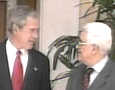 Sharon argues that the disengagement plan
cemented US support for retaining large blocks of Israeli towns in the disputed
territories of Judea and Samaria. For example, on April 18th, 2004 Sharon declared in the Knesset:
Sharon argues that the disengagement plan
cemented US support for retaining large blocks of Israeli towns in the disputed
territories of Judea and Samaria. For example, on April 18th, 2004 Sharon declared in the Knesset:
"…whoever wants to maintain large settlement blocs under our control forever; whoever wants to guarantee that for as long as the Palestinians don't act against terrorism, diplomatic pressures will not be exerted upon us... must support the disengagement plan."
Sharon further said: "The diplomatic support we received during my visit to the U.S. is an unprecedented achievement. Never since the establishment of the State have we received such support with such strength and comprehension. The Palestinians see the Bush letter as the strongest blow they have received since [our] War of Independence."
In light of
the May 26th Bush-Abbas summit and the subsequent statements, Arutz Sheva
presents the following analysis of what is left of Sharon's unprecedented
gains: U.S. President George W. Bush’s statement welcoming PA leader Mahmoud
Abbas into the White House Rose Garden on May 26, provided a highly transparent
view of the administration’s policy toward Israel and an unsettling perspective
on Prime Minister Ariel Sharon’s claims that Bush has agreed to allow Israel to
retain large settlement blocs in Judea and Samaria.
The most unsettling, if not shocking remark by the president was a direct
reference to the 1949 “Armistice lines” agreed to by Israel and Jordan at the end of the War of Independence. Those lines, the famous “Auschwitz borders” as they
were called by the late Israeli Labor-party statesman Abba Eban, leaves
Israel’s heavily populated coastal plain, just 9-11 miles from the border of
what would be Palestine. Not only are none of the major settlement blocs in
Judea and Samaria, such as Ma’ale Adumim included in those borders, but neither
are the Western Wall, the Old City of Jerusalem, the Jerusalem neighborhoods of
Ramot, Gilo, Neve Yaakov, East Talpiot, Pisgat Ze’ev (to name a few), nor the
Jerusalem-Tel Aviv highway (Route 1) as it crosses into the Latrun area.
Yet President Bush, standing next to the man whom he would like to become
the first president of Palestine, told Abbas and the rest of the world, that
the reference point for negotiating the future boundary between the two states
was the 1949 lines, and that any change to that border “must be mutually agreed
to” between Israel and the Arabs. In other words, as far as Bush is
concerned, Abbas must approve Israel's annexing the Western Wall or even part
of the Tel-Aviv-Jerusalem highway to the Jewish State. Conversely, without his
agreement, those areas are slated to be part of an independent State of
Palestine.
Where then, is the great quid-pro-quo for the Gaza withdrawal, the
highly-touted and heavily-marketed Bush promises to Sharon that the U.S. recognizes the facts on the ground in Judea and Samaria, the settlement blocs that preclude a
withdrawal to the 1949 Armistice lines? According to Yoram Ettinger, a
consultant on U.S. Israel relations and former liaison for Congressional
affairs in the Israel Washington embassy, Bush’s April, 2004 letter
supposedly guaranteeing U.S. support for retaining major settlement blocs in
Judea and Samaria “was grossly misrepresented by the Prime Minister and his
spokesman. Bush has not committed the United States to recognizing anything
beyond the 1949 cease-fire lines. Bush doesn’t recognize any single
settlement or blocs of settlements.”
Former Prime Minister Ehud Barak concurs with this analysis of Bush’s view of
the future border between Israel and a Palestinian state. In a recent interview
for Haaretz, Barak said: “A campaign is under way here whose gist is to mislead
the nation about substantive issues in order to prevent it from asking what the
quid pro quo for the disengagement is. Sharon’s claim that he made painful
decisions in Gaza and in return obtained an unprecedented achievement in Judea
and Samaria is not correct… “After all, it is obvious that the U.S. administration is against the Ariel-Kedumim bloc and against Ma’ale Adumim and is even against
Efrat [locataed in the Gush Etzion bloc]…Sharon is not telling the people the
truth. He is treating us all as though we are infantile and incapable of
debating our own fate.” It is not surprising therefore, that Bush, instead of
emphasizing the importance of Abbas fighting terror and keeping his obligations
under the road map, focused mostly on Israel’s roadmap obligations, primarily
to halt all settlement construction in Judea and Samaria and remove what he
called, “unauthorized outposts.”
George W. Bush is a president who means what he
says. After mentioning the 1949 lines, Bush said the following: “A viable
two-state solution must ensure contiguity of the West Bank, and a state of scattered
territories will not work. There must also be meaningful linkages between the
West Bank and Gaza. This is the position of the United States today, it will be
the position of the United States at the time of final status negotiations.”
Territorial contiguity in Judea and Samaria for a viable Palestinian State is not a prescription for accepting settlement blocs anywhere. It’s about time the
Israeli public recognizes that the “Bush vision” as expressed repeatedly by the
President and his Secretary of State, Condoleeza Rice, does not include any
territory east of the 1949 lines. Rather, it holds the disengagement plan as
the first phase of an ongoing process of Israeli withdrawals back to what
the Labor party leader termed "the Auschwitz borders."
Disengagement is opposed to George Bush's values, writes Yoram Ettinger – July 5, 2005
Ynet News - In a recent speech, U.S. President George W. Bush presented his country with a worldview in the tradition of late President Ronald Reagan: no retreat in the face of terrorism, yes to pre-emptive strikes – including assassinations – against terrorist breeding grounds. In word and deed, Bush has put forth an expanded version of Reagan's 1986 attack on Libyan leader Muammar Gadaffi's political, economic and military infrastructure.
In contrast to his father, the president's worldview is influenced by lessons learned from previous U.S. disengagement plans in 1979 (Iranian hostage crisis), 1983 (a terror campaign that killed 300 American diplomats and Marines in Lebanon), and in 1993 (following the lynching of Marines in Somalia). These disengagements poured gasoline on the flames of anti-American Islamic terrorism, resulting in major terror attacks on American targets in 1993,1995,1998,2000, culminating on September 11, 2001.
Bush is determined to prevent Clinton's mistakes. The latter chose to disengage from terror centers, made due with targeted, limited attacks on terrorist bases, and tried to enage in dialogue with terrorist-sponsoring regimes. Clinton pressed for cease-fires and tried not to destroy infrastructure; his disengagements eased the infiltration of terror cells into U.S. population centers.
Texas and religion
In contrast, Bush's worldview is influenced by both his religious connection and his Texas upbringing. As opposed to his father, the Connecticut aristocrat, Bush is loyal to the old Texas saying, "You don't jump off the horse, especially when the horse is bucking." Bush admires Moses, Joshua and Caleb, and is critical of the weakness displayed by the biblical spies who were intimidated by the nations of Canaan and who proposed disengaging from the Promised Land. To Bush – and to Vice President Dick Cheney, the cowboy and historian from Wyoming – to disengage from terror would be a kick in the face to that religious, Texas tradition.
Good-vs.-evil
Disengaging from terrorism is opposed to Bush's struggle of good against evil, freedom against slavery, truth against falsehood. In his speeches, Bush puts forward a worldview fundamentally opposed to the disengagement plan. "The correct answer to terrorism is not to run away, but courage and bravery… the terrorists think they can force us to withdraw. They are wrong. The choice is between war on their territory and war on ours." This is the reason the United States will not be funding the Gaza disengagement plan, a program that will cost the Israeli tax payer at least NIS 10 billion (USD 2.2 billion).
Bush has also not committed to any tangible guarantee. Bush did not propose the program himself, but rather accepted it after four months of pressure from Prime Minister Ariel Sharon (with support from the State Department, in order to prevent a political battle with Israel supporters in the months leading up to the 2004 presidential election.) And the vice president, secretary of defense, and many congressmen have doubts about the disengagement plan.
Possible reprecussions
Therefore, the president and Congress will not go to the wall should Israel call off the disengagement. They will make do with short-term pressure, which will be nothing compared to the brutal pressure that failed to move Israeli prime ministers from 1948 to 1992. In 1981, Reagan imposed a four-month arms embargo on Israel, following the attack on Iraq's nuclear reactor at Osirak. But following the short crisis, Israel benefited from strategic cooperation that continues to this day. President Bush has learned from Reagan (who disengaged from Lebanon), and has stood fast and strong in Afghanistan and Iraq. He admires Israeli democracy - which, like the American version, allows for checks and balances in order to slow down the army. Does Sharon have the same character?
More
Withdrawals Coming ? – July 10, 2005
Lekerev Report - A senior IDF officer hinted in an interview with London-based Arabic-language newspaper al-Sharq al-Awsat that Israel is planning additional unilateral moves, to be carried out by 2008, to complement the upcoming Gaza Strip and northern West Bank withdrawal. "The disengagement plan talks about unilateral steps that would end in 2008, resulting in a situation where the Palestinians would be responsible for managing their own affairs within the boundaries of the area we can give them, and not more than that," the official said. The officer hinted about future West Bank withdrawals, but refused to provide additional details. "I won't get into the matter of borders at this time," he said. "However, it will not be an independent state as the Palestinians expect."
Although Israel and the Palestinian Authority have started to coordinate the upcoming pullout, Israeli officials are unsure the coordination would lead to a peaceful withdrawal, the officer said.
The senior officer also had harsh words about the conduct of Palestinian leader Mahmoud Abbas over his recent trip to Syria and meeting with terror leaders there. Abbas' actions indicate that the culture of terror still reigns supreme in the Palestinian Authority, making peace talks with the Palestinians at this time an unrealistic prospect, he said. Abbas has failed to use the power given to him by the people in the last elections in order to advance his political plans through peaceful means, and instead of restraining terror groups he continues his dialogue with them and allows them to boost their power, the official said. The U.S. Administration and several European governments are convinced Abbas is going in the wrong direction, he said, and added the Palestinian leader would have to contend with harsher international demands.
Stormy
Sharon/Abbas Summit Deemed a Failure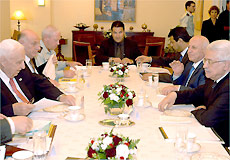 – June 22, 2005
Lekerev Report - An angry Ariel Sharon confronted a stony-faced Abbas Tuesday, June 21, with evidence of Palestinian preparations for a massive terrorist offensive against Israel's evacuation operation from the Gaza Strip in mid-August. The summit was described as "difficult and unsuccessful".
According to Palestinian sources, the Abbas team told Sharon Tuesday, June 21, that the removal of four Israeli communities from the northern West Bank this August was not enough; Israeli troops must also leave their bases in the area, although they face Israel's population and industrial center, and hand it over to full Palestinian sovereignty. By this device the Palestinians would acquire extra territory twice the area of the Gaza Strip without any negotiations or peace talks.
The grim results were reflected on the face of Abbas as he returned from Jerusalem to Ramallah, where he chose to remain in his office instead of addressing reporters outside. Later, Abbas sent top Palestinian figures Ahmed Qureia, Mohammed Dahlan, and Saeb Erekat to provide details of the session. The sides failed to agree on any of the issues raised during the session. The Palestinians requested the release of longtime and senior prisoners as yet another "goodwill" gesture. (How many more do they need????) Abbas also raised the question of continued construction in the settlements and the West Bank security fence and flatly denied that he promised to disarm terrorists.
Israel
Considers Building Railroad to Link West Bank and Gaza – July 6, 2005
Lekerev Report - If you thought the Oslo Accords were dead, think again! One of the many provisions in the Oslo accords that were never implemented was an idea known as "safe passage". Safe Passage meant that Israel would provide the Arabs of the Palestinian Authority with an overland route through Israel's pre- 1967 boundaries, allowing them to travel freely, with a minimum of restrictions, between the two territories.
The idea had major logistical problems, and the upsurge in suicide bombings that began shortly after the Oslo accords were signed and the subsequent Oslo war that took over 1000 Israeli lives seemed to put the idea of safe passage permanently on hold. That is, until now.
The PA reportedly has conditioned its cooperation on implementing the withdrawal and expulsion of Jews from Gaza and northern Samaria on implementing the safe passage provisions of the Oslo accords. Yesterday Israel and representatives of the Palestinian Authority announced an agreement to create a land link between Gaza and Judea and Samaria, in order to implement the safe passage concept. Initially Israeli security forces would escort Palestinian vehicle convoys and Israeli proposed a railway link at a later stage.
Apparently Israeli officials have already approached the World Bank with a request to finance the railroad at a cost $175 million. The World Bank, however, has suggested building a four-lane highway instead, sunken into a five-meter wide trench. Israelis would be able to cross the highway via overpasses that would be built at various intervals over the trench. The estimated cost of this project, which effectively dissects Israel into two parts, is only $130 million. The World Bank also believes it would be easier to operate than a rail line.
Keep an eye on this developing story.
 Sharon spurns Egypt’s demands, tells Washington:
Israel will not entrust its national security to Egypt – June 24, 2005
Sharon spurns Egypt’s demands, tells Washington:
Israel will not entrust its national security to Egypt – June 24, 2005
Debkafile - After months of interminable demands from Cairo that would have breached the 1979 peace treaty, Israeli prime minister Ariel Sharon finally put his foot down.
Will the Dutch Buy Gush Katif Greenhouses? – June 15, 2005
 The National Security
Council and Vice Premier Shimon Peres's office have been working on a deal
whereby Holland would purchase the greenhouses of Gush Katif residents slated
for evacuation. The Dutch would afterward give the greenhouses to the
Palestinians, according to the plan. The money paid to the settlers is supposed
to give them an incentive to leave their greenhouses behind and assist them in
beginning a new life in the post-pullout era.
The National Security
Council and Vice Premier Shimon Peres's office have been working on a deal
whereby Holland would purchase the greenhouses of Gush Katif residents slated
for evacuation. The Dutch would afterward give the greenhouses to the
Palestinians, according to the plan. The money paid to the settlers is supposed
to give them an incentive to leave their greenhouses behind and assist them in
beginning a new life in the post-pullout era.
The additional compensation funds received from the Dutch would give the settlers the privilege of not having to transfer the greenhouses during the relocation, leaving them behind for the Palestinians' benefit. It is feared that, should the deal fall through and the settlers would not receive added monetary compensation, they would opt to transfer the greenhouses in their entirety or disassemble them and transfer only the portable parts during relocation.
The greenhouses, according to the plan that is taking shape, will be handed to the Palestinians as a gift. But what is holding back the plan currently on the table is the Dutch concern that the Palestinians will refuse it if it includes giving money to Jewish residents for businesses established on what the Palestinians consider "conquered" territory. Government officials explained that there's no possibility of a similar transfer of settler homes to the Palestinians. "Regarding the homes, the state will be compensating the settlers in full. It's only the businesses that will not get full compensation," an official said.
The value of the greenhouses and one dairy barn included in the initiative are valued by professionals at 15 million U.S. dollars.
Attorney
General Asks Rabbis for Help - July 11, 2005
Lekerev Report - Attorney General Menachem Mazuz asked leading rabbis Sunday for help in dealing with opponents to the Gaza withdrawal. Mazuz and State Prosecutor Eran Shendar met Sunday with rabbis from the Zionist nationalist camp in an attempt to reach an understanding regarding the behavior of anti- disengagement activists toward the legal authorities.
Mazuz said during the meeting that law enforcement bodies act out of professional considerations only, with the aim of maintaining the rule of law on one hand and the limits of legitimate protest on the other "so that we will be able to continue to live together the day after the disengagement as well." The rabbis present at the meeting were Rabbis Shlomo Aviner, Mordechai Elon, Elyakim Levanon, Eli Sadan, Yuval Sherlo and Daniel Shilo.
The rabbis affirmed that they oppose all forms violent action, including "verbal violence." The sides agreed that under no circumstances is it permissible to harm security forces implementing the plan. However, the rabbis also expressed their fears regarding the growing "rift" within the nation caused by the disengagement implementation.
PM and Chabad Rabbis in a "Very Charged Meeting" – June 29, 2005
A delegation of Chabad rabbis met with Prime Minister Ariel Sharon in his Jerusalem office yesterday - the first meeting of its kind since he announced his expulsion/withdrawal plan.
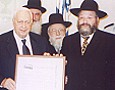 Israel National News - The
meeting began in a friendly atmosphere, but tensions gradually rose, and at
certain points it was "almost on the verge of an explosion." So said
today one of the participants, Chabad Spokesman Rabbi Menachem Brod, to
Arutz-7's Yosef Meiri. Participating in the meeting
were Rabbi Yehuda Leib Groner, who was the Lubavitcher Rebbe’s secretary,
Chabad Israel Rabbinical Court Director Rabbi Yitzchak Yehuda Yaruslavski, his
deputy Rabbi Menachem Glocobosky, Binyamin Regional Council Rabbi Shimon
Elituv, and other senior rabbis. The
90-minute meeting began with the recounting of stories about Prime Minister
Sharon’s meetings with the Lubavitcher Rebbe and the warm ties between them.
Left unmentioned was the fact that the Rebbe once advised Sharon not to enter
politics altogether.
Israel National News - The
meeting began in a friendly atmosphere, but tensions gradually rose, and at
certain points it was "almost on the verge of an explosion." So said
today one of the participants, Chabad Spokesman Rabbi Menachem Brod, to
Arutz-7's Yosef Meiri. Participating in the meeting
were Rabbi Yehuda Leib Groner, who was the Lubavitcher Rebbe’s secretary,
Chabad Israel Rabbinical Court Director Rabbi Yitzchak Yehuda Yaruslavski, his
deputy Rabbi Menachem Glocobosky, Binyamin Regional Council Rabbi Shimon
Elituv, and other senior rabbis. The
90-minute meeting began with the recounting of stories about Prime Minister
Sharon’s meetings with the Lubavitcher Rebbe and the warm ties between them.
Left unmentioned was the fact that the Rebbe once advised Sharon not to enter
politics altogether.
The Chabad representatives told the Prime
Minister how strongly the Lubavitcher Rebbe always opposed any concession over
any part of the Land of Israel. “While we do not have your experience and
knowledge," Rabbi Brod told him, "we do have the Rebbe and we are
certain that he is right." Prime
Minister Sharon explained what he felt were the advantages of his plan, the
circumstances that led him to initiate it, and the importance he ascribes to
the settlement movement. He spoke against violence - with the full agreement of
his guests - and against refusal to fulfill disengagement-related orders. Some
leading Chabad rabbis have called for such refusal. "True, it is difficult
and painful," Sharon said, "but the State of Israel has decided - we
are leaving Gaza. Even if it is difficult, the Plan will be implemented. The
Plan will be implemented because it is the right thing for the State of
Israel.”
Rabbi Brod told Arutz-7 that the rabbis decided
to meet with Sharon after he said that if he could speak with the Lubavitcher
Rebbe, he would persuade him of the correctness of his plan. "We showed
him that the Rebbe's opinion, which is the opposite of Sharon's, corresponds
perfectly to the situation and dangers as we see it now," Rabbi Brod said.
Sharon asked to see the Rebbe's words in writing, and the rabbis said they
would send him the relevant passages. Sharon
himself admitted that the Rebbe had been more precise and accurate in his
analysis of the shortcomings of the infamous Bar-Lev Line [a chain of
fortifications built by Israel along the Suez Canal after the Six Day War,
which was easily overrun by attacking Egyptian forces on the first day of the
Yom Kippur War - ed.] than IDF experts.
Rabbi Groner told Sharon, "You feel that the
plan will be beneficial to Israel, but you yourself cannot be certain that
things will develop the way you want them to. We tell you with absolute
certainty, in light of the Rebbe's clear words, that this plan will cause the
exact opposite." "It will lead
to a most grave security deterioration, will bring terror to inestimably high
levels, and will increase international pressure on Israel," Rabbi Groner
continued. "If you think that giving up Gush Katif and northern Shomron
will save the settlement blocs, the exact opposite will occur; it will serve as
a precedent and proof that it is possible to dismantle even the large
settlement blocs."
Asked if there were any arguments that seemed to
make Sharon more uncomfortable than others, Rabbi Brod said, "When we
talked about the danger to Jews that the plan was likely to bring, we could see
that this was not pleasant for him to hear." The Prime Minister said, "The country cannot
accept violence against policemen and soldiers, and Chabad people who do this
cause damage to Chabad." The rabbis responded that the disengagement plan
causes such great pain and unrest in the public that they can barely exert
their authority over them in these areas.
Supporters of the Gaza Settler’s Right to Remain in their own Homes
Bostoner Rebbe Leads Solidarity Mission to Gush Katif - July 5, 2005
The Bostoner Rebbe, Grand Rabbi Levi Yitzhak Horowitz [pictured] arrived in the Gush Katif town N'vei Dekalim on Monday afternoon accompanied by three busloads of congregants and supporters.
 Israel National News - As the
Rebbe's bulletproof van arrived in front of the town's central synagogue,
dozens of local residents began making their way to greet the Rebbe, a member
of the Council of Torah Sages of Israel and the United States. The visit, at this time, by a prominent member of
the hareidi Torah community sends a unique message to Gush Katif leaders,
residents and the government, that support for a continued Jewish presence in
Gush Katif and Gaza communities is far-reaching, extending outside the National
Religious community to other sectors of Torah Jewry as well.
Israel National News - As the
Rebbe's bulletproof van arrived in front of the town's central synagogue,
dozens of local residents began making their way to greet the Rebbe, a member
of the Council of Torah Sages of Israel and the United States. The visit, at this time, by a prominent member of
the hareidi Torah community sends a unique message to Gush Katif leaders,
residents and the government, that support for a continued Jewish presence in
Gush Katif and Gaza communities is far-reaching, extending outside the National
Religious community to other sectors of Torah Jewry as well.
The Rebbe addressed the crowd inside the
synagogue, speaking of the Jewish People's acquisition of the Land of Israel. The Rebbe expressed a prayer that together, the Jewish People will remain in
Gush Katif area communities in the future, continuing to build and grow for
many years. Following the Rebbe's
remarks, Rabbi Label Groner spoke. Rabbi Groner served for decades as the
secretary of the late Lubavitcher Rebbe, Rabbi Menachem Mendel Schneerson. Following the teachings of Rabbi
Schneerson, Rabbi Groner spoke of the need to continue efforts to reverse the
decree of the disengagement, citing numerous examples from modern history when
the Jewish People witnessed G-d's intervention, saving the residents of Israel from tragedy. Rabbi Groner called for
increased diligence in the observance of Torah and mitzvoth, explaining that
with our actions and mesirut nefesh -- self sacrifice, the Jewish People
can reverse the decree of the government's expulsion plan. The Bostoner
Rebbe and his followers proceeded to the Maoz Yam Hotel which was evacuated
last week by the army and currently serves as an army base. From there, the
group visited Kfar Darom, meeting with leaders and residents before returning
to Jerusalem.
American
Born IDF Soldier Takes A Stand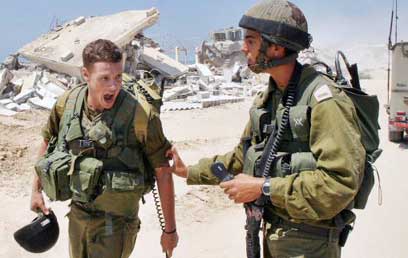 – June 27, 2005
Lekerev Report - A group of 12 soldiers who belong to the unit tasked with razing abandoned Gaza Strip structures yesterday were tried by their commander after threatening to refuse to take part in future settlement evacuation. The 12 soldiers followed the lead of Corporal Avi Beiber, who was born in America and immigrated to Israel with his family when he was nine years old. He was detained after refusing to take part in the demolition operation and yelled out (see photo) "A Jew doesn't evacuate a Jew." His courage inspired the others to follow suit.
During a difficult conversation with their commander, soldiers in the company expressed their anger over what they said was army deceit. The troops said they were not prepared for the mission and charged the IDF hid the true mission from them.
The soldiers said the received an order to arrive at Neve Dekalim to take part in an "unspecified mission. The troops said they were told to take their weapons and a protective vest. "We arrived at the site and saw a bulldozer razing structures," one soldier told Ynet. "We were told to deploy in the area and secure it so the settlers won't enter. They were stunned to hear about the mission they were tasked with and said they would have done everything in their power to stay behind had they known the mission's true nature. Some soldiers even turned to their commanders and said they were unable to perform the mission. Those troops were told to assume new positions so they do not have to clash with settlers.
Corporal Beiber defended his action as that of a conscientious objector, saying that his family "didn't come to the country to expel Jews from their homes." "I didn't enlist in the IDF in order to destroy communities or prepare the ground for the destruction of communities. I enlisted in the IDF to defend the state, and this action is not the role of the IDF," the young soldier said.
His father, Rafael Bieber, said today that his telephone was constantly ringing with callers praising his son's actions. "Many people from all over the country have telephoned me to say that what he did was a good thing, that he had spoken from his heart, and that many people felt the same way. I received a call from someone in Brooklyn, New York, who told me that everyone there is with us," Bieber said, adding that the caller told him that footage of his son had appeared on television channels Two, Four and Seven in New York City.
According to Bieber, politics was not behind his son's actions, but rather concern for the demonstrators. "He's a human being. He saw that his commanders were beating Jews, and he'd never seen anything like that in his life. He did not do this because of politics. He did it because he is sensitive, and because he cares, just like you would care if you saw someone beating someone else."
Speaking to Haaretz after the incident, Avi Bieber said he and some of his fellow soldiers were initially unaware of why they had been taken to the site, adding that he had not planned to refuse to participate in the operation. "It wasn't something I planned because I had no idea what I was going into, but when I saw what was happening, when I saw how they were beating dedicated Jews, my heart broke, and my conscience said to me, 'Avi, this isn't Jewish justice. You are not going to participate in such a thing.'
Bieber's parents, Michelle and Rafael, said they were proud of their son. "Our boy showed the entire country just how much he loves the State of Israel," Michelle Bieber said. "We raised him to love the country and we hope that others will follow in his footsteps."
Prestigious Golani Brigade Says "NO" to Disengagement – June 17, 2005
 Lekerev Report - The
IDF has decided to relieve the prestigious Golani Brigade of the task of
removing Jewish residents from their homes, fearing mass refusal and lack of
motivation among soldiers and officers.
Lekerev Report - The
IDF has decided to relieve the prestigious Golani Brigade of the task of
removing Jewish residents from their homes, fearing mass refusal and lack of
motivation among soldiers and officers.
It was decided that the soldiers of the brigade, many of them either religious or children of immigrants, will be charged with defending the region from Arab terror attacks during this summer's withdrawal instead of removing Jews from their homes, which was their original assignment.
Hagit Rothenberg of the B'Sheva weekly reports that Golani Brigade commander, Col. Erez Zuckerman, informed the commander of the 36th division, Brig.- Gen. Gershon HaCohen - who is supposed to command the uprooting of the residents of Gush Katif - that the soldiers of the brigade and their commanders are unable to fulfill the expulsion mission. The Golani Brigade Commander came to this conclusion in light of recent conversations with senior officers in the brigade.
Golani Brigade Says No to Expelling Jews – June 17, 2005
The IDF has decided to relieve the prestigious Golani Brigade of the task of removing Jews from their homes this summer, fearing mass refusal and lack of motivation among soldiers and officers.
 Israel National News - It was
decided that the soldiers of the brigade will be charged with defending the
region from Arab terror attacks during this summer’s withdrawal, instead of
removing Jews from their homes. Many of the brigade soldiers are either
religious or children of immigrants.vBrig.-Gen.
Gershon HaCohen is the disengagement commander who received word of this decision.
He is charged with overseeing the uprooting of the residents of Gush Katif.
Israel National News - It was
decided that the soldiers of the brigade will be charged with defending the
region from Arab terror attacks during this summer’s withdrawal, instead of
removing Jews from their homes. Many of the brigade soldiers are either
religious or children of immigrants.vBrig.-Gen.
Gershon HaCohen is the disengagement commander who received word of this decision.
He is charged with overseeing the uprooting of the residents of Gush Katif.
Hagit Rotenberg of the B’Sheva weekly reports
that Golani Brigade commander Col. Erez Zuckerman informed HaCohen that the
soldiers of the brigade and their commanders would be unable to fulfill the
expulsion mission. The Golani Brigade Commander came to this conclusion in
light of recent conversations with senior officers in the brigade. The
situation became apparent following a conference of Golani officers, when
lectures on the importance of fulfilling the disengagement mission and
maintaining loyalty to democracy and the rule of law were delivered. The
Brigade Commander noticed that officers were purposely avoiding addressing
questions having to do with the question of fulfilling the expulsion order.
Following the conference, the Brigade Commander
invited all the Deputy Battalion Commanders to a discussion to clarify the
matter. The Deputy Battalion Commanders
told him unequivocally that the brigade was simply not built to fulfill the
expulsion order. "Not for this did we join the IDF," they said.
An entire company of yeshiva-graduated Golani
soldiers serving in the Philadelphi corridor informed their commanders that in
the event that they are assigned to carry out an operation against a Jewish
civilian population, they have no intention of carrying out that order. They
say they will only act in a capacity against Arab attacks, but that if assigned
any other task with regard to Jewish towns, the commanders warned of mass disobedience.
“The sentiment of the commanders in the brigade
is that they are being forced to choose where their loyalties lie – with their
father or with their mother. It's an impossible choice between settlement in
the Land of Israel and the IDF,” the Deputy Battalion Commanders said, “and
they want to continue to be loyal to both of them.”
As a result of the Deputy Battalion Commanders’
briefing, the Brigade Commander informed the Division Commander that the
brigade will not be able to take part in the uprooting of residents. The
situation was also brought to the attention of the Chief of Staff.
Ari Abramowitz, a former Golani Sergeant who
served in the Philadelphi Corridor, told Arutz-7 that the news of Golani’s
removal from the task of expelling Jews from their homes was to be expected. “I
am not surprised one bit,” he said. “I and all the former Golani soldiers I
know would refuse the orders together with them. The stereotype of Golani,
which is somewhat true, is that they are first- and second-generation
immigrants from Arab countries. They understand Arabs on a much deeper level
than the Ashkenazi Jew from Tel Aviv. They know that the Arabs understand power
and strength, and know that the transfer of Jews from their homes will be a
victory for Arab terror and will encourage further attacks on Jews.”
Hundreds
of Reserve IDF Soldiers Say "No" to Disengagment – June 24, 2005
Lekerev Report - Hundreds of IDF reserve soldiers and officers gathered in Jerusalem's Binyanei HaUmah Convention Center Tuesday to call upon their fellow soldiers to refuse to take part in the Disengagement Plan. The audience also included several elite unit soldiers in uniform and the parents of a Druze soldier already sitting in prison for refusing to train for the uprooting were in attendance. Many of the reservists tore up draft notices in front of the television cameras. They instead accepted orange "call-up notices" (pictured here) symbolizing their enlistment in the struggle against the planned withdrawal from Gush Katif and northern Samaria. "There are those who tell us we are destroying the IDF - that a soldier must fulfill every order given to him," Colonel (ret.) Moshe Leshem told those gathered. "At Nuremberg, people were hanged for saying, 'We were just fulfilling orders.' We say to them: 'We are saving the IDF.'"
The father of Sgt. Timor Abdullah, one of two Druze soldier sent to prison so far for refusing to take part in preparations for the Disengagement Plan, took the podium last night to a sustained standing ovation from the crowd. He was presented with a framed certificate for his son, referring to him as a "Righteous Gentile."
Sgt. Abdullah had sent a letter to the IDF's new Chief of Staff, Lt.-Gen. Dan Halutz, saying, ""When my colleagues and I are demanded to participate in operations whose objective is to defend the country and its citizens, we feel obliged to participate, but when we are asked to participate in an operation against the people we are meant to defend - our consciences would tremble eternally." Wiping a tear from his eye, Nazib Abdullah, from the Druze village of Kfar Kama, thanked those present for the "warm embrace," calling upon all Israelis to follow in his son's footsteps. "What he did, everyone must do," he said. "He has been sentenced to 35 days, and he will continue to sit in prison for what is right rather than take part in something he will regret for the rest of his life." It has also become known that the elite Golani Brigade of the IDF has been excused from participating in the Disengagement because of wholesale unwillingness on the part of the entire unit. Kol HaKavod to all of them!
Americans
Oppose Disengagement in Large Numbers – July 3, 2005
Lekerev Report - Two -thirds of Americans are opposed to the disengagement plan, according to a recent professional poll. The survey conducted for the Zionist Organization of America (ZOA) by McLaughlin & Associates, a major polling firm, was carried out last week and sampled 1,000 Americans from all religions.
It showed that more than 60 percent of Americans oppose the Israeli government's plan to force more than 9,000 Jews out of their homes this summer and give Gaza and northern Samaria to the Palestinian Authority (PA). The results "expose the myth that Americans support disengagement," according to ZOA president Morton Klein. A well placed source in the Bush Administration has also told me that the White House has been flooded with emails and letters of opposition to the President's support for the Disengagement.
The new McLaughlin survey also showed that half of Americans agree that ""this Gaza plan sends a message that Arab terrorism is being rewarded." An overwhelming majority of respondents oppose continuing aid to the Palestinian Authority (PA).
Majority Now Against Evacuation Under Fire – June 12, 2005
 A well respected
independent survey has determined that 51 per cent of Israelis are now against
the planned evacuation under fire, while only 37 percent support it. The poll
was conducted Thursday night by the Maagar Mohot Survey Institute, headed by
Professor Yitzchak Katz. Respondents answered the question, "Are you for
or against withdrawal under fire in the disengagement plan?" Professor
Katz said the question is different from most polls which have asked people if
they are for against the plan, without giving them the opportunity to express
their conditions for support.
A well respected
independent survey has determined that 51 per cent of Israelis are now against
the planned evacuation under fire, while only 37 percent support it. The poll
was conducted Thursday night by the Maagar Mohot Survey Institute, headed by
Professor Yitzchak Katz. Respondents answered the question, "Are you for
or against withdrawal under fire in the disengagement plan?" Professor
Katz said the question is different from most polls which have asked people if
they are for against the plan, without giving them the opportunity to express
their conditions for support.
The government claimed last year that there was no need to conduct a national referendum on the plan to force more than 9,000 Jews out of their homes because all polls showed that two-thirds of the public supported the plan. After recent polls revealed that support has gone down from 65% in favor of the plan to 48-50%, spokesmen for the Prime Minister's office said that government policy should not be made according to public polls.
The results of Katz' poll supports the trend on the street in which most of those Israelis who formerly supported the Disengagment now oppose it because of the recent increase in terrorism and the probability of terrorists attack during the operation and afterward.
Extreme Left Wing Leaders Come Out Against Disengagement – June 14, 2005
 Very Left Wing leaders
including Yossi Beilin, Shlomo Ben-Ami, Ami Ayalon and others are warning of
the dangers, security-wise and diplomatically, that the unilateral
retreat/expulsion from Gaza/northern Shomron will create for Israel.
Very Left Wing leaders
including Yossi Beilin, Shlomo Ben-Ami, Ami Ayalon and others are warning of
the dangers, security-wise and diplomatically, that the unilateral
retreat/expulsion from Gaza/northern Shomron will create for Israel.
Former Justice Minister Yossi Beilin (pictured here), currently not a Knesset Member but the chairman of the extreme left-wing Yahad/Meretz Party said, "If the disengagement does not lead to an immediate permanent status arrangement, it will bring a catastrophe upon both Israelis and Palestinians. It is liable to bring a renewal of violence [that] is liable to bring down the moderate Palestinian leadership. There is a concrete danger that following the disengagement, the violence will greatly increase in [Judea and Samaria] in order to achieve the same thing as was achieved in Gaza. A retreat from Gaza with nothing in return and with no agreement will strengthen Hamas."
Former Foreign Minister Shlomo Ben-Ami of the left- wing of the Labor Party added, "A unilateral retreat perpetuates Israel's image as a country that runs away under pressure. In Fatah and Hamas, they will assume that they must prepare for their third intifada - this time in [Judea and Samaria]. If we continue these unilateral steps, we will find ourselves establishing an enemy Palestinian state."
Former General Security Service chief Ami Ayalon declared, "The captain of the disengagement can be compared to the captain of a ship who takes it from port to a very stormy sea, without knowing at all where he wants to lead it. And possibly even worse: He knows where he wants to lead it, but is hiding the information from his crew. Retreat without getting anything in return is liable to be interpreted by some of the Palestinians as surrender. The plan is likely to strengthen extremist forces in the Palestinians society. There is a high chance that shortly after the disengagement, the violence will be renewed. 2006 is liable to be a year of another round of violence."
Rabbi Levinger Stands Trial, Verdict Monday – June 17, 2005
Hevron elder Rabbi Moshe Levinger, arrested for blocking traffic as part of the massive coordinated “dry-run” civil disobedience protest, appeared in a Be’er Sheva court Thursday.
 Israel National News - He
spoke with Israel
National Radio's Eli Stutz and Yishai Fleisher on his way to the courtroom,
unsure whether he would be allowed to go home or be placed in prison. The rabbi, founder of the Jewish community in Hevron,
was arrested last month for participating in the “dry-run” nationwide road
blocking, meant to offer the public and police a taste of the civil
disobedience to be expected if the expulsion of nearly 10,000 Jews from their
homes goes ahead as planned. Though the
rabbi was released at the time, he later received a summons informing him that
he must sign a commitment to remain under house arrest until the end of legal
proceedings against him. He refused to sign, and was ordered to appear in a
Be’er Sheva court on Tuesday of last week - at which time he was told to come
back Thursday, June 16, after the Jewish festival of Shavuot. On his way to court, Rabbi Levinger said he is not
scared at the prospect of being sent to jail: “I am not worried, thank G-d. I
will be happy because I will be in jail in the Land of Israel, and because I
will be going into jail due to my protest of the awful thing which the prime
minister wishes to do.”
Israel National News - He
spoke with Israel
National Radio's Eli Stutz and Yishai Fleisher on his way to the courtroom,
unsure whether he would be allowed to go home or be placed in prison. The rabbi, founder of the Jewish community in Hevron,
was arrested last month for participating in the “dry-run” nationwide road
blocking, meant to offer the public and police a taste of the civil
disobedience to be expected if the expulsion of nearly 10,000 Jews from their
homes goes ahead as planned. Though the
rabbi was released at the time, he later received a summons informing him that
he must sign a commitment to remain under house arrest until the end of legal
proceedings against him. He refused to sign, and was ordered to appear in a
Be’er Sheva court on Tuesday of last week - at which time he was told to come
back Thursday, June 16, after the Jewish festival of Shavuot. On his way to court, Rabbi Levinger said he is not
scared at the prospect of being sent to jail: “I am not worried, thank G-d. I
will be happy because I will be in jail in the Land of Israel, and because I
will be going into jail due to my protest of the awful thing which the prime
minister wishes to do.”
The longtime activist, who induced the government
to allow Jews to resettle in Hevron via a long-term rental of an Arab-owned
hotel there for Passover in 1968, says that now is the time for Jews to come
out to the streets and show they are willing to sacrifice for what they believe
in. “We have to show the nations of the world that a Jew will not, G-d forbid,
expel a Jew from his home.” He is facing
trial for blocking a major highway near Be’er Sheva, while at the same time as
more than 500 others filled the country’s holding cells for blocking over 40
intersections and highways. Rabbi Levinger says, however, that there are a
myriad of ways to successfully combat the government’s plan. He declined to
mention specific tactics, but said they were all non-violent and would be used
when the time was right.
Asked by host Yishai Fleisher whether the looming
expulsion and other events caused him to doubt that the nation of Israel stands at the beginning of its redemption, Rabbi Levinger emphatically stated that
it does not. “We have still not lost faith that we are at the beginning of the
redemption,” he said. “Although the road is a windy one, we still see many of
the signs – we must simply deal with the problems along the way.” Host Eli Stutz compared today's situation to that of
the Biblical sin of the Golden Calf. He noted that Aaron the Priest appeared to
be taking the "democratic" position of following the popular will,
while Moses said that the Divine Law overrules democracy. "Do you see your
actions as parallel to those of Moses?" he asked Rabbi Levinger. “First of all,” said Rabbi Levinger, “I have nothing in
common with the lofty level of Moses our teacher. Second of all, whereas in the
Bible, Aaron said, ‘these people have an evil inclination,’ today, most of the
nation has their eyes opened, seeing that this is a ridiculous plan and that
the prime minister’s considerations were for his own personal gain.”
Rabbi Levinger’s claim was bolstered several
hours earlier on Israel’s Channel Two. a target="_blank"
href="http://www.israelnationalnews.com/news.php3?id=83986"
class="wntu">Two senior journalists presented their new book's
findings that Prime Minister Sharon came up with the disengagement plan simply
to avoid prosecution for corruption. Rabbi
Levinger said that though he realizes the goal of the government is to silence
him, they will not succeed in shutting the mouths of the myriads of people
saying the same things. “We cannot be shut up – the truth is too loud,” he
said.
The rabbi advises the general public to follow a
three-pronged strategy in explaining the truth to the nation:
“One,
to explain that the security dangers will be increased – that after we, G-d
forbid, leave Gush Katif, there will be rockets in Sderot, Ashkelon, the Negev
and elsewhere.
"Two, do not shy away from speaking out about the fact that this entire
plan is meant to distract the public from Sharon’s private crimes and
corruption. The Channel Two program yesterday made that clear to everyone.
"Three, the people of Israel must shout out that there is no way we will
leave even one millimeter of the Land of Israel. Just like you can’t remove
even one word from the Torah, you can’t remove parts of Israel. To cut away parts of the Land of Israel is like cutting off a limb from a person.”
After a trial session lasting several hours, Rabbi Levinger was told to return to the Be’er Sheva court on Monday at 1 PM to receive the decision as to whether he will be imprisoned or not.
Mazuz, Rabbis Trade Blame on Violence - July 11, 2005
Attorney General Menachem Mazuz told nationalist leaders Sunday night he will not tolerate law and incitement. They replied that government anti-democratic actions have ignited bloodshed.
 Israel National News - Mazuz
invited seven leading national religious rabbis for a five-hour talk. "If
the [present] situation continues, there will be a more severe split between
the people of Israel that no one knows where it will end," warned Mazuz.
Rabbi Yuval Cherlow informed Mazuz, "The idea that we will stand silent is
a mistake. Our children and our grandchildren feel that have been trampled. The
limits initially were broken by the government and the Knesset and afterwards
by the judicial system. If we are speaking about a rebellion..., the government
has rebelled against itself and against the country."
Israel National News - Mazuz
invited seven leading national religious rabbis for a five-hour talk. "If
the [present] situation continues, there will be a more severe split between
the people of Israel that no one knows where it will end," warned Mazuz.
Rabbi Yuval Cherlow informed Mazuz, "The idea that we will stand silent is
a mistake. Our children and our grandchildren feel that have been trampled. The
limits initially were broken by the government and the Knesset and afterwards
by the judicial system. If we are speaking about a rebellion..., the government
has rebelled against itself and against the country."
The rabbis expressed anger at what they called
excessive police brutality, and Mazuz said all complaints of
"exceptions" of police violence will be investigated. He also said
warning letters have been sent to several left wing internet sites which have
incited violence against people opposed to the planned evacuation. The participants agreed not to make any public
statements other than that the meeting was positive, demonstrations should be
within the law and that dialogue will continue.
Famed Musician Performs Outside IDF Bases, Preaches Refusal - July 12, 2005
Israeli pop-music legend Ariel Zilber performed a series of concerts Monday, opposite army bases, aimed at calling upon IDF soldiers to refuse to take part in the expulsion of Jews from their homes.
 Israel National News - Zilber
performed opposite several army bases in the Gaza region, calling on soldiers
"not to be robots." Soldiers who gathered opposite the fences of the
bases were told by Zilber that if they were to take part in uprooting the Jews
of Gaza from their homes they would have to drag him out as well. Zilber told the Walla news site that his aim was to
bring happiness to the soldiers and to dismantle the demonic and monstrous images
that supporters of the expulsion are creating with regard to the residents and
opponents of the Disengagement Plan.
Israel National News - Zilber
performed opposite several army bases in the Gaza region, calling on soldiers
"not to be robots." Soldiers who gathered opposite the fences of the
bases were told by Zilber that if they were to take part in uprooting the Jews
of Gaza from their homes they would have to drag him out as well. Zilber told the Walla news site that his aim was to
bring happiness to the soldiers and to dismantle the demonic and monstrous images
that supporters of the expulsion are creating with regard to the residents and
opponents of the Disengagement Plan.
The famed musician moved his home to the
threatened northern Gaza community of Elei Sinai last year and has since then
used his performances as a platform to attack Prime Minister Ariel Sharon's
policies of withdrawal and transfer. "Anyone with even a bit of Zionism in
their head must get up and move to Gush Katif," Zilber told the packed
Tzavta Club in Tel Aviv in January.Zilber has stated that he will chain himself
to his home in Elei Sinai. "What is this? Does Sharon think he is Queen
Isabella of Spain that he can just expel Jews?" Zilber told Army Radio
last year.
Likud legislator
moves to Gaza – June 17, 2005

Israel Today - Hawkish Israeli parliamentarian Yuli Edelstein of the ruling Likud party is moving to a Jewish community in Gaza with his family, in solidarity with the settlers slated for evacuation. "I am a public representative," Edelstein told Army Radio, "and it's a duty to be with the public I represent." Edelstein said the Gaza pullout is dangerous and a reward for Palestinian terror. He said he still believes that the withdrawal will not take place
Stand
Off at Gaza Hotel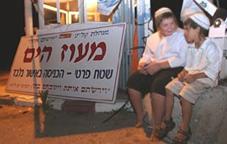 – June 28, 2005
Lekerev Report - Some 600 Jewish residents of Gaza and hundreds of their supporters streamed to the Maoz Hayam hotel last night in Gush Katif, following rumors that IDF forces planned to storm the building. The hotel has become a symbol of the struggle against disengagement and the government's policy of expelling Jews from the Land of Israel.
The alarm went out for anti-disengagement supporters both inside and outside Gaza to come to the hotel Monday evening. Within hours, some 10 buses arrived from Ramat Gan, Beit Shemesh, Jerusalem, Sderot and other settlements. And lest the impression be that teenagers are the only protestors, let me be quick to tell you that one of the arrivals was 85-year-old Yenta Kockmange of Beit Shemesh, who told reporters she came "to cry." "I have a lot of energy for the Land of Israel," she said. "I say (Prime Minister) Ariel Sharon has lost his mind. I am here, at this hotel, to say that the Gaza Strip, too, is part of the Land of Israel."
MK Aryeh Eldad: Sa-Nur will be the Stalingrad of Samaria - June 15, 2005
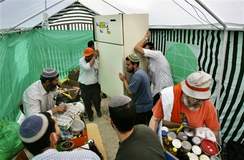 Haaretz - Thousands attended
an assembly Tuesday to mark the absorption of 20 new families in the northern West Bank settlement of Sa-Nur, which is slated for evacuation. Twelve families on
Tuesday joined eight others that had moved to the settlement in recent weeks,
pitching tents in a makeshift campsite. "Tens of
thousands will come to Homesh and Sa-Nur in northern Samaria," MK Aryeh
Eldad (National Union) told the crowd. "They won't care about any law. No
fence will stop them. Nor the security cordons of the police and army," he
said."Every struggle has its name. This place will be called Samaria's 'ad halom,'" Eldad said, referring to the line south of Ashdod where
Israeli troops halted the Egyptian army in the 1948 War of Independence.
Haaretz - Thousands attended
an assembly Tuesday to mark the absorption of 20 new families in the northern West Bank settlement of Sa-Nur, which is slated for evacuation. Twelve families on
Tuesday joined eight others that had moved to the settlement in recent weeks,
pitching tents in a makeshift campsite. "Tens of
thousands will come to Homesh and Sa-Nur in northern Samaria," MK Aryeh
Eldad (National Union) told the crowd. "They won't care about any law. No
fence will stop them. Nor the security cordons of the police and army," he
said."Every struggle has its name. This place will be called Samaria's 'ad halom,'" Eldad said, referring to the line south of Ashdod where
Israeli troops halted the Egyptian army in the 1948 War of Independence.
Settlers moving a refrigerator into a tent as a family moves
into the West Bank settlement of Sa-Nur Tuesday. (AP)
"It will not be Masada, heaven forbid. It will be the
Stalingrad of Samaria. Sa-Nur will not be removed from here. Tens of thousands
will tell Sharon's evil regime: 'That's it.' We have the power to stop him and
we will indeed do so," he said. There are now 58
families living in Sa-Nur; most of the residents left at the start of the
intifada. Eldad moved there a few months ago.
Yossi Dagan, a member of the original founding group that
reestablished Sa-Nur, said the families' move to Sa-Nur is a stage in the
struggle, and certainly not its high point. "Dozens
more families will come to live here. The campsites we have prepared can take
in hundreds more. There is a tremendous flow of requests, and we cannot accede
to them all," Dagan said. If the Israel Defense
Forces closes the area, Dagan said, masses will come to the settlement on foot.
"Such a mass of people will cause all of the thoughts about uprooting to
be mooted," he said. Another new resident who spoke
at the assembly was a former MK, Rabbi Eliezer Waldman, the head of the Nir
yeshiva in Kiryat Arba, who moved to Sa-Nur with 25 of his students several
months ago. Waldman said that settling in Sa-Nur, like everywhere in the land
of Israel, is realizing the sanctification of God's name. "Woe be it to whoever dares interfere with the sanctification of
God's name in his world. In the past, when the people of Israel was not in the land, the land was cursed, and it will again be cursed if we are expelled from
here," Waldman said.
Also on Tuesday, hundreds of ultra-Orthodox worshipers took
part in an anti-disengagement prayer assembly at the Western Wall. Some
worshipers wore sackcloths and blew shofars in a plea for the "expulsion
plan" to be canceled. The event was organized by several
ultra-Orthodox rabbis, including Yaakov Yosef, the son of Shas spiritual leader
Ovadia Yosef, and Zalman Goldberg, who presides over the rabbinical
court in Jerusalem.
The Orange Revolution
How "Orange" is Israel? – June 28, 2005
 Lekerev Report - The "Orange"
campaign is currently enjoying an approval rating of over 67% according to the
latest polls. Orange has taken over as the color of choice for many children's
and youths' T-shirts.
Lekerev Report - The "Orange"
campaign is currently enjoying an approval rating of over 67% according to the
latest polls. Orange has taken over as the color of choice for many children's
and youths' T-shirts.
Many people wear orange braclets, scarves, and yarmulkes, and children's schoolbags, teenagers' backpacks and adults' briefcases are adorned with orange ribbons, as are car antennas throughout the country. Walking canes, yeshiva-style hats, and store windows have also been seen sporting orange ribbons and orange merchandise.
Talk a walk anywhere in Israel today and ORANGE is everywhere! Click the link below to take a virtual stroll amidst the Orange!
Civil
War Is National Suicide – June 29, 2005
Lekerev Report - Aiton Birnbaum published an article in today's Jerusalem post entitled "Civil War is National Suicide, which which he says, "As disengagement draws closer, some fear that growing tensions may erupt into armed conflict. Worst-case scenarios of disengagement, security chiefs warn, include assassination of the prime minister or other leaders and violent civil unrest."
The more we positively discount such possibilities, the more likely it is that we are in denial. Civil war could threaten our very existence - the prospect of which, while naturally engendering avoidance of the topic, also demands overcoming anxiety in order to perform a realistic risk assessment, he suggests.
The article is too long for this report but not so long that you couldn't read it in just a few minutes which is exactly what I encourage you to do. Please click on the link below.
Thousands Participate in Demonstration – June 28, 2005
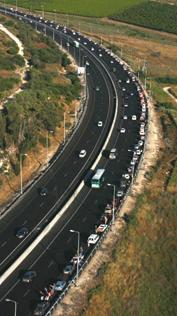 Lekerev Report - The "Stop a
Moment - Think Again" protest organized by the Council of Judea, Samaria and Gaza began at 6 PM last night, lining many of Israel's highways with anti-Disengagement
motorists.
Lekerev Report - The "Stop a
Moment - Think Again" protest organized by the Council of Judea, Samaria and Gaza began at 6 PM last night, lining many of Israel's highways with anti-Disengagement
motorists.
Some 40,000 vehicles pulled over to the side of the road and more than 200,000 demonstrators stood outside their cars along Israel's highways to demand the government rethink the decision to expel 10,000 Jews from their homes in Gaza and northern Samaria.
Police in Jerusalem expressed satisfaction with the order and peaceful nature of the current "Stop a Moment and Think Again" protest against the government's Disengagement Plan.
Yesterday as I was enroute to Jerusalem for the Eli Cohen Memorial Ceremony, I saw dozens and dozens of stopped cars and I can tell you as an eye witness that while there were many young people, there were just as many families - husbands, wives and children -older couples, Rabbis, adults of all ages - both religious Jews and secular Jews, all joined together in one cause: to say to the Government of Israel and to Israelis in general, "STOP AND THINK".
In a less publicized development, Arab Druze Knesset Member Ayoob Kara, from Sharon's Likud Party, said last week that he will introduce a bill seeking to ban all Druze Arab soldiers from participating in the Gaza evacuation. (The Druze are a minority sect that broke away from mainstream Islam and live peaceably in Israel and are loyal Israeli citizens. They serve in the IDF and many have died defending Israel). "My community didn't come to Israel to rip Jews out of their houses," Kara said. "Druze Arabs gladly become soldiers in the Israeli Defense Forces to defend Israel from its enemies and to participate in operations that will make Israel a safer place. We don't want to be used to do something immoral and damaging like the Gaza evacuation." Said Kara: "Quietly, most leaders of the army and police are terrified because they can't predict what enforcing the evacuation is going to do to their units, but they know it will not be good."
Anti-withdrawal
protesters to shut down Israel - Campaign seeks to cripple country for 15
minutes this month – June 15, 2005
NEVE DEKALIM, Gaza (WorldNetDaily) –
Anti-withdrawal campaigners plan to shut down Israel some time this month for
15 minutes to protest Israeli Prime Minister Ariel Sharon's plan to evacuate
Jewish communities from Gaza and parts of the West Bank this summer. An
official from the Yesha settlers council, which has planned several recent
anti-withdrawal protests, said a signal would be given within two weeks for
thousands of activists from around the country to block traffic and park their cars
in the middle of busy intersections. "It's going to be our largest protest
yet," a senior settler leader told WND today. "We are going to show Sharon we have the ability to cripple the country. He can't possibly get away with the [Gaza] evacuation because we are going to shut down Israel when he tries to go through with
his evil plan."
The leader said protests can stop the Gaza withdrawal from being implemented. "If we block roads during the evacuation, if there are protests all over, it will require an enormous police response. They wont have the resources to deal with civil disobedience every day and also use police to kick Jews out of their homes." He said traffic blocking will increase as the Aug. 15 Gaza evacuation date approaches.
Said the leader: "There will be a lot more. Sharon thinks he can disrupt the lives of the people living in Gush Katif. We can disrupt the lives of the rest of the country."
Last month, hundreds of anti-withdrawal activists blocked traffic and nearly shut down the main entrances to Jerusalem, Tel Aviv and several other Israeli towns. Israeli police allowed the protesters to block traffic in certain areas for about five minutes, then quickly moved to disperse the crowds. But the Jerusalem entrance was closed for about an hour and backed up for almost three hours. "This time will be a lot bigger," promised the settler leader.
Some settler leaders have said they don't support the civil-disobedience campaign. Yekutiel Ben Yaacov, a prominent activist, told WND: "There are so many more effective ways to get the message across. There needs to be a better public relations campaign. Blocking traffic doesn't do it. If people understood the real issues, Israelis and the international community would never support expelling Jews from Gaza evacuation. If anything, they would support expelling the Palestinians, which most Israelis really want."
Last July, WND broke the story that a group of settlers was planning a civil revolt. "We have plans for a civil revolt, which is going to include stopping traffic and causing traffic jams, no more paying of taxes, cutting down the fences the IDF will try to put up to keep us from our land, having people lie down in the streets and block bulldozers, and disobeying orders from the Israeli authorities," an operational leader in the planned revolt who asked that his name be withheld told WND.
Sharon's Gaza evacuation plan this summer has drawn criticism from many in his government, with several ministers of his own Likud Party, including Finance Minister Benjamin Netanyahu and Foreign Minister Silvan Shalom, opposing the plan.
Critics worry the withdrawal will be seen as a reward for Palestinian terrorism and argue territories evacuated by Israel will be used by Hamas to stage attacks against the Jewish state. A confidential memo written by Dr. Mahmoud al-Zahar, Hamas leader in the Gaza Strip, and obtained last summer by WorldNetDaily, stated the terror group views Sharon's unilateral withdrawal as a capitulation to terror and is planning to continue its "armed struggle" against the Jewish state until "all territories" are in Palestinian hands. "The withdrawal, if it is implemented, is an important achievement by the Palestinian people, its intifada and armed struggle, its determination and great sacrifice, and confirms the willingness, correctness and usefulness of employing an armed struggle and its ability to attain political objectives," wrote al-Zahar. "We will emphasize our people's right to resist the occupation [outside the Gaza Strip] so long as the occupation of the land and the aggression continue, with the understanding that withdrawal from Gaza is not the end of the story and occupation is still present in the rest of the lands and that not all rights and holy sites have been returned yet," the memo stated.
1000
Guests in Gush Katif – July 10, 2005
Lekerev Report - More than 1,000 guests from communities in Judea and Samaria spent Shabbat in Gush katif. The original plan actually was for the Judea/Samaria residents to host their threatened friends from Gush Katif. But the timing - only five and a half weeks from the date on which Prime Minister Ariel Sharon plans to begin to demolish 25 Jewish Land of Israel communities in Katif and Shomron - was not felt to be ideal for a mass exodus, however temporary, away from the threatened areas so the plan was reversed.
Well over 200 people came from Beit El, the largest community in the Binyamin area, to N'vei Dekalim, the capital of Gush Katif. Sleeping and eating arrangements were somewhat helter-skelter, with some people sleeping in unused rooms in one of the nearby yeshivot (bible schools), and others making do with classrooms in the local school. The meals were had wherever there was room: in the school dining room/synagogue on Friday night, and in the hall under the main synagogue in town the next day. Local residents took part in the meals, as well as in classes, youth gatherings, and other activities arranged by the visitors. The traditional Third Meal just before twilight as Sabbath neared its end was a moving get-together of hundreds of residents of both towns. Many called it an "engagement," or "union," in contrast with Sharon's attempt to "disengage."
Neveh Dekalim / People will die here, rabbi says - June 14, 2005
Haaretz
- Four or five times during our conversation, Rabbi Shaul Bar-Ilan stops in
mid-sentence and turns off the tape recorder. The head of the Tal Orot yeshiva
at Kfar Darom says he does not want to be considered a "fanatic."
"I only agreed to be interviewed about halakha (Jewish law) and not about
politics," he says. The rabbi has just published a book that includes a
series of proscriptions for soldiers who try to evacuate settlers, and he takes
to task those rabbis who oppose refusing orders to evacuate them. The interview
took place last week, a day before the former Sephardi chief rabbi,
Mordechai Eliahu, dropped a bombshell by saying that soldiers must obey Israel Defense Forces orders to evacuate settlers. It is doubtful whether Bar-Ilan would
have agreed to be interveiwed after that, as there are fixed hierarchies among
rabbis.

The 37-year-old Bar-Ilan, a father of five, has been at Kfar Darom for the past
six years and has headed the yeshiva for the last year. He is currently
preparing most of his 40 students for ordainment as rabbis. His style is a
mixture of erudition, zealotry and sarcastic humor, and he has traveled varied
and contradictory paths. On the one hand, he is a member of the Likud Central
Committee but on the other, he is arguably one of the few settlers who is a
full-fledged member of Amnesty International and participates in their
meetings. His attempts to foil the disengagement plan from within both bodies
failed, but he says he has not given up and will continue fighting from
outside.
If that does not work, he says, let the State of Israel disengage, and then he
will disengage from it. All he wants is to remain in Kfar Darom, in an armed
Jewish autonomy. And all means justify this end, he says, even civil
disobedience. As we walked around the settlement, Bar-Ilan saw unidentified men
taking video shots. They are "the enemy," he says, who have come to
record what construction work there is. He uses his cell phone to call the
settlement's security head.
But Bar-Ilan's main argument is not with the secular Jews and not with the
left, and not even with the government. It is with the Zionist rabbis who
sanctify the state and the army above the evacuation, and with the ultra-Orthodox
rabbis. "A rabbi who tells people to take me out of my home, is allowing
my blood to be spilled," he says. "In my opinion, people will die
here. The army is also preparing for 200-300 dead; there are documents."
He believes the Palestinians will stop the disengagement. "When the
evacuation forces come, the terrorists will shoot mortars, the soldiers will
withdraw and the settlement will be saved," he says. "And there's
only one thing I don't have a response to: What will we do with the religious
soldiers and officers ... who even when the shells are falling will risk their
lives and come here and evict us?"
He says the only way to stop this is to appeal to them via halakha. He says the
battle is now at its height - to convince them that there is no chance that the
settlers will be evacuated. He believes 100,000 people will come to Gush Katif
to help. Bar-Ilan dreams of a state where halakha rules. Meanwhile, he believes
the religious public must remain involved in the state. "If the religious
public that is involved in the state had its own genius, then - without
violence and without breaking laws - everyone would be aware, even those in the
standing army, that no one comes to work after a certain date. Everyone
resigns. If that were to happen, the evacuation would not even start," he
says.
Dolls
Join Pullout Battle – July 3, 2005
Lekerev Report - Dozens of motorists across the country were surprised to discover "people hanging from bridges" this morning. However, a closer look revealed the figures were actually dolls hung by anti-pullout student activists from Jerusalem's Hebrew University in the framework of the battle against the upcoming disengagement.
Members of the "Orange Cell" group apparently worked the entire night to hang about 100 hundred dolls from 50 bridges across Israel. The well-planned operation got under way early Sunday and involved 300 students. The hanging dolls were meant to demonstrate the dangers associated with the disengagement plan, activist Liron Zaiden told Ynet. "We are talking about a doll of a person that comes to illustrate to drivers democracy's and Zionism's suicide," he said. "Our message is where this move is taking us as a nation and a society."
Students Detained by Police After Imaginative Protest - July 3, 2005
Orange Cell students - secular and religious students against the
disengagement/expulsion plan - spent the night hanging posters and dummies from
bridges 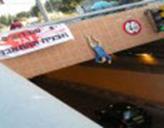 and overpasses across
the country.
and overpasses across
the country.
Israel National News - "A
peaceful protest," they said - but some of them were detained by police. The cardboard dummies were hung from the bridges as if
to show them jumping off the bridge. As one student later explained to Arutz-7,
"We wish to portray to the Israeli public that this disengagement plan is
national suicide - in terms of ethics, values and security." The dummies-and-posters protest was held on 50 bridges,
from Carmiel in the north to Eilat in the south. Fliers were handed out to
drivers below, explaining why the plan to abandon the northern Shomron and Gush
Katif in Gaza - involving the expulsion of some 9,000 Jews from their homes and
relocating them in temporary mobile homes - is "national suicide."
Some five students were detained by police,
including three near Jaffa Gate in Jerusalem. In protest of the police
behavior, several Ta Katom students held an impromptu demonstration outside the
Russian Compound, the police station to where the three were taken. Their
mouths were taped with orange tape, as a sign of the freedom of speech that was
taken from them. The detained students were released shortly after noon.
In response to complaints that the dummies might
have distracted drivers and/or represented incitement, one student told Ynet
that billboard pictures of women in bikinis are more distracting. "It's
time to put an end to the wild incitement by the press of every move taken by
the right-wing, even when it is legitimate. As opposed to the extremist left,
which throws rocks on soldiers in Bil'in, we are students who have chosen to
persuade others of the justness of our cause by explaining."
World Largest Orange Ribbon Hung, Hunger Strike Launched - July 5, 2005
As protests continue and others are planned, young people arrested in past protests have launched a hunger strike in prison.
 Israel National News - Twelve
young girls arrested for blocking roads as part of a civil disobedience
campaign against the government’s plan to forcibly expel Jews from their homes
in Gaza and northern Samaria, have started a hunger strike. None of the girls
have yet to be charged with committing a crime. Prison officials say the girls have already missed four
meals.Saturday night demonstrations continue outside the Ma’asiyahu Prison to
show solidarity with teenagers jailed for blocking traffic. Leading rabbis and
entertainers continue to attend the gatherings.
Israel National News - Twelve
young girls arrested for blocking roads as part of a civil disobedience
campaign against the government’s plan to forcibly expel Jews from their homes
in Gaza and northern Samaria, have started a hunger strike. None of the girls
have yet to be charged with committing a crime. Prison officials say the girls have already missed four
meals.Saturday night demonstrations continue outside the Ma’asiyahu Prison to
show solidarity with teenagers jailed for blocking traffic. Leading rabbis and
entertainers continue to attend the gatherings.
Opponents of the Disengagement Plan are planning
a "face-to-face" explanation campaign Wednesday evening in the
central Gush Dan region, despite the fact that Prime Minister Ariel Sharon has
long ago nixed the idea of holding a national referendum. They are planning to
speak with residents in their homes and hand out pamphlets and ribbons at
intersections. The world’s largest orange
ribbon (99 feet tall) was hung from a building in Rishon LeZion, south of Tel
Aviv, Monday afternoon. Orange is the color symbolizing opposition to the
government plan to dismantle 25 Jewish communities and hand over the area to
the Palestinian Authority (PA).The Council of Jewish Communities in Judea and Samaria (Yesha) said it will request that the Guinness World Book of Records include the
orange ribbon as the longest in the world.
A day-long motorcade protest against the planned
evacuation is also being planned in what may be the largest demonstration every
in Israel. Tens of thousands of drivers will head towards Gush Katif and if the
police stop them, people will "leave their cars and start marching,"
according to Pinchas Wallerstein of the Yesha Council. A date for the
demonstration has not yet been announced, though the Bayit Leumi (National
Home) civil disobedience movement has called for similar moves to be taken on
D-day – which is whenever Gaza or northern Samaria are closed to non-residents.
Olmert:
'Stupid Settlers' – June 22, 2005
Lekerev Report - Headlines on the Jerusalem Post website at the moment read "Olmert: 'Stupid Settlers should stop comparing Gaza to Jerusalem'. In the article, Olmert is quoted as saying, "I am sick and tired of hearing from stupid settlers that Gaza and Jerusalem are the same," Olmert said. "Gaza and Jerusalem are not the same. They never were. There are priorities. And I am not prepared to look at Gaza and Jerusalem and Shilo and Beit El and Ofra as if they were all on the same level. Nor am I prepared to accept the argument that if I pull out of Gaza, I am necessarily willing to pull out of Jerusalem. This is nonsense and I won't have any part of it."
This is just the kind of logic that is promoting the disengagement for, at the end of the day, Mr. Olmert, it IS the same. Read your Bible!
Not to mention that it is disgraceful for a public official, a deputy Prime Minister, to so denigrate a suffering segment of Israel's population. An apology needs to be made - a sincere one.
'Orange
Wave' Upsets Sharon and Bush  ’ – June 26, 2005
Lekerev Report - Opposition to the government's evacuation plan has sent tremors throughout the establishment, not just in Israel but also in the United States. Sharon has ordered police to clear the roads, the police fear loss of control, and President Bush is losing support.
In a massive protest scheduled for Monday, thousands of motorists plan to stop their cars on the shoulders for 15 minutes without actually blocking the roads. Prime Minister Ariel Sharon demanded on Thursday that the police spare no efforts to keep roads clear of anti-evacuation protestors. Police fear they will not be able to cope with anti-evacuation organizers who plan to "shut down the country" if the government starts to force Jews out of their homes. The inability of the police and courts to function smoothly was exposed last month when hundreds of youth were arrested for blocking roads. Imprisonment under harsh conditions only strengthened the will of the "orange crowd" and won sympathy from supporters after exposure of bias in the media and courts.
The timing of the start of the evacuation could not be worse for the government because it coincides with the peak summer vacation period. Tens of thousands of families plan to spend their vacations actively supporting the continuation of Jewish life in Gaza and northern Samaria.
American support for Sharon and President George W. Bush also is beginning to crumble. Bush received only 25 percent of the Jewish vote in the presidential elections last year, but he won support from more than half of the orthodox community. Losing their support could cost the Republican Party serious financial and electoral losses in next year's mid-term elections. "My community is very upset," said Bush backer Dr. Mandell Granchow, a former president of the Orthodox Union. "Bush is turning on Israel." Susan Rosenbluth, editor of a pro-Yesha New Jersey Jewish newspaper, said many people are angry that they voted for Bush.
Chief Rabbis Permit Exhumation - If No Jews Remain - June 15, 2005
 In a letter to Ilan Cohen,
Director-General of the Prime Minister's Bureau, Rabbis Amar and Metzger write
that in principle, it is forbidden to exhume a body - unless the exhumation is
done for the "honor of the dead." "In this case, however,"
the rabbis write, "where the chance exists that the [enemy] will abuse the
dead and will vandalize their graves, in the event that the plan is implemented
and the graves are left alone, Heaven forbid - it is clear and simple that it
would be a matter of respect for the dead to take them to another place where
they may rest in peace, and will not be given to abuse, Heaven forbid."
In a letter to Ilan Cohen,
Director-General of the Prime Minister's Bureau, Rabbis Amar and Metzger write
that in principle, it is forbidden to exhume a body - unless the exhumation is
done for the "honor of the dead." "In this case, however,"
the rabbis write, "where the chance exists that the [enemy] will abuse the
dead and will vandalize their graves, in the event that the plan is implemented
and the graves are left alone, Heaven forbid - it is clear and simple that it
would be a matter of respect for the dead to take them to another place where
they may rest in peace, and will not be given to abuse, Heaven forbid."
Israel's Chief Rabbis permit the exhumation of the 48 bodies buried in Gush Katif - but only if "no Jewish residents remain and the experts feel that the graves will be vandalized by our enemies."
The rabbis emphasize that this should be done with the full cooperation and
consent of the families. They also make clear that no graves may be exhumed
while Jews still live in Gaza - as opposed to the opinion of some in the
government who proposed that the bodies be removed before the actual
disengagement. Rabbis Amar and Metzger raise the proposal that the dead should
be re-interred in the ancient Mt. of Olives cemetery, opposite the Temple Mount. Rabbi Moshe Tzuriel, author of many Jewish-legal works and formerly of
Yeshivat Shaalvim, expressed his opposition to the ruling. Speaking with
Arutz-7 today, he said that the fear that gravestones may be vandalized does
not justify removing the bodies. "We have seen on Mt. of Olives and in Hevron before 1967, that the Arabs do not desecrate the bodies, but only the
gravestones," he said. "Furthermore," Rabbi Tzuriel said,
"whether the families agree or not does not change the prohibition of
exhuming bodies. We see that there are many Jewish cemeteries in foreign and
Arab countries, and there is no immediate demand to bring the bodies here...
The rabbis should have simply said outright: The uprooting is forbidden,
period, and the exhumation as well."
Rabbis Amar and Metzger begin their letter with, "First of all, we wish to
clarify that we are not discussing the issue of the disengagement at all, and
certainly that which we write below is not an expression of opinion on this
matter, Heaven forbid... This is a matter of sharp dispute among the military
and political experts, and we don't see ourselves as worthy to express an
opinion on it... but we call upon the public to pray before G-d to save us and
save our forefathers' inheritance, with salvation and mercy." Gush Katif
spokesman Eran Sternberg responded with disappointment to the rabbis' ruling.
He said, "In the framework of the collapse of the various institutions of
the regime in the country, the Chief Rabbinate has now fallen like another
domino in the general downfall of the Knesset, the government, the Supreme
Court, the Attorney General, and more."
Graves in Gaza to Be Moved – June 16, 2005
Lekerev Report - Chief rabbis Yona Metzger and Shlomo Amar issued a religious ruling issued last week that the government must unearth the remains of Jewish people buried in Gaza and rebury them in Israel. Normally, Jewish law forbids unearthing the dead. However, it is permitted for the purpose of reburial in Israel, or to move the dead from a place where non-Jews are likely to desecrate their graves. "In this case, where there is concern that non-Jews will show disrespect for the dead and desecrate the graves if the [disengagement] plan is implemented, it is clear and obvious that respect for the dead entails moving them elsewhere," the rabbis wrote to Prime Minister Ariel Sharon. They suggested that the remains be reburied on the Mount of Olives in Jerusalem.
However, they added, the transfers must be effected with the consent of and in coordination with the families of the deceased.
Provocation by Anti-Expulsion Activist and the Blame to the Orthodox “Right”
Dummy Bomb A Suspected GSS Provocation - July 12, 2005
Anti-expulsion activists claim the fake bomb left in the Jerusalem Central Bus Station with a note decrying the Disengagement Plan is a provocation created by the Shabak (General Security Service).
 Israel National News - According
to the activists, every single person entering the Central Bus Station
undergoes a very thorough manual and electronic inspection. They say that one
would have to have the kind of clearance afforded to security services in order
to bring a bomb the size of the one found into the station. The Jerusalem bus station boasts one of the most thorough security setups in Israel. Passengers must pass through metal detectors and put their bags through x-ray machines
before entering the station, which is closely watched by closed-circuit video
cameras placed throughout the building.
Israel National News - According
to the activists, every single person entering the Central Bus Station
undergoes a very thorough manual and electronic inspection. They say that one
would have to have the kind of clearance afforded to security services in order
to bring a bomb the size of the one found into the station. The Jerusalem bus station boasts one of the most thorough security setups in Israel. Passengers must pass through metal detectors and put their bags through x-ray machines
before entering the station, which is closely watched by closed-circuit video
cameras placed throughout the building.
The timing of the "discovery," they
say, was also suspicious - allowing maximal live coverage of the event due to
its proximity to prime-time nightly news programs."I would not discount
the possibility that we are dealing with a coordinated provocation," MK
Uri Ariel told Arutz-7. The dummy bomb was
discovered in one of the station's rest rooms and had a note attached to it
reading, "the disengagement will blow up in your faces" - a reference
to statements by former Chief of Staff Lt.-Gen. (Ret.) Moshe Ya'alon regarding
the Disengagement Plan. The device consisted of a 25-pound gas balloon attached
to a clock, with wires protruding from it. The station was evacuated, causing
an hour's delay for travelers.
The last time suspicious objects with messages
regarding the Disengagement were left around the capital was May 17th - the day
of the highly successful civil disobedience "dry-run." At that time,
the stunt tied up traffic, but failed to draw attention away from the
successful non-violent blocking of 40 intersections throughout the country and
the 500 activists who willingly submitted to arrest in protest of the plan to
uproot 25 Jewish communities in Gaza and northern Samaria. The morning of the
next massive roadblockings, however, media attention was completely focused on
the mysterious dumping of oil and nails on the Jerusalem-Tel Aviv highway,
which largely distracted from the non-violent civil disobedience performed
later in the day.
In the period following the signing of the Oslo
Accords, the Shabak had at least one phony activist on its payroll whose job it
was to create outrageous incitement and attack Arabs in order to create public
outrage toward the right-wing. The agent, Avishai Raviv, was found in court to
have worked with state-controlled television producers to stage swearing-in
ceremonies for supposed underground groups that were prominently featured on
the nightly news. Interior Minister Ophir
Pines-Paz (Labor) harshly blamed opponents of the Disengagement Plan for what
he said was an act of terrorism. "This is neither a protest nor a demonstration.
This is an act of terror - Jewish terror. Jewish terrorism aimed against
Jews," Pines-Paz told Army Radio. "It is true the bomb didn't
explode, but it caused exactly the same hysteria, the same panic, the same
tying up of police and security forces and the same suffering to the population
as any other terror attack." MK
Sha'ul Yahalom also condemned the dummy bomb, blaming it on right-wing Jews.
"The extremists are making our position hated in the Israeli public,
causing a desecration of G-d's name and deepening the fractures between
different segments of the nation," he said.
Road-Blocking Organizers: Beware of Gov´t Provocateurs - June 29, 2005
Oil and nails were spilled onto the right lane of the Jerusalem-Tel Aviv Highway Wednesday morning in an act that anti-disengagement activists suspect is a provocation by the government.
 Israel National News - No
injuries were reported, but long traffic jams resulted near the town of Kfar Chabad, where the nails and oil were deposited on the road. Police reported that
twenty vehicles sustained flat tires, adding it was fortunate that no accidents
or injuries resulted. “We do not put oil and nails
on the roads and whomever does such a thing is a provocateur,” said a statement
by the "Bayit Leumi" anti-expulsion civil disobedience organization.
“Anyone who witnesses or knows of such acts that endanger the public is
requested to inform the police. Sharon and the left are looking for pretexts
and the smell of 'Champagne' is in the air." Champagne was the code-name
of GSS-provocateur Avishai Raviv who carried out acts to delegitimize the
right-wing during the first half of the 90's."It is highly likely,"
stated Bayit Leumi, "that provocateurs will attempt to create violence
during today’s roadblockings as well, and one who tries to do so should be
removed from the area by activists.”
Israel National News - No
injuries were reported, but long traffic jams resulted near the town of Kfar Chabad, where the nails and oil were deposited on the road. Police reported that
twenty vehicles sustained flat tires, adding it was fortunate that no accidents
or injuries resulted. “We do not put oil and nails
on the roads and whomever does such a thing is a provocateur,” said a statement
by the "Bayit Leumi" anti-expulsion civil disobedience organization.
“Anyone who witnesses or knows of such acts that endanger the public is
requested to inform the police. Sharon and the left are looking for pretexts
and the smell of 'Champagne' is in the air." Champagne was the code-name
of GSS-provocateur Avishai Raviv who carried out acts to delegitimize the
right-wing during the first half of the 90's."It is highly likely,"
stated Bayit Leumi, "that provocateurs will attempt to create violence
during today’s roadblockings as well, and one who tries to do so should be
removed from the area by activists.”
Bayit Leumi (“National Home”) has come to be
identified with all road blockings due to the organization’s successful
“dry-run” on May 17th, in which 40 intersections and main highways were blocked
for at least an hour. They originally said that their next mass protest act
would begin the day Gush Katif or northern Samaria is closed off, but have lent
their de-facto support to today’s nationwide roadblocking as well. "Thousands of policemen," according to a
senior police commander, are out in full force today to try to prevent this
afternoon's planned massive nationwide road-blocking campaign. The police denied
reports in this morning's newspapers that they had called upon the public to
stay home this afternoon. Police officials said they would act with "full
force" to foil the plans to block traffic. Tension was in the air all day
in anticipation of this afternoon's events. "We have already won," said the organizers,
"because the police themselves are so tied up with preventing our activity
that they have blocked some of the roads themselves." They emphasized that
the goal was not to interfere with citizens' daily routines, but to show that
the disengagement was such an immoral and undemocratic act that "we will
not let it happen."
At the last convention of the movement,
organizers repeatedly stressed the importance not only of non-violence – to the
point of tying one’s own hands while blocking the road - but explicitly forbade
the use of burning tires to bring traffic to a halt. “Having people sitting
peacefully in the middle of the road is enough to bring traffic to a halt,”
said Moshe Feiglin, who headed the Zo Artzeinu civil disobedience movement
during the Oslo era. “There is no need for burning tires or anything like that
– it only complicates matters legally.”
Aviad Visouly of the Land of Israel Task Force told Voice of Israel radio that the movement “condemns the [oil and nails]
act, and we have been extremely explicit in our calls for completely
non-violent civil disobedience. This is nothing more than a provocation of the
type the government produced using Avishai Raviv." The interviewer asked Visouly if blocking roads in
general was not a provocation. “When
thousands of people come out of their homes to stand in the roads and accept
the punishment of jail and the inevitable beatings of Sharon’s police, in order
to prevent the expulsion of people from their homes, that is anything but a
provocation,” Visouly said. “It is waking up the country.” “But it is a violent act,” said the interviewer.
“Throwing 9,000 people out of their homes so that
he can escape a criminal indictment is also a violent act,” Aviad replied,
referring to Prime Minister Ariel Sharon. “What we are doing is non-violent
civil disobedience.”
Journalists received pager messages from persons
claiming responsibility for spreading oil and nails on the road, stating they
are affiliated with the Chabad Hassidic sect. Chabad spokesman Rabbi Menachem
Brod, however, categorically denied this, telling Army Radio that
Chabad-Lubavitch oppose such actions. The rabbi stressed that while Chabad
opposes the disengagement plan, the Chabad Rabbinical Council has come out
clearly against the use of any violence to stop the expulsion.
Interior Minister Ofir Pines-Paz (Labor) accused
the anti-expulsion protestors of "attempted murder." “To put ninjas
[the army's term for bent nails intended to puncture tires on a road –ed.] on
Highway #1 is nothing less than attempted murder,” Pines-Paz said, not even
bothering to entertain the possibility that the guilty party might not be from
among the anti-expulsion forces. “We must find these people and prosecute them
in the harshest and firmest possible manner. Those who block roads need to be
careful because we will deal with them very harshly as well, including any
rabbi who sends his students to do so or visits them in jail. He will also find
himself in serious trouble.” MK Michael
Eitan (Likud) also released a statement saying the act was the equivalent of
terrorism. “Placing nails on the highway and running away is a cowardly act and
in no way qualifies as a legitimate act of protest," he said, "but
compares more to an act of terror."
Gush Katif leaders also condemned the act. An unsigned editorial on the Walla Hebrew news site
today calls on "large groups of people go to the Ayalon highway [in Tel
Aviv] with heavy chains…or just plain fists" to assault road block protestors.
The article also suggests throwing gasoline on anti-evacuation demonstrators
and taking screwdrivers to "fix" their windows and headlights.
Readers are advised to say, if police question them, that they thought they saw
a baby locked in the car. Other ideas from
Walla include making the protestors look suspicious by embracing them as if
they are close friends and then yelling, "How're you doing, Yossi? I
didn't know you left the Shabak (General Security Service)!" Knesset
Member Aryeh Eldad (National Union) appealed to Attorney General Menachem Mazuz
to arrest the Walla writer on charges of incitement to murder.
Worst
Train Disaster in Israeli History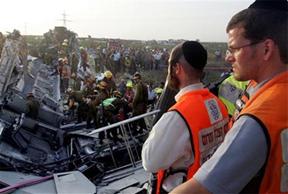 – June 22, 2005
Lekerev Report - Eight Israelis lost their lives and 195 are injured in the worst train accident in Israel's history. Fifteen people are in critical condition and fighting for their lives at this hour.
At 5:30 pm yesterday, a southbound passenger train collided with a large cement truck near the Revadim junction near Kiryat Gat and derailed. People were trapped within derailed cars for more than an hour. The army sent helicopters and dozens of ambulances reached the remote scene.
The first car of the train was reported to have been utterly destroyed, with only its platform remaining, off the tracks. The train's second and third cars flipped over and were completely crushed, witnesses told Israel Radio. The train was enroute from Haifa to Beersheba when a truck, which had left Kibbutz Revadim, crossed the tracks at an ungated crossing, Channel 2 reported. Survivors reported that the driver tried to apply the emergency brake, but not in time to prevent the collision. The driver repeatedly sounded the train's horn before the crash, Channel 1 reported. The truck was completely shattered by the force of the collision.
The names of victims released so far include the truck driver Leonid Galinsky, 51, train conductor Leonid Toruk, 46, IDF Sergeant Major Nir Sarusi, 33, and Rabbi Yosef Dramer, 58.
Soldiers on the train used their personal medical kits to treat the injured until medical crews arrived on the scene. The injured were evacuated by ambulance, IAF helicopter and another train.
Chaim Azulai, 20, from Beer Sheva, was taken to Kaplan Hospital in Rehovot. "I was in the train when suddenly I heard the whistle of the engine, and from that point on, I don't remember anything," Azulai said. "When I woke up, there was a lot of dust and screaming from the car. There was a baby next to me. I hope nothing happened to him."
 Police suspect haulage company of
forcing drivers to work over-long hours as possible cause of Israel’s worst
ever rail disaster – June 22, 2005
Police suspect haulage company of
forcing drivers to work over-long hours as possible cause of Israel’s worst
ever rail disaster – June 22, 2005
Debkafiles - A collision between the Beersheba-Haifa train and a truck left 8 dead and 200 casualties. Both drivers were killed. Two coaches were derailed.
Anti-Semitism of the Jews
Terrorists Target Jews Praying at Joseph´s Tomb - July 7, 2005
Hundreds of Jewish worshippers visited Joseph’s Tomb in Shechem (Nablus) Wednesday night to pray at the site. Terrorists opened fire at soldiers escorting the visitors, failing to inflict injuries.
 Israel National News - In what
has become a monthly tradition, more than 450 Shomron residents and Breslev
hassidim participated in the visit, which was planned and coordinated with the
IDF. Buses filled with excited visitors left from the community of Itamar,
located on the outskirts of Shechem. The visit marked the anniversary of the
death of Joseph, the son of the patriarch Jacob, who after being sold into
slavery by his brothers, rose in stature to eventually rule over Egypt. When his brothers and father finally joined him there, he made them promise that
when the Jewish people left Egypt for the Land of Israel, they would bring his
body with them for burial there.
Israel National News - In what
has become a monthly tradition, more than 450 Shomron residents and Breslev
hassidim participated in the visit, which was planned and coordinated with the
IDF. Buses filled with excited visitors left from the community of Itamar,
located on the outskirts of Shechem. The visit marked the anniversary of the
death of Joseph, the son of the patriarch Jacob, who after being sold into
slavery by his brothers, rose in stature to eventually rule over Egypt. When his brothers and father finally joined him there, he made them promise that
when the Jewish people left Egypt for the Land of Israel, they would bring his
body with them for burial there.
Throughout the ages, Jews prayed at the site,
until it came under Jordanian control in 1948. In 1967, following the Six Day
War, Israel liberated the site and Jewish prayer was renewed there. In the 80s,
the Od Yosef Chai (“Joseph Lives”) yeshiva was founded and Jewish yeshiva
students studied there full-time. Under the Oslo Accords, Shechem was handed
over to the Palestinian Authority, but Jewish access to Joseph’s Tomb was to be
guaranteed. The IDF retreated from Joseph’s Tomb in the first weeks of the Oslo
War in an episode that is remembered for the manner in which wounded IDF
soldier Madhat Yusuf was abandoned. Yusuf, wounded by Arab gunfire, bled to
death at the holy site as the IDF chose to negotiate with the Palestinian
Authority for his evacuation instead of sending troops in to rescue him.
Over the past year, the IDF has begun enabling
renewed visits by Jewish worshippers to the holy site on an almost monthly
basis. After the visitors left the city of
Shechem early Thursday morning, three terrorists attacked an IDF force
stationed near the city’s casbah (open-air market). The commander of the 101st
paratrooper battalion, Eliezer Toledano, told Arutz-7 that the three armed
Arabs intended on targeting the busloads of worshippers. Soldiers identified
the terrorists and wounded two. Before the soldiers moved in, Arabs reported
one dead from IDF fire. As the soldiers had not yet opened fire, an
investigation revealed that the terrorist had been killed by Arab “friendly
fire.”
Russia Investigates Jewish Law Code for Racism - June 27, 2005
Responding to reports of an official investigation against the Shulhan Arukh (Jewish Law Code) in Russia, Knesset Speaker Reuven Rivlin said the Knesset will show "zero tolerance" for anti-Semitism.
The
Moscow State Prosecutor has ordered an investigation into possible anti-Russian
and racist material in the famous and authoritative Jewish Law Code. The work
was authored nearly 500 years ago by famed Rabbis Yosef Karo and Moshe
Isserles, and is the fundamental binding religious law code for both Asheknazi
and Sephardic Jews.
The Moscow prosecutor ordered the investigation
after 500 public figures signed a letter urging outlawing of Judaism and all
Jewish organizations operating in Russia. Prosecution attorneys last week
questioned Rabbi Zinovy Kogan, chairman of the Congress of Jewish
Organizations, about the contents of the law code, especially regarding its
attitude toward non-Jews.
Jerusalem
sources following the affair, Haaretz reported, said this was the first time
since Stalin's regime that Russian officials have described holy Jewish
scriptures as "prohibited incitement." The affair has been covered
widely by the Russian news media, and has elicited sharp reactions from Jewish
organizations there. Russia has seen a rise of late in anti-Semitic incidents.
"We are aware of official condemnations in Russia, including by both houses of parliament, against this sharply anti-Semitic
invective," Rivlin told the Knesset today, "but condemnations - thus
it seems once again - are not enough. I am convinced that all MKs join me in my
hope that these reports are fundamentally mistaken and that no official source
in the democratic Russia of 2005 is involved in a new blood libel against the
Jewish People."
"Anti-Semitism is, first and foremost, a
malignant disease that damages the society in which it develops," Rivlin
said. "Democracies that fear to defend themselves, democracies that fear
to stop those who abuse the freedoms that they provide, democracies that show
forbearance for fascism, racism and anti-Semitism - will not last." Rivlin
added that the Foreign Ministry has demanded clarifications from Russia on the matter.
“Peace, Peace and Sudden Destruction Shall Come Among You”
Letter from Katif: The Expulsion Has Started! – July 11, 2005
A young father who has lived his whole life in Gush Katif’s oldest Jewish town, Netzer Hazani, writes that the moment of truth for the Jewish People has arrived.
 Israel National News - An open letter: "To the People of Israel, to every Jew wherever he
may be.
Israel National News - An open letter: "To the People of Israel, to every Jew wherever he
may be.
I write this letter with great inner turmoil, at
the end of another day in Gush Katif. In
the past year and a half, we inhabitants of Gush Katif have waged a struggle,
the likes of which have never been seen in our circles. It was a pure and
unblemished struggle: we screamed Faith with all our strength, we cried out
Love until our throats were sore. We knocked on the doors of thousands of
homes, and we embraced thousands of Jews. We felt that we were greatly
privileged, we sensed that we had fallen upon a period of history that would
yet be talked about for many years to come. We had a sense that we were leading
the Nation of Israel in a new direction. We believed that from amidst all this
impurity, something holy and pure wold result. We truly felt the pangs of the
Messiah’s arrival!
But the powers of impurity continued in their
work – and despite the fact that we did not betray the trust that had been
placed in us, and did not for a minute get sucked into selling our faith and
our beloved Land for money, the days wore on, and time is catching up with us,
and we can already feel the heavy breathing of the Satan’s emissaries down our
necks.
[The government has made it mandatory to have
government-approved adjusters appraise the value of property, with the threat
of not receiving any compensation at all looming in the background. In protest,
700 families signed the application for these adjusters just hours before the
deadline arrived, on orange paper, and with plans “not to be home” when the
adjusters might wish to arrive… Rumors emanating from the nearby army camp say
that giant containers are on the way to each and every home in Gush Katif, into
which the homes’ contents will be packed. “Those of us who are strong in our
determination and faith, and those of us who are weaker – what are we to think
when we see such a sight outside our door?” asks one resident. – HF]
Do you know, dear brothers, that the expulsion
has already begun? Do you know that the media refuse to broadcast pictures
and information that could cause the cancellation of the expulsion? Do you know
that policemen are beating Gush Katif Jews who are bound with handcuffs? Did
you know that even girls have been and are being cruelly beaten by policemen?
Did you know that policemen are equipped with metal knuckles and other cruel
accessories in order to hit us? Did you
know that policemen are freely fabricating arrest reports in order to cover up
for their acts, leaving innocent citizens to stand trial for crimes they did
not commit? Did you know that all of this is backed up by the authorities, in
full knowledge of the injustice that is being caused to innocent people?
In another five weeks, they will knock on our
doors – but we know now very clearly that the “evacuation” will not be done
gently. We will be beaten until we bleed, and then dragged cruelly from our
homes.
Here in the Gush, we’re still anticipating a
miracle, we’re still praying for salvation. But you, dear brothers, must be
ready to move! We have carried out our part; we have remained strong, and we
will continue to do so until the end. But
now, we need you. On the day that Gush Katif is closed, I ask you, please,
please, don’t sit at home! Get up and start walking! Don’t say it’s too late or
there’s no chance; if everyone gets up and comes, perhaps, perhaps we will
succeed! Maybe the Master of the Universe will hear and will save us. Each and
every person must feel that in the merit of his own actions, Gush Katif will be
saved.
Those of you who might prefer to sit on a
comfortable sofa in your living room and watch us on television being cruelly
beaten and our beloved Land sold away to murderers – will have to live with
this his whole life. He will have to explain to his grandchildren, who will ask
him again and again, “What did you do to save the Land of Israel? What did you
do on behalf of your brothers in Gush Kati?” We have not lost our faith, and even when and if the
situation gets even worse, we will continue to believe – for the Master of the
Universe does only good for His children. But the moments of truth have arrived
– and soon it will be too late.
Sincerely, Aviel Tucker, Father of Noam, Dan and Elad, Netzer Hazani
Exclusive: Gov´t Plans to Arrest Leading Gush Katif Residents – June 19, 2005
A week before the planned expulsion of thousands of Gush Katif Jews, a
special military police unit will seek out leading residents and arrest them in
the  middle of the night.
Israel National News - A
military source has informed Arutz-7 that the army and police thus hope to
weaken morale in Katif, as well as weaken the opposition to the uprooting. The
special unit's job will be to search out the central figures in the area,
according to a prepared list, and arrest them. One of the officers said that the mission will involve
"picking out and peeling off the people from their homes in the middle of
the night." The operative assumption is that the early removal of the
leading figures will break the residents' staying power. A week before the planned expulsion of thousands of
Gush Katif Jews, a special military police unit will seek out leading Gush
Katif figures and arrest them in the middle of the night.
Gush Katif spokesman Eran Sternberg said,
"The ideas of this government are getting wilder and wilder by the day. MK
Michael Eitan's statement that Sharon is worse than the late Romanian dictator
Nicolae Ceausescu has taken on terrible significance in light of this new idea,
which it is hard to believe has even been thought of. Sharon is trying with all
his might to turn the IDF into the Securitate [the cruel Romanian secret
police]. If the army officers, public figures and rabbis do not call
unambiguously for soldiers not to take part in these political games and to
refuse such appalling orders, I don't know where we will end up."
Supreme Court Judge Jails Six 13 Year-Olds From Gush Katif - July 4, 2005
Boys allegedly occupy an Arab house on the beach in Gush Katif. Justice Procaccia calls it a "mass, violent incident." A local Arab invites Jews into his home, saying he supports their struggle.
 Israel National News - Six
13 year-old Jewish boys who were arrested last week in Gush Katif will be held
in jail at least until this Wednesday, under an order handed down by Supreme
Court Justice Ayala Procaccia. The children are
accused of occupying an Arab house near the Maoz Hayam hotel near on the Gush
Katif beach. They were arrested for questioning and have yet to be formerly
charged with any crime.
Israel National News - Six
13 year-old Jewish boys who were arrested last week in Gush Katif will be held
in jail at least until this Wednesday, under an order handed down by Supreme
Court Justice Ayala Procaccia. The children are
accused of occupying an Arab house near the Maoz Hayam hotel near on the Gush
Katif beach. They were arrested for questioning and have yet to be formerly
charged with any crime.
Despite the fact that under Israeli law, the
children, like other suspects who have not been convicted beyond a reasonable
doubt, are presumed innocent, Justice Procaccia sounded convinced in her ruling
that the children had been involved in wrongdoing. “This was a mass, violent
incident involving a group of Jews seizing a building owned by Palestinians,
throwing rocks at Palestinians and injuring at least one of them, and a refusal
to adhere to the orders of security forces," Procaccia wrote. The justice’s attitude stands in sharp contrast to the
opinions of some of the Arabs living in close proximity to the Jewish residents
of Gush Katif, many of whom support the Jews’ struggle to stay in their homes.
One Arab, the brother of the man whose house was
allegedly occupied by the youngsters, would probably be shocked by the language
of the justice’s ruling. He invited some Jewish residents into his home this
morning to tell them his side of the story, which according to the version
reported in the media, had the youngsters lynching an Arab and almost beating
him to death. Prime Minister Ariel Sharon used the media reports in order to
publically berate opponents of the expulsion plan. He call the incident a “wild
barabaric, and heartless act.” "What is happening in front of our eyes,”
he said, “is not a battle over disengagement from Gaza, but a battle over the
image of the state. This is not a situation I will allow to continue."
The Arab man said that the Arab youth who was
allegedly lynched was injured only lightly and has since returned home. The man
told his Israeli guests that he was not opposed to having Jewish youth occupy
the house near the Gush Katif beach as an act of protest against the expulsion
plan, because he himself was opposed to the plan. The man did, however, express his displeasure over a
slogan he says was scrawled on the wall of the house that read, “Mohammed is a
pig.” Aside from that, he said, no other damage had been done to the property.
He also said that reports in the media of the IDF carrying out work on the
structure to repair damage deliberately done by Jews were untrue. He said the
only thing the army did was to seal off the entrance and stairwell in order to
prevent youngsters from re-entering the house.
The Arab who invited the Gush Katif residents
into his house by the beach, doesn’t seem to have much trouble with the Jewish
youngsters living near his home. That doesn’t seem to the the case with Justice
Procaccia. The Justice, however, may be more interested in punishing the
children’s parents than the youngsters she remanded, though she hopes the boys
are thoroughly interrogated by police.
“The presence of children in detention for means
of interrogation is a high price that they and their families are paying for
the willingness of the initiators of the disturbances to use youths,” wrote the
Justice. “The youths' parents have a heavy responsibility to rush their children
from the heart of danger and place them outside the ideological struggle that
they are leading, which is a matter for adults.”
Cadet to Halutz: 3 Brothers Serve in IDF, 3 Serving Jail Time – June 19, 2005
Receiving a citation for excellence, a young cadet tells the IDF Chief-of-Staff that while 3 brothers are serving the IDF, 3 others are in jail for opposing the destruction of Gush Katif.
 Israel National News -
“I have six brothers, three in the army and three in jail,” a cadet in an
officers training course told IDF Chief of Staff Lt.-Gen. Dan Halutz last
Thursday. The cadet, who received a citation
for excellence, told Halutz that three of his brothers were arrested for
opposing the government’s plan to expel nearly 10,000 Jewish civilians from
their homes in Gaza and northern Samaria.
Israel National News -
“I have six brothers, three in the army and three in jail,” a cadet in an
officers training course told IDF Chief of Staff Lt.-Gen. Dan Halutz last
Thursday. The cadet, who received a citation
for excellence, told Halutz that three of his brothers were arrested for
opposing the government’s plan to expel nearly 10,000 Jewish civilians from
their homes in Gaza and northern Samaria.
Arutz-7's Haggai Huberman reports that Halutz
struck up a conversation with the cadet as he was awarding him his citation.
“Where are you from?” asked Halutz. The young cadet told Gen. Halutz the name
of one of the Jewish communities in the Binyamin district of Samaria. “What does your father do?” Halutz continued. “My
father’s a rabbi,” the cadet answered. “And how many brothers do you have?”
asked Halutz. “Six,” responded the cadet, “three in the army and three in
jail.” Three of the cadet’s brothers were
arrested over the past few weeks, he explained. One was arrested while putting
up posters against the expulsion plan; another was caught carrying a tire on
his way to blocking traffic; a third, the youngest, was arrested simply for
wearing an orange shirt. Halutz listened
and warmly shook the cadet’s hand.
More Reports of Police Brutality - July 7, 2005
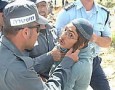 Reports of police
brutality continue to be received.
Reports of police
brutality continue to be received.
Israel National News - One
youth imprisoned in Maasiyahu Prison in Ramle reports that as he was waiting
for a disciplinary hearing, Prison Commander Rami Ovadiah punched him in the
face, and said to him, "You want me to bang your head into the wall? You
want me to hang you?" The the youth was sentenced the next day to 30 days
of no phone or visiting privileges, and was taken from the prison's
Disengagement Wing to a form of solitary confinement. Elsewhere in the Ramle prison, Eliyahu Herbst - father
of six and grandfather of two - claims he was removed without justification
from the Disengagement Wing, and placed in solitary confinement. A resident of Arad in the south, Herbst has refused to be released from prison, saying he is a
"calming and unifying influence" on the youths being held there.
Last Thursday, while being taken in handcuffs to
a Supreme Court hearing, a policeman brutally pulled Herbst out of the car by
his handcuffs - causing him to fall on the ground - and he was then dragged
again by his handcuffs on the ground to another car, into which he was thrown.
After waiting a long while for medical treatment, he was placed in solitary
confinement without his belongings or a change of clothes; as he was washing
them, he was called out and humiliated while wearing only a sheet around him. A
lawyer then came to see him, and he received his belongings - but he was placed
again in solitary. "All this occurred without the disciplinary hearings
necessary for such treatment," his brother Hanoch said. Eliyahu later told
his family in the lone phone call allowed him, "They are trying to get me
to agree to be released under the conditions they set. I came in here with my
head high, and I'll continue sitting here with my head high. They won't succeed
in humiliating me." Herbst was
originally arrested in Arad during the first roadblockings, for "standing
in an illegal assembly and not dispersing." The judge offered to release
him on condition that he not take part in further illegal demonstrations, but
he refused, saying, "The evidence against me shows that I was only
standing nearby - so that means that every time I walk in the street I can be
accused of violating the conditions." The judge refused to allow this
argument to be placed in the protocol. The Supreme Court, hearing his appeal
last Thursday, said that the lower court must rehear the case - but a date has
not yet been set.
In general, youths imprisoned in the Disengagement
Wing of the Maasiyahu Prison report that conditions have been worsened there.
Visits and phone calls are restricted, and the youths say they are barely
allowed to leave their cells. The Honenu
legal organization says it has submitted complaints to the Prison
Service on the topic, but no response has yet been forthcoming. Orit Strook of
Hevron, appointed by Honenu to deal with complaints regarding unfair treatment
of prisoners, told Arutz-7 today, "First of all, know that there are [she
counts] 44 other people waiting for me to return their calls... that's how
things are going here. I can just tell you that there is no question that over
the last two weeks, conditions in Maasiyahu have worsened. They have simply
decided to deal with them according to the letter of the law. Our ability to
complain is therefore limited..." Strook said that there have been cases
of violence by the jailers, and that there is even the fear that the prison
will dissolve the Disengagement Wing and spread the youths in cells throughout
the prisons. "I will complain about these issues in upcoming Knesset
committee sessions next week," she said. She added that among the
privileges she can fight for are the right to make phone calls for those whose
custody has been extended for a number of days (as opposed to those who are
there until the end of proceedings).
MK Aryeh Eldad (National Union) visited the
youths in Maasiyahu Prison, after having received special permission to do so.
In a letter this week to Public Security Minister Gideon Ezra, Eldad asked him
to take immediate action, and wrote, "It appears that the plague of
violence has also reached the Prison Service - possibly because the strong
spirit of the imprisoned youths is bothersome to the country's leaders, who
have decided to take a strong hand against them." Mr. Vitaly Vovnoboy, 49, who runs a web-server hosting
an anti-disengagement website, was arrested on Monday morning for no reported
reason. Plainclothes policemen burst into his home without an arrest warning
and took him away. He was released from prison this morning, three days later.
Police Caught on Video Beating Demonstrator - July 3, 2005
A gang of policemen cruelly beating a road-blocking protestor last Wednesday night was caught on an Arutz-7 video camera.
 Israel National News - On
Wednesday night, June 29, Arutz-7's Russian-language site's director Tuvia Lerner
set out for the Gush Dan-Tel Aviv area, with the aim of covering the scheduled
anti-disengagement road-blocking protests set for that night. At one point, he
was standing at the main thoroughfare in Ramat Gan, Jabotinsky Blvd., when he
saw what he later described as a "cruel, shocking and pre-meditated attack
by policemen." Lerner said that despite attempts by the police to hide it
by standing tightly around, he managed to film it on an amateur digital camera.
Israel National News - On
Wednesday night, June 29, Arutz-7's Russian-language site's director Tuvia Lerner
set out for the Gush Dan-Tel Aviv area, with the aim of covering the scheduled
anti-disengagement road-blocking protests set for that night. At one point, he
was standing at the main thoroughfare in Ramat Gan, Jabotinsky Blvd., when he
saw what he later described as a "cruel, shocking and pre-meditated attack
by policemen." Lerner said that despite attempts by the police to hide it
by standing tightly around, he managed to film it on an amateur digital camera.
Lerner's video
testimony can be seen here.
Arutz-7 spoke both with the demonstrator (see
below) and Lerner. Lerner's story: "I
heard someone call out, 'Photographer!' When I turned around, I saw a
demonstrator lying on the road, with three Yasamnikim [special unit policemen
used for missions that require extra force - ed.] sitting on him, bending his
arms, and putting handcuffs on him. There is no doubt that a man in this
position is totally neutralized and cannot endanger anyone. I should note that
I had passed that part of the road a few times before that and there was no
violence at all by demonstrators. "I
saw the policemen surrounding this demonstrator. It seemed very strange to me.
I pointed my camera towards them and towards what they were doing to him. The
policeman who was wearing an ID tag with the name Eliran Avraham tried to
prevent me from taking the pictures. He pushed me and kept on turning my camera
away and threatened to arrest me. His behavior just intensified my suspicions.
"Through the screen of my camera I saw the
officer, wearing a name tag with the name Eran Naim, go behind the
demonstrator, go on top of him, and stick his full hand towards his face. He
stuck his fingers into the man's nostrils and pulled upwards and backwards in a
fast and professional way, and tore his whole face, including a blow at his
eyes. "I realized that I had
incriminating material in my camera. I saw how nervous/angry the policeman
Eliran Avraham was, in his fear that I might have managed to catch the act on
my camera despite the wall of policemen blocking it, and he continued to
threaten to arrest me. That's why I did not photograph the officer Eran Naim when
he walked aside to wipe off his hands that were filled with the blood of the
demonstrator. I didn't want to take a chance on losing the material that I
already had.
"The policemen immediately picked up the
wounded demonstrator and arrested him, while he was dripping blood. His head,
nose and eyes were almost totally covered with blood. "Afterwards, I disappeared from the scene so that
the policemen would think that I had already given in the material to my
editors, and then I came back to take more pictures. "There were many other press photographers on the
scene. No one else filmed this very hard scene. But what worries me more than
anything is that I gave the material to the three main television channels -
Channel 1 (Israel Broadcasting Authority), Channel Two and Channel Ten - and
none of them showed real interest in receiving it. This, despite the fact that
I had already done all the 'dirty work' and found the demonstrator, who has
still not yet recovered. He is suffering from pain and psychological anguish. "Despite the fact that both he and I agreed to be
interviewed, some of the reporters told me, off the record, that it was a waste
of effort because their editors would not approve it. "This showed me that the watchdogs of democracy
had turned into etrog-preservers." The
reference to etrogim applies to a recent remark by leading television
commentator Amnon Abramovitch, who said that the media in Israel must protect
Ariel Sharon "like an etrog" - the citron used and carefully
sheltered by observant Jews on the Sukkot holiday - presumably, so that he not
suffer a political downfall before he succeeds in carrying out the expulsion
plan.
Lerner reported that he later spoke with the
victimized demonstrator. The latter said that after he was brought to the
police station, he was taken into a room while in handcuffs, and there he was
beaten by three policemen - one of whom was Eliran Avraham. A Gush Dan Police spokesman contacted by Arutz-7 said,
"We have received the material you sent, and you will receive a
response."
The demonstator, named Akiva, told Arutz-7 what
happened from his point of view. His story (paraphrased):
"I was on the scene of the road-blocking,
and I heard the police near me say they wanted to arrest me. Suddenly, four or
five Yassamnikim surrounded and grabbed me - each one with his own job: One
choked me, one bent my arms, one poked his fingers very strongly into my nose
up and down - on two different occasions - and it felt as if he was trying to
push my nose into my skull. It hurt terribly. And another one poked my eyes
very strongly. They handcuffed me and dragged me to the truck, and then to the
police station. I asked for medical assistance, they said OK, but didn't give
me. After about two hours, they wanted to give me water to wash off the blood,
but I said I didn't want them to wash it off until a doctor sees me. "A
few of us [arrestees] were there together, and we were talking, and the
policemen said to be quiet. I said that they can't take away our right to
speak. One guy looked at me as if he was about to kill me and said, 'Is that
so?' or something like that. He then took me into a side room where there was a
bunch of policemen and they all started beating me up. Punches to the head,
kicks, everything, while at the same time, one of them was trying to put
handcuffs on me. When they finished, they sat me on a chair, with my hands
handcuffed behind me, and one guy started slapping and punching me in my face
and head with all his strength. I of course couldn't defend myself. It was just
like one long terrible painful hurt; I couldn't feel each individual punch...
"I don't know why, but I still didn't shut up; when he finished, I said,
'I'll see you in Machash [the Complaints Against Policemen Department]. He
looked at me again and started beating me up again - and then a third time. He
even gored me with his head against my head one time."
Later, Akiva related, "I refused to identify
myself, or be photographed, as is my right, and they put me in a room for a
couple of minutes with one of the Yassamnikim from before - maybe to scare me
or something. He said two things that I think are very important. First he
said, 'You guys work on the issue of justice - but sometimes it's not such a
good idea; sometimes you have be smart, not right.' And then he said, 'What you
got today is nothing compared to what often goes on here.'" ... They
finally photographed me, and then, at 1 AM, just let me go, just like
that." Akiva said he plans to file a
complaint with the police department, as well as a civil suit.
Exclusive: Gov´t Plans to Arrest Leading Gush Katif Residents – June 19, 2005
A week before the
planned expulsion of thousands of Gush Katif Jews, a special military police
unit will seek out leading residents and arrest them in the middle of the
night.
Israel National News - A
military source has informed Arutz-7 that the army and police thus hope to
weaken morale in Katif, as well as weaken the opposition to the uprooting. The
special unit's job will be to search out the central figures in the area,
according to a prepared list, and arrest them.
One of the officers said that the mission will
involve "picking out and peeling off the people from their homes in the middle
of the night." The operative assumption is that the early removal of the
leading figures will break the residents' staying power.
A week before the planned expulsion of thousands
of Gush Katif Jews, a special military police unit will seek out leading Gush
Katif figures and arrest them in the middle of the night.
Gush Katif spokesman Eran Sternberg said,
"The ideas of this government are getting wilder and wilder by the day. MK
Michael Eitan's statement that Sharon is worse than the late Romanian dictator
Nicolae Ceausescu has taken on terrible significance in light of this new idea,
which it is hard to believe has even been thought of. Sharon is trying with all
his might to turn the IDF into the Securitate [the cruel Romanian secret
police]. If the army officers, public figures and rabbis do not call
unambiguously for soldiers not to take part in these political games and to
refuse such appalling orders, I don't know where we will end up."
Terror Against the Jewish People
Easing of Restrictions Led to Friday´s Terrorist Murders - June 26, 2005
Arab terrorists who murdered two teenaged yeshiva students - Avichai Levi and Aviad Mantzur - took advantage of the recent easing of army restrictions, an IDF officer said.
 Israel National News - Avichai,
17 (pictured), was shot in the head on Friday afternoon and died on the spot.
His friend, Aviad, lost much blood after being shot in both legs, and succumbed
to his wounds this morning. The two were from the South Hevron Hills
communities of Beit Haggai and Otniel, respectively, and were standing at the
side of the road waiting for a ride when they were shot. Three others were wounded in the attack. IDF Hevron
Battalion Commander Lt.-Col. Moti Baruch said he had no doubt that the easing
of restrictions allowed the terrorists to reach the road bypassing Beit Haggai.
The terrorists are from Hevron, the industrial area of which is across the
highway from Beit Haggai. The opening of the road to Arab traffic between these
two points enabled the terrorists to perpetrate their attack, and then turn
around and flee to safe haven back into the PA-controlled parts of Hevron.
Israel National News - Avichai,
17 (pictured), was shot in the head on Friday afternoon and died on the spot.
His friend, Aviad, lost much blood after being shot in both legs, and succumbed
to his wounds this morning. The two were from the South Hevron Hills
communities of Beit Haggai and Otniel, respectively, and were standing at the
side of the road waiting for a ride when they were shot. Three others were wounded in the attack. IDF Hevron
Battalion Commander Lt.-Col. Moti Baruch said he had no doubt that the easing
of restrictions allowed the terrorists to reach the road bypassing Beit Haggai.
The terrorists are from Hevron, the industrial area of which is across the
highway from Beit Haggai. The opening of the road to Arab traffic between these
two points enabled the terrorists to perpetrate their attack, and then turn
around and flee to safe haven back into the PA-controlled parts of Hevron.
The army reinstated the restrictions following
the attack, and intelligence units are searching for the attackers. Beit Haggai
resident Ya'ir Lior, son of Hevron Chief Rabbi Dov Lior, said he warned the
army last week that it had "opened the road for murderers." He said,
"I told the army commanders this past Sunday that he was allowing too much
Arab traffic in the region, and too many Arab murderers to travel freely, and
that Jews are being endangered." Lior
said that Avichai was a youth movement leader, "full of life and
humor," and his death is a "great loss for Beit Haggai."
Both Islamic Jihad and Hamas terrorists claimed
they were involved in the attack. The IDF estimated that 2-4 attackers were in
a white car that bypassed a group of four young hitchhikers near the entrance
to Beit Haggai Friday around 4:45 p.m. The terrorists made a U-turn after
realizing there were defenseless targets waiting for them. They returned and opened fire just as a car from Beit
Haggai stopped to pick up the youths. Witnesses reported that the shooting was
"long and protracted," until the Israeli car was able to drive off
towards the nearby army base of Adorayim.
Aviad Mantzur was flown in critical condition to Hadassah Ein Kerem Hospital, where he remained unconscious until he died this morning.
Another teenager, from Beit Haggai, is recovering from serious gun wounds. A
fourth boy waiting with his frinds for a ride escaped unharmed. The couple who
stopped to pick up the teenagers was lightly injured; both 23 years old, they
were treated at Soroka Hospital in Be'er Sheva. Their toddler passenger was not
hurt. The funeral for Avichai Levi, a
student at the Kiryat Arba Yeshiva High School, is scheduled to begin today
(Sunday) at noon at Beit Haggai, leading to the Mount of Olives in Jerusalem. His parents have requested that those who attend the funeral wear orange, the
color symbolizing opposition to the planned evacuation from the northern Samaria and Gaza regions. They said Avichai felt very close to the Gush Katif communities
that the government plans to dismantle. Southern
Hevron Hills Regional Council Chairman Tzviki Bar-Chai said, "The
terrorists observe very well the weakness of the government of Israel and the retreat from Gaza." He said the government policy will continue to encourage
terrorists "until they chase us out of the entire State of Israel.”
PA
Continues to Teach Children to Become ‘Martyrs’ –
June 23, 2005
–
June 23, 2005
Lekerev Report - The Palestinian Authority continues to promote "martyrdom" in its state-produced children's television programs according to a report filed yesterday by Palestinian Media Watch (PMW).
"Shahada, or death for Allah, has been the backbone of the Palestinian Authority's messages to its children since the start of the terror war in September 2000. Although the number of these messages has been reduced in recent months, the promotion and glorification of child Shahada continues nonetheless, as seen this week on PA TV."
The report cites a broadcast of a PA TV series named "The Palestinian Diaspora." The series is presented daily as a factual portrayal of history. Though throughout the series, Israel's creation and ongoing existence has been presented as injustices that must be fought, this past week's episode honed in on the issue of child martyrdom.
This week's episode, set in 1956, shows Arabs mourning Israel's existence. A 12-year-old refugee is shown reading his uncle a story he wrote. "The scene has two explicit messages," write PMW's Itamar Marcus and Barbara Crook. "A child should be willing and anxious to fight and die in order to destroy Israel, and Arab 'refugees' can never resettle, but must 'return' to Israel."
An excerpt from the clip, broadcast on PA TV on June 16 follows. The scene opens with the 12-year- old boy's friend writing, "I shall return" over a map he drew of "Palestine," covering all of Israel. The 12- year-old Arab Boy: "His mother cried and said, 'My son! Swear to me! Don't leave me alone! I'm afraid you will be killed.'
"Her son said to her, 'Don't cry, my mother! Let me go and fight for the sake of the homeland. The enemy stole our beautiful land. We all must fight in order to redeem the lost paradise. We lived in joy and happiness, until the foreign enemy (Israel) came and expelled us from our land, and we became refugees in tents. But we will return, by Allah's will!'
"His mother told him, 'Farewell, my son. Allah be with you.' He kissed her and left to fight, and fought until he became a Shahid (martyr for Allah)."
The
So-Called "Lynching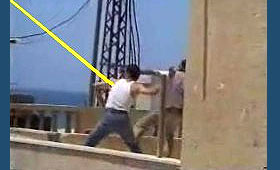 ” – July 4, 2005
Lekerev Report - The police announced last night that they had caught an 18-year-old youth whom they accuse of being one of their three chief suspects in the incident in which Jewish youths were filmed throwing rocks towards a supposedly injured Arab youth a few days ago.
One eye-witness told Arutz-7: "When I saw the newspaper reports the next day of what had happened, I simply felt violated. They describe it as if we all ganged up on this poor Arab. That's not what happened at all. What happened was that we were dancing and singing in a circle, as often happens in a new outpost and the like, and suddenly a gang of about 30 Arabs started smashing us with rocks. I ran away, like the others, and hid behind an army jeep. Suddenly, this youth - the one who everyone claims was 'mortally wounded' - came around from behind me and threw this big concrete block right towards my head. He almost killed me!"
Yesterday, a young man who wished to be identified only as "A.D." told Arutz-7 that he saw reporters "go over to [the Arab youth in question] and tell him to lie down and act as if he was unconscious. Later on, he was taken out walking on his own, holding on to a soldier; all this talk of his being mortally wounded is total nonsense. In addition, he was taken to a hospital in Gaza; if he was really mortally wounded, they would have taken him to Soroka in Be'er Sheva." A.D. said he saw this same Arab "get hit in the head with a rock - and yet he continued to throw rocks, like a tiger, for the next 15 minutes!"
The Honenu legal organization, which has taken upon itself to provide legal assistance for those accused of anti-disengagement protests, is taking measures to fight the current anti-protestor climate. "Under the current public atmosphere," said one Honenu official, "with the media continually referring to the incident as a 'lynching' and with politicians calling forcefully for the police to 'mete out justice to the lynchers' and the like, we fear that the three suspects will be sacrificed unjustly. We are coordinating and gathering all the testimony that shows the whole incident was staged and blown out of all proportion."
Another eyewitness said: "The Arabs were the ones who started throwing rocks, just like they've known how to do for the last 20 years. The media people who were there knew that this boy, the one who was 'mortally wounded,' came up to us and threw rocks - and so we threw back. It's interesting how someone who is "mortally wounded" gets up on his legs and laughs with his friends and gets interviewed while he's mortally wounded."
PA Text Books Cite ´Protocols´, Reject Peace – July 11, 2005
A report on the textbooks published by the Palestinian Authority was released Monday, exposing the teaching of Islamic supremacy, the illegitimacy of Israel and citing an infamous forgery as fact.
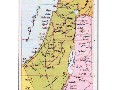 Israel National News - The
report was published by the Center for Monitoring
the Impact of Peace (CMIP), a non-governmental organization whose
stated purpose is to “encourage a climate of tolerance and mutual respect
between peoples and nations, founded on the rejection of violence and the
changing of negative stereotypes, as a means to resolving conflicts.” CMIP’s director of research, Arnon Groiss, spoke with Israel National Radio's Yishai & Malkah Fleisher.
Groiss, who compiled and translated the material from the PA school books, said
the findings left little room for optimism.
Israel National News - The
report was published by the Center for Monitoring
the Impact of Peace (CMIP), a non-governmental organization whose
stated purpose is to “encourage a climate of tolerance and mutual respect
between peoples and nations, founded on the rejection of violence and the
changing of negative stereotypes, as a means to resolving conflicts.” CMIP’s director of research, Arnon Groiss, spoke with Israel National Radio's Yishai & Malkah Fleisher.
Groiss, who compiled and translated the material from the PA school books, said
the findings left little room for optimism.
“[The school books] follow the same line of
non-recognition of Israel as a sovereign state, non-recognition of the Jewish
people as having rights in the country and non-recognition of anything that
belongs to Jews – including holy places – nothing. Holy places are all Muslim,
whether they say they are ‘used by Jews’ or ‘Jews claim’ such places are holy,”
Groiss said. The assertion that the
“occupation” began in 1948 is another central aspect of the school books that
Groiss finds particularly alarming. “Haifa and the Sea of Galilee and the Negev are all Palestinian. They never say ‘Israeli territory’ - it is only the ‘lands of
1948,’” Groiss said. “They are not so
explicit in the books because they know they will be scrutinized. They are much
more subtle than Syrian, Saudi Arabian and Egyptian text books,” he said. “But
the struggle for liberation will not end at the borders of 1967, this [message]
is very clear. They do not say it explicitly, but the hint is very well
understood, I believe, and the teacher is there to explain if necessary.”
The seasoned translator and research director
says that the inclusion of the Protocols of the Elders of Zion as a historical
document is a disturbing feature of one of the 10th grade history text books.
“For the first time in the history of text-book publishing in the PA, they
claim the Protocols of Zion as a valid document, saying it was a resolution of
the first Zionist Congress in Basel, Switzerland in 1897.” Groiss read from a 10th grade PA textbook: “There is a
group of confidential resolutions adopted by the Congress and known by the name
‘The Protocols of the Elders of Zion’, the goal of which is world domination.
They were brought to light by Sergey Nilos and translated into Arabic by
Muhammad Khalifa Al-Tunisi.” In fact,
Nilos, a Russian priest, authored the “Protocols” at the behest of the Czarist
secret police. “Our reports are made up of
quotations taken directly from the books as-is,” Groiss said, reading a passage
(“The martyrs rank is above all ranks”) from a fifth-grade grammar book.
“Analysis is presented at the conclusion of the report.”
Some of the report’s conclusions include:
- “The city of Jerusalem is portrayed as exclusively Arab. Nothing is said about the strong connection of the Jews to the city historically and at present, both religiously and nationally. The fact that the Jews constitute the absolute majority in the city today, and have done so for some 120 years, and that it serves as Israel’s capital are ignored. Jewish holy places there are not mentioned as such. Rather, it is said that Jerusalem is facing Israeli attempts at Judaization.”
- “Islam and the Muslims are portrayed as superior to all other religions and their respective followers. For example, the Qur'an alone is safeguarded by God against loss and distortion, unlike sacred books of other religions, and Jews and Christians – unlike Muslims – are not part of ‘Abraham's nation’.”
- “The Jews are hardly mentioned in historical contexts either in antiquity or in modern times (except in a special section on Zionism). Their strong historical ties to Palestine are virtually ignored – even in Christian Education textbooks that speak of Old and New Testament events. At the same time, the Canaanites, and all other ancient nations in the region, are presented as Arab nations, the forebears of the Arabs, including the Palestinians, of today.”
- “Israel is not recognized as a sovereign state. Its name does not appear on any of the maps where, in some cases, the name “Palestine” appears instead…”
- “Israel’s image is wholly negative: It has been an occupying entity since 1948 [emphasis added], exclusively responsible for the Palestinian Catastrophe of that year and the source of violence.”
- “Peace with Israel is never mentioned, let alone encouraged. Indeed there is at least one text that holds out the hope of final victory and the disappearance of the Israelis as such from the region. The Oslo Accord of 1993 is now presented as part of the violent struggle against Israel and inserted between the two Intifadas of 1987 and 2000.”
- “Positive references to ‘martyrs’ and
‘prisoners-of-war’ within the context of the struggle against Israel.”
CMIP did find a few “minute changes for the better,” Groiss said. They include:
- "There is one sentence in which the phrase 'the State of Israel' appears within quotation marks. Israel’s pre-1967 territory is never mentioned as such and phrases like “the 1948 areas” are used instead. There are cases in which Palestine replaces Israel as the sovereign state in the region. Regions, sites and cities within pre-1967 Israel are described as Palestinian and once or twice the West Bank and the Gaza Strip are implicitly described as part of a larger Palestine. On the other hand, there is a sole reference to Israel as a sovereign state in an official document issued by Christian religious leaders, which is quoted in a Christian Education textbook."
- "One piece of literature presents a dead
enemy soldier as a human being."
Groiss hopes that the publication of the report can lead to improvements in the PA educational system through external pressure to make reforms in the school books.
- “I believe there are three main elements that should be inserted in books,” Groiss said. “First: some sort of recognition of the other party in the conflict – interests, rights, something – at least something. Second: stopping the process of stereotyping the other and giving some objective and valid information about the individual Jew or Israel for example. Third: trying to advocate for peace based on real reconciliation with the other.”
Analysis: Netanya bombing may be Mahmoud Abbas' final test - July 13, 2005
 Haaretz - The suicide
bombing Tuesday in Netanya may be Palestinian Authority Chairman Mahmoud Abbas'
final test, a senior Israeli official said Tuesday night."His approach to
coexistence arrangements is crumbling," the official said.
Haaretz - The suicide
bombing Tuesday in Netanya may be Palestinian Authority Chairman Mahmoud Abbas'
final test, a senior Israeli official said Tuesday night."His approach to
coexistence arrangements is crumbling," the official said.
Paramedics loading a body into an ambulance after a suicide bombing in Netanya on Tuesday. (AP)
Israeli officials believe that Hamas has an interest in
maintaining the security calm, but Islamic Jihad has long distanced itself from
the agreements Abbas reached with the Palestinian terror organizations in
February. Israel has come to recognize the various levels of Palestinian
terrorism, and suicide bombings are the most severe. Every such action has
political significance within the Palestinian Authority, beyond harming
Israelis."Jihad threw a spitball at Abu Mazen's face," said the
Israeli official, using Abbas' nickname. The bombing, he said, embarrassed
Abbas in the eyes of the Americans and Europeans, as well as his own people.
The terrorist attack further erodes Abbas' standing among the Palestinians, and
Israeli officials are asking whether the Palestinians have reached the stage of
ignoring his leadership, he said.
The signs of Abbas' weakness are growing. The Prisons Service
has recently received an increased number of requests to visit popular jailed
Fatah leader Marwan Barghouti. The visitors are headed by "troika"
members: PA Prisoner Affairs Minister Sufyan Abu Zaydeh; Hisham Abd al-Raziq,
who filled the same post under late PA chairman Yasser Arafat; and PA Finance
Minister Salam Fayad. The Prisons Service has been approving their visits,
which are meant to confer legitimacy on the current and former ministers.
Israel says Abbas has already stopped
saying he wants to confront terrorism but cannot to do so, and suffices with
displaying his impotence. His calls for Israeli aid are increasingly dwindling
away, as is international pressure on Israel that could strengthen him. Israel interprets this as increased American recognition that there is no medicine that
would save Abbas' weak regime.
The message Abbas gave Prime Minister Ariel Sharon on Tuesday,
that he intends to capture those responsible for the Netanya bombing and indict
them, was not taken seriously in Jerusalem. Israeli
officials say that perhaps the bombing will shake Abbas up and that maybe this
time he will regain his composure and try to bring the situation under control
but it would be tough to say they genuinely expect this to happen.
International officials who deal with the PA say Abbas must fire several
Palestinian leaders, even if only to demonstrate his leadership ability.
The security reforms Abbas has promised have yet to take
effect. American security coordinator Lieutenant General William E. Ward is
trying to strengthen PA Interior Minister Nasser Yousef's position, and is
pressuring Israel to treat him with respect and meet with him. Ward insists on
operating within the Palestinian chain of command. People familiar with how
Ward works say he has difficulty accepting the lack of hierarchy in the PA.
Israel prefers to talk to Yousef's
rival, PA Civil Affairs Minister Mohammed Dahlan, who has positioned himself as
the central figure in coordinating Israel's pullout from the Gaza Strip. Israel is expected to try to use the bombing to demonstrate its contention that the PA has
not confronted terrorism.
Foreign Minister Silvan Shalom, who warned a few days ago that
the security quiet was not real, is leading a campaign to pressure the
international community to refrain from any contact with Hamas so as not to
legitimize the militant group, which calls for the destruction of Israel.
Forecast in Israel:Raining rockets - Hamas announces new strategy to destroy Israel, replacing suicide bombers with Qassam campaign – July 12, 2005
JERUSALEM (WorldNetDaily) - Hamas will begin the next phase of
its war to destroy the Jewish state by launching Qassam rockets at Jerusalem, Tel Aviv and West Bank communities instead of focusing on suicide bombings, the
terror group explained on its website.  Hamas and Islamic Jihad have been launching an average
of three rockets or mortars per day at Gush Katif, the largest area of Jewish
communities in Gaza scheduled for evacuation Aug. 15. The Israeli army has done
little to stop the rocket attacks.
Hamas and Islamic Jihad have been launching an average
of three rockets or mortars per day at Gush Katif, the largest area of Jewish
communities in Gaza scheduled for evacuation Aug. 15. The Israeli army has done
little to stop the rocket attacks.
Materials found in West Bank Qassam lab. Photo: IDF spokesperson.
Now Hamas has published an article on its website stating it will extend its Qassam manufacturing and firing capabilities to the West Bank. It warned it will launch a rocket onslaught against Israeli cities, including Jerusalem and Tel Aviv, until the Jewish state is destroyed. "Should the Zionist army partially withdraw from the cities of the West Bank ... Afula, Hadera, Beit She'an, Netanya, Tel-Aviv, Jerusalem and other cities will all fall within the range of the Qassam rocket. ... The implication is that this rocket, which was previously looked upon with disdain by many, will serve as the weapon of choice in the coming period of time, as the acts of suicide martyrdom served as the weapon of choice during all the previous years," stated the Hamas article, translated by the Intelligence and Terrorism Information Center at the Center for Special Studies in Israel.
Hamas
admitted Israel's West Bank security barrier has diminished its ability to
infiltrate Israeli cities and carry out suicide attacks, but it explained the
rockets cannot be stopped: "All the bombings of the workshops carried out
by the Zionist army failed. The manufacturing of Qassam rockets has not
stopped; quite the opposite, it has been upgraded. "From a technical
standpoint, the Zionist army presently does not have any means to intercept an
airborne Qassam rocket. The only possibility, therefore, of stopping the fire,
if possible, is to strike the operating cells or the rockets themselves, a
moment before they are launched. "A pre-emptive strike against  the attacking cell is a complicated
and almost impossible affair. According to the assessments of the Zionist army,
the members of the resistance bring the missiles in vans and unload them under
the cover of agricultural activity. This makes them more difficult to expose.
Furthermore, the timeframe available to the Zionist forces is a quarter of an
hour at the most. It takes that long for the resistance members to aim the
rockets and activate them at a distance using an electronic timer. To foil the
action, the army needs to keep combat helicopters in the air for 24 hours a
day, seven days a week. It is, therefore, highly bothersome."
the attacking cell is a complicated
and almost impossible affair. According to the assessments of the Zionist army,
the members of the resistance bring the missiles in vans and unload them under
the cover of agricultural activity. This makes them more difficult to expose.
Furthermore, the timeframe available to the Zionist forces is a quarter of an
hour at the most. It takes that long for the resistance members to aim the
rockets and activate them at a distance using an electronic timer. To foil the
action, the army needs to keep combat helicopters in the air for 24 hours a
day, seven days a week. It is, therefore, highly bothersome."
Materials confiscated from West Bank rocket lab Photo: IDF spokesperson
The terror group scoffed at any Israeli attempt to establish a buffer between Israeli and Palestinian population centers. "The idea of establishing a security zone in the West Bank is not considered to be an effective one. … The entire distance between Qalqilya and occupied 'Tel Aviv' is no greater than 7 kilometers. The distance between Netanya and Tulkarm is no greater than 4 kilometers. Ramallah and Bethlehem are adjacent to Jerusalem. The settlements are everywhere." Hamas went on to explain that to reach Jerusalem and other Israeli cities, the terror group doesn't need to improve the range of the current Qassam rocket it uses. "Jerusalem and other cities will all fall within the range of the Qassam 1 rocket, and there will not even be need for the Qassam 2 rocket." Israeli retaliatory attacks will not establish deterrence against missile launchings, Hamas stated. "The only solution, as far as the Zionist establishment is concerned, is severe retaliation for every Qassam rocket launched, in order to teach the Palestinians a lesson and make them think a thousand times before launching any kind of rocket. [But] have all the previous mass murders and the acts of hostility carried out as collective punishment quenched the fire of resistance, or, rather, have they served as a catalyst for the increasing sophistication of the creative methods of the resistance [factions]?"
Israeli security sources say Hamas has been using time gained from a cease-fire agreement signed in February by Palestinian leader Mahmoud Abbas and Israeli Prime Minister Ariel Sharon to stockpile weapons and extend its Qassam manufacturing capabilities to the West Bank. In March, the Israeli Defense Forces destroyed a large Qassam laboratory in the West Bank village of Al-Ya moun. Earlier, the army arrested 11 members of a West Bank Hamas cell who admitted during interrogation to producing Qassam rockets and constructing a laboratory for the manufacturing of heavy explosives. Qassams are relatively unsophisticated steel rockets, about four feet in length, filled with explosives and fuel. The rockets lack a guidance system and are launched by terrorists in nearby towns who reportedly use the rocket's trajectory and known travel distance to aim at a particular Jewish community. About 20 percent of Qassams do not explode upon impact. "As far as rockets go, they may be low tech, but if they land in a population center, they're incredibly deadly," Ami Shaked, chief security coordinator for Gaza's Jewish communities, told WND.
Of particular concern for the IDF is the development of longer-range Qassam missiles that could strike Jerusalem if launched from certain West Bank areas. In August 2003, a Qassam traveled 5 miles from the Gaza Strip into Israel and landed near Ashkelon, the farthest a Qassam rocket has penetrated. Hamas also recently started manufacturing a new rocket, the Nasser 3, capable of reaching farther than even the updated Qassam, security sources said.
US
Admits Having No Confidence in Palestinian Security – July 1, 2005
Lekerev Report - Senior Bush officials have informed Congress that, with Israel due to begin evacuating Gaza in six weeks, Palestinian forces are not yet capable of taking charge of security in the area. American Lt. Gen. William Ward, who monitors Israeli-Palestinian peace efforts, told the Foreign Relations Committee, "It [security] does not now exist. That process will take time," said Ward.
"You need a chain of command," and on any given day, Ward testified, only about 20,000 of the 58,000 Palestinians with security jobs show up for work.
Backing up Ward, who was in Washington for consultations and was due to return to the area at the end of the week, Assistant Secretary of State David Welch said he also was discouraged by the state of Palestinian security. "Overall, Palestinian performance in confronting violence has been far from satisfactory, and this is a real shortfall and area of concern," Welch said.
Palestinians
Preparing for Combat – June 29, 2005
Lekerev Report - IDF intelligence sources inform the Israeli public that the Palestinians of Judea/Samaria are at the height of general preparations for the battles widely expected to follow the planned evacuation from Gaza. This stockpiling is of special concern, army elements say, because it is reminiscent of the measures the Arabs took before they initiated the Oslo War in late 2000. Among the arms being amassed are light weapons, mortar shells, rockets and more.
Food, medicine and weapons are being stockpiled in villages and cities throughout the PA-controlled areas in Judea and Samaria. It is obvious that the Palestinians expect the increased terror and other attacks against Israeli civilians and soldiers to lead to army-imposed closures and encirclements around the cities and centers of combat.
Arutz-7's Shimon Cohen reports that the security establishment is particularly concerned that the shift of the center of fighting from Gaza to Judea/Samaria (Yesha) is more dangerous from several standpoints. The Arab and Jewish populations in Yesha are physically much closer to each other than in Gaza, placing the Jews in greater danger and the Arabs have greater accessibility to the roadways on which Jewish citizens drive to and from their communities.
In addition to conventional threats on Jewish traffic, the threat of rockets, including accurate anti- tank rockets, is also being taken into account. Also of concern is the fact that the soft sandy earth of Gush Katif absorbed much of the impact of terrorist-fired rockets, while rockets that hit the hard rocky land of Judea and Samaria could be more dangerous. Rocks could be splintered and fire off their own shrapnel, multiplying the effect of the missiles.
IDF officers have informed security coordinators in many Yesha communities that they must begin preparing the residents and emergency teams for the coming offensive. To this end, Yesha civilian security officers will tour Gush Katif today, to learn the threats faced by the residents there over the past several years and the means with which they dealt with them.
PA Arabs Readying for Combat - June 29, 2005
IDF intelligence sources have learned that the Arabs of Judea/Samaria are at the height of general preparations for the battles widely expected to follow the planned expulsion/abandonment of Gaza.
 Israel National News - The reports say that
food and medicine - and weapons - are being stockpiled in villages and cities
throughout the PA-controlled areas in Judea and Samaria. The Arabs expect the
increased terror and other attacks against Israeli civilians and soldiers to
lead to army-imposed closures and encirclements around the cities and centers
of combat. This stockpiling is of special concern, army elements say, because
it is reminiscent of the measures the Arabs took before they initiated the Oslo
War in late 2000. Among the arms being amassed are
light weapons, mortar shells, rockets and more.
Israel National News - The reports say that
food and medicine - and weapons - are being stockpiled in villages and cities
throughout the PA-controlled areas in Judea and Samaria. The Arabs expect the
increased terror and other attacks against Israeli civilians and soldiers to
lead to army-imposed closures and encirclements around the cities and centers
of combat. This stockpiling is of special concern, army elements say, because
it is reminiscent of the measures the Arabs took before they initiated the Oslo
War in late 2000. Among the arms being amassed are
light weapons, mortar shells, rockets and more.
Arutz-7's Shimon Cohen reports that the security
establishment is particularly concerned that the shift of the center of
fighting from Gaza to Judea/Samaria (Yesha) is more dangerous from several standpoints.
The Arab and Jewish populations in Yesha are physically much closer to each
other than in Gaza, placing the Jews in greater danger. In addition, the Arabs
have greater accessibility to the roadways on which Jewish citizens drive to
and from their communities.
In addition to conventional threats on Jewish
traffic, the threat of Arab rockets, including accurate anti-tank rockets, is
also being taken into account. Such weapons could also endanger reinforced
vehicles. Also of concern is the fact that the soft sandy earth of Gush Katif
absorbed much of the impact of terrorist-fired rockets, while rockets that hit
the hard rocky land of Yesha could be more dangerous. Rocks could be splintered
and fire off their own shrapnel, multiplying the effect of the missiles.IDF
officers have informed security coordinators in many Yesha communities that
they must begin preparing the residents and emergency teams for the coming
offensive. To this end, Yesha civilian security officers will tour Gush Katif
today, to learn the threats faced by the residents there over the past several
years and the means with which they dealt with them.
Fatah Terrorist Caught Before Israeli Hospital Suicide Attack - June 21, 2005
The Israeli branch of Physicians for Human Rights has issued a mild statement in response to yesterday's thwarted Palestinian terror attack inside a crowded Israeli hospital.
 Israel National News - PHR is a left-wing
organization which states that it "has and will continue to work against
the occupation." The organization stated yesterday that it "calls
upon the Palestinian society and its leaders to strongly condemn the use of
patients for violent purposes." The statement was issued "in response
to the reports in the media that a patient used her travel permit which was
issued to her for medical reasons, in order to attempt to attack an Israeli
hospital, in a place full of people." A 21-year
old Arab woman from Gaza, who had been treated in an Israeli hospital for
massive burns she received as a result of a gas tank explosion, was apprehended
yesterday at the Erez Crossing wearing "explosive pants." She said
she had been directed to carry out her suicide attack inside the crowded
Israeli hospital. The woman, Wafaa Samir
Ibrahim Bass, had been given permission to cross the Gaza lines yesterday for
admission to Soroka Medical Center in Be'er Sheva for continued medical
treatment for her facial scars. "The terrorist infrastructure took advantage
of her medical condition," read an IDF statement, "in order to carry
out a major suicide bombing attack inside Israel."
Israel National News - PHR is a left-wing
organization which states that it "has and will continue to work against
the occupation." The organization stated yesterday that it "calls
upon the Palestinian society and its leaders to strongly condemn the use of
patients for violent purposes." The statement was issued "in response
to the reports in the media that a patient used her travel permit which was
issued to her for medical reasons, in order to attempt to attack an Israeli
hospital, in a place full of people." A 21-year
old Arab woman from Gaza, who had been treated in an Israeli hospital for
massive burns she received as a result of a gas tank explosion, was apprehended
yesterday at the Erez Crossing wearing "explosive pants." She said
she had been directed to carry out her suicide attack inside the crowded
Israeli hospital. The woman, Wafaa Samir
Ibrahim Bass, had been given permission to cross the Gaza lines yesterday for
admission to Soroka Medical Center in Be'er Sheva for continued medical
treatment for her facial scars. "The terrorist infrastructure took advantage
of her medical condition," read an IDF statement, "in order to carry
out a major suicide bombing attack inside Israel."
The resident of Jabaliya aroused the suspicion of
the IDF soldiers at the crossing, who placed her in a side room for further checking
via camera. During her security check, when she realized that the soldiers had
discovered the explosive belt on her body, she attempted unsuccessfully to
detonate it. "The professionalism of
the soldiers and the technology at the crossing were what helped reveal the
terrorist's intentions and prevent this attack," later said Col. Avi Levy,
the local IDF Brigade Commander. The
terrorist told her questioners that she had been dispatched as a suicide bomber
by the Fatah Al Aqsa Martyrs Brigade infrastructure based in the northern Gaza
Strip. Wafaa was to use her personal medical authorization documents, allowing
her to cross through into Israel to receive medical treatment.
This was not the first time that terrorist
organizations have attempted to dispatch terrorists from Gaza by exploiting
those in need of medical treatment, the IDF reports: Hamed A-Karim Hamed Abu Lihiya of Jabaliya was arrested
on December 20, 2004 by Israeli security forces. He was allowed through the
Erez Crossing by virtue of forged documents claiming that he was a cancer
patient in need of medical treatment from an Israeli hospital. He confessed in
his questioning that he had been smuggled through Erez as a "sleeper"
agent of the Hamas terror organization four months before. Abu Lihiya He was to
have been joined by an additional terrorist, after which the two would receive
weaponry and carry out the attack with the help of terrorist aides inside Israel.
In another incident, Hassan Ahmed Ali Tom of the
Gaza-based El Aqsa Martyrs Brigades terror organization was arrested by
security forces six months ago. He crossed into Egypt through the Rafiah
crossing after presenting medical documents which allowed him entry, and was
later caught by Israeli forces after he attempted to infiltrate into the Negev. He admitted during his interrogation that he had intended to murder an Israeli
citizen and bury his body, as well as to sabotage the train rails near Netanya
using an explosive device which he was to receive from Fatah elements. The IDF
further reports that PA women have been increasingly joining the ranks of
terror, both as suicide bombers and as assistants in planning and carrying out
terrorist attacks. Eight PA women have carried out suicide attacks over the
past 4.5 years of the Oslo War, murdering 39 Israelis and wounding 314. Nearly
60 additional women planned to do so but were arrested.
OUTRAGE!
Former PA Patient Caught Enroute to Blow Up Israeli Hospital – June 21, 2005
Lekerev Report - Six months ago doctors and nurses at Soroka Hospital in Be'ersheba saved her life after a gas canister blew up near her, causing severe burns. Yesterday those same doctors and nurses were shocked to learn that their former patient had been caught at a checkpoint coming out of Gaza, enroute to their hospital, outfitted with a suicide belt and intending to blow herself up inside the hospital.
The would-be bomber, 21-year-old Wafa Samir Ibrahim was dispatched by the Al-Aqsa Martyr Brigades, a military offshoot of the Fatah movement, to carry out the suicide attack. She was carrying 10 kilograms of explosives in her pants and held a permit to enter Israel for medical treatment.
After her arrest, she said openly, "I wanted to kill as many Jews as possible, 40 or 50, the more the better, especially children." And added, " I have dreamed since I was a child of being a 'Shahid' (martyr)." Brigadier General Avi Levy, commander of the Gaza northern brigade told Israel Radio that she carried the explosives on her person believing that the respectful manner in which soldiers treat women during security checks would enable her to smuggle the belt successfully.
"Palestinians are trying to slip through every possible crack in the security belt, including humanitarian, in order to smuggle explosives into Israel," Levy said. "There has been a very serious escalation in the number of incidents in the sector secured by the brigade, including mortar shelling, Qassam rockets and light arms fire. The PA, we can say, is not doing its part in preventing such incidents," Levy concluded.
Remember this incident the next time you hear people moaning about the "poor Paslestinians trying to get through checkpoints"; or the next time people try to say that Israel isn't kind enough to our enemies. We thank Hashem today that she was stopped. Who knows how many lives were spared.
Pollard: Israel Preparing Barghouti´s Release - June 27, 2005
Jonathan Pollard warns that Israel is grooming terrorist leader Marwan Barghouti, who is serving five life sentences in Israeli prison for his murderous terrorist crimes, to be the next PA leader.
 Israel National News - Pollard told Maariv
reporter Boaz Gaon, in an interview published on Friday, "Barghouti is
coming out. How do we know? We were told." Gaon then reported that Pollard
said it was Vice Prime Minister Ehud Olmert who had told him and his wife
Esther about the release. The earlier
Justice for Jonathan Pollard organization later said that this was a misquote,
and that in fact, Olmert had told a "close associate" of the
Pollards. "Specifically," the clarification stated, "Olmert said
that Israel is grooming Barghouti and preparing him to be the next leader of
the Palestinians. What is more, we were told that Barghouti intended to run for
President of the PA against Abu Mazen - but [White House official] Elliot Abrams,
during his visit to Israel, met with Barghouti's people. He gave them ironclad
American promises regarding Barghouti, which induced Barghouti to drop out of
the elections."
Israel National News - Pollard told Maariv
reporter Boaz Gaon, in an interview published on Friday, "Barghouti is
coming out. How do we know? We were told." Gaon then reported that Pollard
said it was Vice Prime Minister Ehud Olmert who had told him and his wife
Esther about the release. The earlier
Justice for Jonathan Pollard organization later said that this was a misquote,
and that in fact, Olmert had told a "close associate" of the
Pollards. "Specifically," the clarification stated, "Olmert said
that Israel is grooming Barghouti and preparing him to be the next leader of
the Palestinians. What is more, we were told that Barghouti intended to run for
President of the PA against Abu Mazen - but [White House official] Elliot Abrams,
during his visit to Israel, met with Barghouti's people. He gave them ironclad
American promises regarding Barghouti, which induced Barghouti to drop out of
the elections."
Israel
daily Yediot Acharonot reported two weeks ago that top Israeli officials have
recommended that the government consider releasing Barghouti. The paper states
that the recommendation appears in a secret document that was recently given to
senior security cabinet ministers. Tanzim terrorist leader Marwan Barghouti was
found guilty in May 2004 of three terror attacks involving the deaths of five
Israelis, planning a fourth attack, and of membership in a terrorist
organization. The Tel Aviv District court acquitted him of involvement in 33
other attacks, stating that the evidence against him in those cases was
lacking. The Prosecution came under criticism for not succeeding in proving
Barghouti's involvement in these incidents.
Pollard brought up the issue of Barghouti in
order to highlight his future with that of Barghouti: "This is the way one
goes about preparing someone for release. That is the point. The meeting with
Barghouti was done in secret; promises were made to him; he was asked to keep a
low profile. None of these things have happened in my case, in spite of all of
the spin by Sharon's people." Pollard
had strong criticism of Prime Minister Ariel Sharon, accusing him of leading a
"corrupt, twisted, sick, self-centered political establishment;" of
totally ignoring a straightforward initiative to release him that was proposed
by someone with close ties to U.S. President George Bush and who said it would
be "looked upon favorably" by Bush; and of telling the late Minister
Rehavam Ze'evi that the only way he would bring Pollard home is in a
coffin." Regarding the last accusation,
Pollard has written, "You [Ariel Sharon] never flinched when this was
widely reported in the Israeli media. No shame, no embarrassment and not even a
spurious denial. Arik, Arik, what is it that you have on your conscience that
makes you fear and hate me so?"
The Palestinians and the Gaza Disengagement
Ten Reasons to Love Palestine – by Goffaq Yussef, a Palestinian writer – June 27, 2005
Israel National News - “Golly gee, I am SOOOO proud to be a Palestinian Arab from the West Bank. Let me tell you the reasons why I have such warm, fuzzy feelings about my people and culture:
1. There is no such thing as Mothers Day. No worry about cards, gifts, and expensive meals. There is no honor in being a woman in our culture, so there is no reason to devote a day to her. We do, however, get to enjoy watching our fathers beat our mothers senseless for the slightest real or imagined infraction. Also, if Dad suspects that Mom spoke to a strange man in the street, he gets to kill her to preserve the family honor!
2. Weapons. Every child, from the time he can grasp an object, is trained to feel comfortable with a rifle or pistol in his hand. And every Palestinian has a weapon: a gun, a rocket launcher, a pound of C-4. What good are hands if they aren't used to kill?
3. Hate. Boy, we love to hate. Hate is the very basis and foundation of our culture. From the time a child is old enough to understand language, we teach him to hate. Hate Jews, hate the West, hate his fellow man, and most of all, hate himself. We have no love songs, we do not preach love, the word love does not appear anywhere in our society. Hate is the fuel that runs our motors.
4. Death. The moment a Palestinian Arab child is born, his parents begin to plan his death. How will he die? Will he be struck by an Israeli bullet while being used as a human shield by Palestinian gunmen? Will he get shot while throwing rocks at Jewish soldiers? Will he be packed with explosives and sent to blow himself up, killing others? Or will he merely be one of the many Palestinians murdered by other Palestinians in the normal course of daily life in the death-culture of the Palestinian Arabs? Who knows? That's part of the thrill.
5. Unemployment. Palestinians used to have jobs, working in Israel. But then, our leaders had a brilliant idea: suicide bombings! For their own protection, Israel had to close its borders, preventing Palestinians from going to their jobs, so they could sit around unemployed and blame the Jews for it. What great fun to be your own worst enemy!
6. Martyrdom. Who in their right mind wants to be a martyr? Among normal people, a martyr complex is considered immature and obnoxious, if not downright crazy. With us, it's the central syndrome of our society! Hey, look at me, I'm gonna kill myself and become admired! And then, when we do kill ourselves, instead of being considered pathetic, we DO get admired! It's a whole complete cycle of sickness! American kids collect baseball cards; Palestinian kids collect martyr cards (really! no joke!).
7. A feeling of entitlement. When Israel came into being, we declared war. We lost. We fought again. We lost. We fought again. We lost. Israel had the right to kill us all (we sure would kill all of them if we got the chance). Instead, they allow us to live on land they conquered. But we can't leave that alone. We have to claim entitlement to live on land that we lost in 6 wars. Since when does the loser of a war get to claim the land he fought over? They don't. But we do. Not only that, but we happily kill our kids over it! Hey, what's more important -- a chunk of dirt, or some worthless kid who isn't going to amount to anything anyway?
8. Uselessness. The Jews have won more Nobel Prizes than all other ethnic groups combined. Their contributions to science, art, literature and the humanities is far out of proportion to their population. What have Palestinians produced? Nothing! Not a thing. We don't do anything productive. We're too busy rioting and killing and chanting and screaming and calling for everyone's death. And we blame the Jews for it, as though the Jews stop us from being productive.
9. Friends. The Palestinian people sure know how to pick 'em. Saadam Hussein. The Taliban. Adolf Hitler. You name a psychopath, and we embrace him. And look who our supporters are! The American Nazi Party. The KKK. Just check their websites and see how they stand in solidarity with us. When you support the Palestinian "cause," you're in real good company. Bring your white sheet!
10. Freedom. The biggest laugh in the world is when people call us "freedom fighters" or they say we're fighting for our freedom. Take a look at all 22 Arab countries. Do you see any freedom there? Well, that's what our country will be like if we ever get one. It will be a dictatorship run by armed, masked thugs who will kill anyone who dissents. Just like we are now. Freedom???? LO LO LO LOL The word doesn't even exist in our language. Hey, just like George Orwell said: "Freedom is slavery. Long live big brother!"
Remember: Israel is bad! It's existence keeps reminding us what a bunch of losers we are.
Thanks to Shoshana Rubin and Naomi Ragen for forwarding this piece. I hope you'll print it out, keep it and share it with those who need to read it. It IS, after all, written by a PALESTINIAN who lives IN THE WEST BANK. Somebody in there can think straight!
Senior
Hamas Official: We Have Lost Faith in Abbas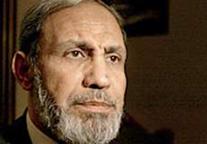 – July 7, 2005
Lekerev Report - A senior Hamas official threatened both open confrontation with the Palestinian Authority and continued attacks on Israel from Gaza after the disengagement, saying that Hamas had "lost faith" in Palestinian Authority Chairman Mahmoud Abbas (Abu Mazen).
In an interview with a local Gaza news agency, Mahmoud al-Zahar, a senior Hamas official in the Gaza Strip, said Hamas was not willing "to serve as a fig leaf" for PA control of Gaza following the disengagement, would not give up its weapons and was liable to continue bombarding Israel with mortars and rockets from Gaza after the disengagement "in order to liberate the West Bank and Jerusalem." However, other senior Hamas officials moved quickly to try to moderate the fears of civil war that Zahar's interview aroused among the Palestinian public.
Zahar, who gave the interview as Abbas was in Damascus to try and reach an agreement with Hamas' external leadership on various PA-Hamas disputes, warned: "The Palestinian Authority and Fatah need to know that what they are doing now is playing with fire. They will bear responsibility for ignoring Hamas and the [other] factions and for their insistence on managing the withdrawal alone. We will not serve as a fig leaf on this matter, nor will we allow it [the PA] to steal the achievements of the street and Hamas - the sacrifice of its [Hamas'] sons and its leadership to liberate the land of Gaza - just so that this land will be distributed to some individual or another."
He even hinted that Hamas would be willing to use force against the PA to prevent it from running Gaza after Israel's withdrawal: "Just as we did not accept the occupation of the land, we will not allow it to be allocated to anyone who did not play a part in liberating it," he said, referring to the PA. "The PA, which accuses itself day and night of corruption, cannot manage the population. They will encounter a determined street if they try to decide by themselves, and Hamas will never work with them."
Abbas
Meets Terror Chiefs in Damascus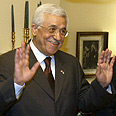 – July 7, 2005
Lekerev Report - Palestinian Authority chairman Mahmoud Abbas began talks in Damascus yesterday with Palestinian Islamist leaders, hoping to pacify terrorist groups before Israel's planned withdrawal from Gaza. Abbas was expected to meet Syrian President Bashar Assad today and had also scheduled talks with leaders of Hamas and Islamic Jihad .
Syrian Foreign Minister Farouk al-Sharaa, who welcomed Abbas at the airport, said Abbas' talks with Assad "will benefit the Palestinian cause and will also concentrate on a comprehensive and fair peace" in the Middle East. Shortly after arriving here for a two- day visit, Abbas met with Ahmed Jibril, leader of the Syrian-backed Popular Front for the Liberation of Palestine-General Command.
Alert!
Hamas, PLO To Move Offices to Gaza – June 27, 2005
Lekerev Report - Palestinian officials confirmed yesterday that leaders of Hamas and other Palestinian terror groups in Lebanon and Syria are planning to move to the Gaza Strip after Israel evacuates the area. The sources said Palestinian Authority officials have been urging Hamas leader Khaled Mashaal, who spends most of his time in Damascus, to consider moving his office to the Gaza Strip after the completion of the Israeli withdrawal. Mashaal's deputy, Musa Abu Marzouk, and another senior Hamas official, Imad al-Alami, are reported to have expressed their desire to move from Syria to the Gaza Strip.
Saudi newspaper Al-Watan reported over the weekend that PA Civil Affairs Minister Muhammad Dahlan, who is in charge of coordinating the withdrawal with Israel, has invited the Hamas leaders to move to the Gaza Strip. According to the newspaper, Dahlan's invitation came following US pressure on Syria to close down the offices and bases of Hamas and other Palestinian radical groups.
Dahlan is the "nice-looking young man" who has been touted in the west as a 'moderate' and someone to be trusted??? Now he's the one inviting Hamas and the PLO to set up shop in Gaza???? With the approval of top Palestinian Authority officials??? At the same time that we are told the Abbas is 'fighting' to keep control of Gaza out of the hands of Hamas??? It doesn't add up, friends. Like I've said before, a terrorist in a pin-striped suit is still a terrorist!
As-Safir Al-Arabi in Hebrew: No Dialogue With Israel - July 1, 2005
Lekerev
Report - In its June 21st edition, the editors of the on-line Egyptian weekly
newspaper As-Safir Al-Arabi (Arab Ambassador) felt it necessary to react
to the Israeli press' "falsification" in reporting about As-Safir's
new Hebrew-language edition. The self-described "independent newspaper
issuing from Cairo in 5 languages" published its  "clarification",
in Hebrew and Arabic, after one of Israel's leading newspapers, Ma'ariv,
claimed that As-Safir Al-Arabi intends to "increase understanding
between the Arab nation and the Israelis" and to thaw the cold relations
between Egypt and Israel.
"clarification",
in Hebrew and Arabic, after one of Israel's leading newspapers, Ma'ariv,
claimed that As-Safir Al-Arabi intends to "increase understanding
between the Arab nation and the Israelis" and to thaw the cold relations
between Egypt and Israel.
As Ma'ariv was quoting an Egyptian daily
for its story, the editors of As-Safir Al-Arabi begin their response by
expressing "respect for the editors of the Al-Masry Al-Youm
newspaper," but "utterly reject the misleading and inaccurate"
report in Ma'ariv. "But we are not surprised by the determination
of the Israeli media to adopt the way of falsification and misdirection,"
the editors wrote.
The weekly said its editorial line is
"adherence to Arab identity and commitment to the nation's principles, in
addition to absolute rejection of any dialogue, contact or normalization with
the Israeli side, especially in light of the continuation of the Israeli
policies that deny Arab rights and that are in opposition to international and
humanitarian law, in addition to the ongoing Israeli crimes against the Arab
peoples."
Immediately thereafter, however, the editorial
stated: "As-Safir Al-Arabi again emphasizes that it is interested
in opening channels [of communication] with all sides, and in opening bridges
of ideological and cultural closeness." Not "all sides",
exactly, as the editors then explained, "As-Safir emphasizes that
its interest is focused on those sides struggling for peace and that are
committed to international legitimacy, and also respect the humanitarian,
historical and diplomatic laws of all nations."
The pan-Arab weekly's June
5, 2005, press release announcing the Hebrew web site made it clear:
"The Hebrew edition of As-Safir Al-Arabi does not represent a call
for dialogue with the Zionist entity, or an initiative to thaw the frozen peace
process between Israel and the Arab states...."
Another
'Terror Tunnel' Discovered Today in Gaza – June 26, 2005
Lekerev Report – The IDF uncovered yet another tunnel this morning that had been dug from a Palestinian town in Gaza and led to a nearby Jewish settlement, raising fears terrorists planned to send suicide bombers to attack in the area.
The tunnel extended from the town of Khan Younis toward an industrial zone in the settlement of Neve Dekalim. It was discovered after the Palestinian Authority relayed intelligence information to Israeli authorities. Israel and the United States have been pressuring the Palestinian Authority to stop terrorists and weapons smuggling into Gaza towns.
The 20-meter tunnel, which appeared to be freshly dug, had meant to bypass a checkpoint to allow Palestinian terrorists to infiltrate Israeli territory, Israeli military sources said. The army plans to demolish it later today.
FAIR
USE NOTICE
This site contains copyrighted material the use of which has not always been
specifically authorized by the copyright owner. We are making such material
available in our efforts to advance understanding of environmental, political,
human rights, economic, democracy, scientific, and social justice issues, etc.
We believe this constitutes a 'fair use' of any such copyrighted material as
provided for in section 107 of the US Copyright Law. In accordance with Title
17 U.S.C. Section 107, the material on this site is distributed without profit
to those who have expressed a prior interest in receiving the included
information for research and educational purposes. For more information go to: http://www.law.cornell.edu/uscode/17/107.shtml